
From pastoral to demonic
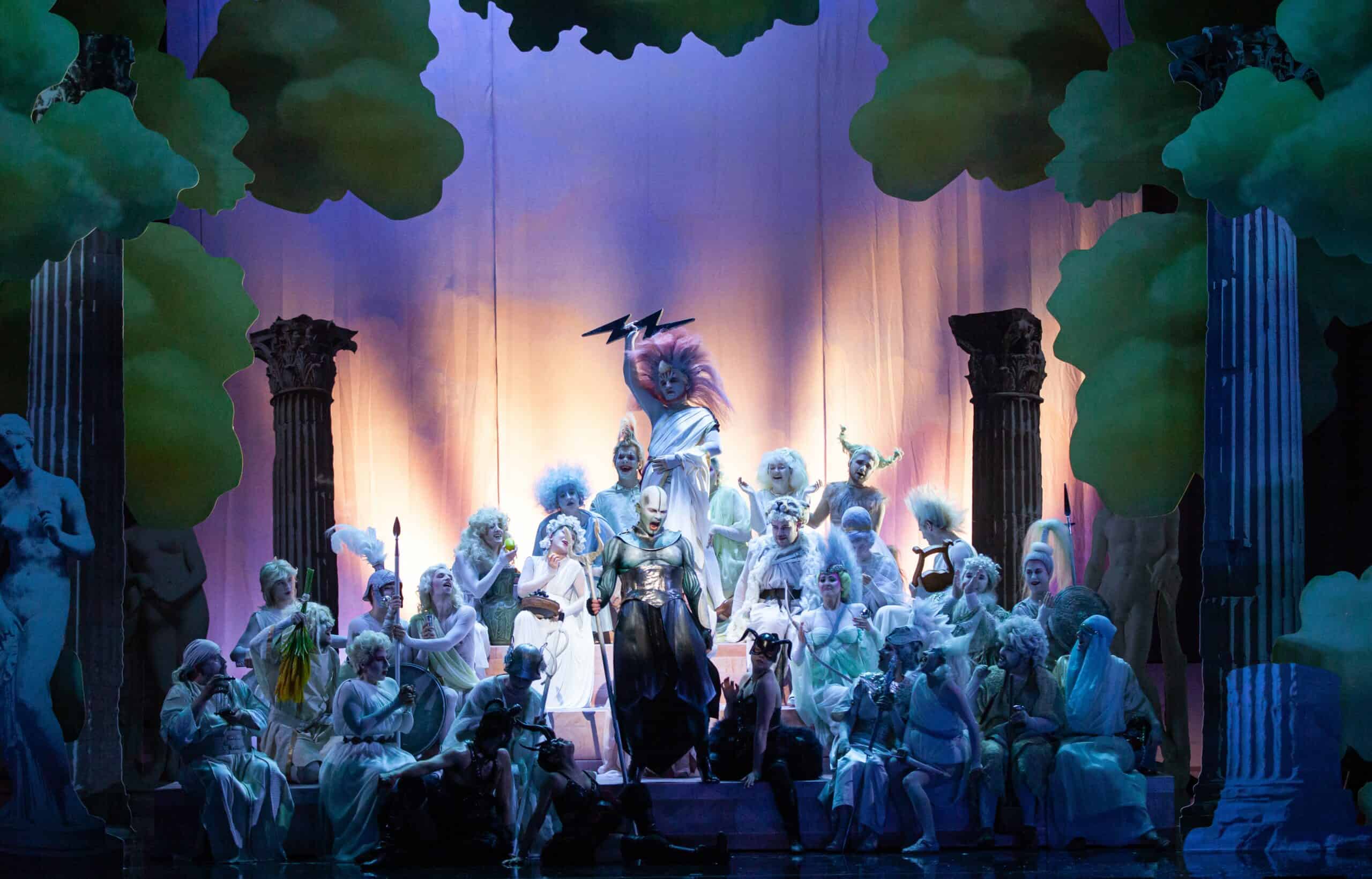
"Shameless, hilarious and a bit brutal". That is how Opera Zuid describes their new production in their program brochure. Opera Zuid plays the right card of parody and irony from the first scenes. L'Opinion Publique in chic cocktail dress and ostentatious may first point the audience to her role: approach the "ancient tragedy" with respect! That she may later reveal herself as a proud (!) drag queen is one of the topical allusions by director Benjamin Prins. The satire on "classical" opera (and art in general) becomes apparent as soon as the curtain rises for the first act and is nicely carried through to the end. The décor looks somewhat kitschy at first sight, but it refers to the decorative panels of baroque opera theater. Besides irony on ancient theater, it also offers the opportunity to quickly switch to the beautiful scene of Olympus with the gods in ridiculous robes and likewise hairstyles enthroned according to their ranks and then to the eerie black hellhole where Pluto imprisons Eurydice and the foolish little sheep from the beginning are absolute devils. In the last scene, the décor contains references to the arts of almost the entire Western history, from ancient Greek statues to a surrealist chess figure. Pluto looks eerie gothic and punk, Jupiter wields his "lightning bolt" at every turn. His appearance as a fly to be able to approach Eurydice shows as an "ancient" god his little flaws (me too is not far away) and John Styx (Olivier Hernandez) apparently gets to keep hell neat as a "technician" of Opera Zuid (logo on his t-shirt)! Indeed, at times hilarious! © Joost Milde © Joost Milde © Joost Milde © Joost Milde © Joost Milde


Double layer
Orphée is presented as a "classical" violinist, who has eyes mainly for his instrument (the violinist in the orchestra pit delivers a fine performance incidentally). As a nod to Gluck's Orphée, in the second part he literally quotes J'ai perdu mon Eurydice. As protagonists, Orphée and Eurydice remain representatives of the lyrical aspects of opera. Especially Eurydice has tender and nostalgic passages that contrast with the busy ensembles. The alternation of the fragments makes up the richness of the opera and emphasizes the double layer of the work: the caricature remains at the same time an opera of quality. We experienced this in Opera Zuid's performance. The performers are completely absorbed in their roles and play with enthusiasm. Amel Brahim-Djelloul sings Eurydice with a beautiful lyrical voice in moments full of melancholy but also with strength in her curiosity and resistance. Only the highest notes were occasionally a problem. Pluto (Mark Omvlee) had no trouble with his various tenor tones as her false and malicious seducer. The voice of Roger Smeets as ambiguous Jupiter lacked luster and he convinced more as an actor than as a singer. Thomas Morris clearly enjoyed himself as Opinion Publique. Enrico Delamboye conducted Philharmonie Zuidnederland with flair and finesse. The sensitive passages offered a welcome respite between the funny and lively moments. But the orchestra sparkled especially in the passages that sound rhythmically and rousing. The infernal galop and the cancan burst into the hall, where the audience on the same rhythm scandalized their exuberant and well-deserved applause! WHAT: Jacques Offenbach, Orphée aux enfers WHO: Benjamin Prins [director], Enrico Delamboye [conductor], Amel Brahim Djelloul, Mark Omvlee, Roger Smeets, Francis van Broekhuizen, Mathys Lagier, Thomas Morris Philharmonie Zuidnederland, Theater Choir Opera Zuid WHERE: Schouwburg Tilburg WHEN: Tuesday 23-5-2023More performances until 22 June see: www.operazuid.nl