
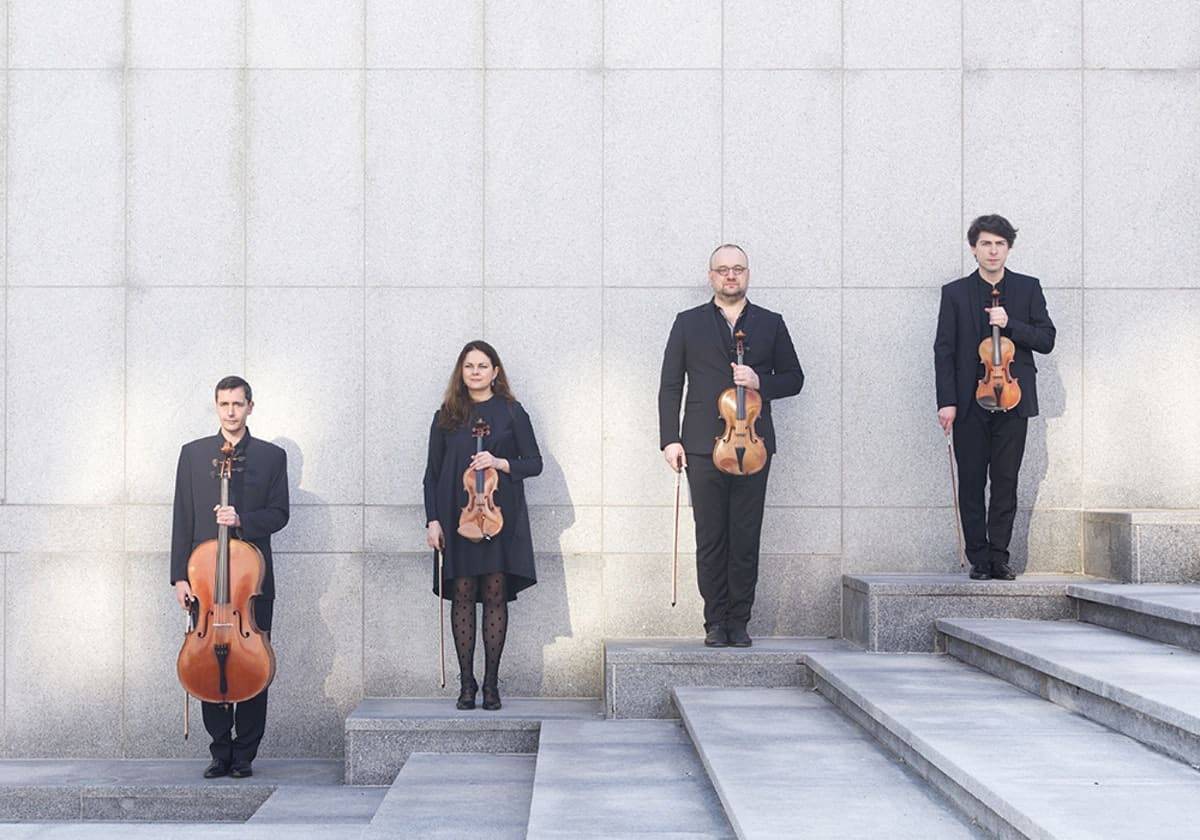
After the youthful 'turbulence' of the past two days, an established name took the stage today at the Brussels conservatory. Although. The Malibran Quartet made a fresh start earlier this year and presented itself at the Festival Midis-Minimes with two new members and … a coup de théâtre.
The concert began with the announcement that – due to unforeseen circumstances – the planned Trois pièces pour quatuor à cordes by Stravinsky were replaced by the nocturne from Alexander Borodin's second string quartet (1881). That was somewhat of a shame, since these three remarkable pieces rarely make it onto a concert programme. How different it is for the third movement of Borodin's second quartet (Andante), which, partly through its use in the musical Kismet (1953), or more recently also in the Disney short film The Little Matchgirl (2006), has become incredibly popular. A real crowd-pleaser then, and what a pleasure it was to hear the Malibran Quartet perform this wonderfully beautiful love duet as an encore. Cellist Guy Danel, an experienced hand at the beginning of a new chamber music adventure, had the privilege of being the first to sing that sweetly melancholic melody that crops up throughout the movement in all the parts. The response from first violin Tatiana Samouil was equally heartfelt and a harbinger of a Più mosso in which the newly appointed second violin Nicolas Dupont and viola player Tony Nys also poked their noses out the window with decisive crescendos. That was moreover a very pleasant constant throughout the entire concert: the determined way in which each of the musicians seized his moment and broke through the otherwise cohesive sonority when the composer prescribed it. Borodin's utterances certainly contributed to this.
Unexpected results
Prokofiev's second string quartet has quite a different character, written after his return to the Soviet Union. In 1941 the Soviet government decided that important intellectuals and artists had to be evacuated from the horrors of war. So Sergei ended up in Nalchik, in the northern Caucasus, where he became acquainted with the folk music of the Kabards. About this episode he writes in his autobiography as follows: "The Chairman of the Arts Committee in Nalchik said to us, 'Look here ... you have a gold mine of folk music in this region that has practically been untapped.' He went to his files and brought out some songs collected by earlier musical visitors. The material proved to be very fresh and original, and I settled on writing a string quartet, thinking that the combination of new, untouched Oriental folklore with the most classical of classic forms, the string quartet, ought to produce interesting and unexpected results." And that last point is the very least one can say. This is powerful music that is impossible to ignore. From beginning to end. In the virile Allegro sostenuto, the Malibran Quartet set the tone immediately: precise interplay between the different instruments, crisp accents, and a smouldering development that was rhythmically conducted with panache. In all the contagious enthusiasm, a dynamic marking was occasionally lost, but the brilliantly swelling climax made up for this entirely. "Un compositeur d'une grande finesse", so Guy Danel described Prokofiev to his colleagues at Musiq'3 (38:54), and it is this composer we also hear at work in the mysterious middle section (Adagio). Together with his chamber music partners, the cellist worked out the delicate harmonies to perfection. The Poco più animato, which can be understood as an undisguised scherzo, sounded delightfully sprightly. Finally, the dancelike finale (Allegro) was also fresh and lively, passing by like an alternately agitated and swinging perpetuum mobile: a winning combination of technical mastery and communicative ensemble playing.
'Oh la la la / Oh la la la / C'était magnifique'. Sometimes a short refrain from a crowd-pleaser from the early 1980s is enough to capture the prevailing feeling.
- WHAT: Sergei Prokofiev (1891-1953), String Quartet no. 2 in F (opus 92) || Alexander Borodin (1833-1887), String Quartet no. 2 in D – Notturno. Andante
- WHO: Malibran Quartet [Tatiana Samouil (violin), Nicolas Dupont (violin), Tony Nys (viola), Guy Danel (cello)]
- WHERE: Royal Conservatory, Brussels (as part of the Festival Midis-Minimes)
- WHEN: Wednesday, August 1, 2018
- PHOTO: © Tysje Severens