
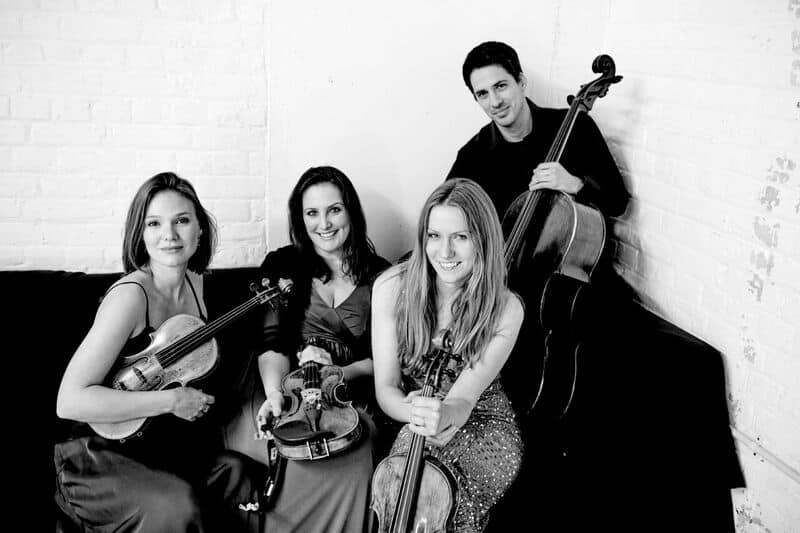
The music world brings like-minded people together in a wonderful way. Various festivals and concerts in the United Kingdom brought the Albion Quartet together. Forged through friendship, the quartet members came to the conclusion that the dynamics between them worked. Now Brussels is about to embrace the Albions for the very first time and the quartet is completely ready to return the favor to the audience. "The music of Dvořák is like a big warm hug!"
As an experienced newcomer to the international string quartet scene, the British Albion Quartet will perform as part of the MuCH music season of the Muziekkapel Koningin Elisabeth. MuCH stands for intimate concerts in the Studio Haas-Teichen, with an audience sitting close to the musicians while overlooking the Zoniënwoud. The season offers the general public the opportunity to immerse themselves in the heart of the Chapel as a musical laboratory and presents artists in residence, guest musicians and rising stars.
One of these artists in residence at the moment is Rosalind Ventris, the violist of the Albion Quartet. Next week, on Wednesday 24 January, this ensemble will perform a 100% Dvořák programme, partially assisted by Master in Residence Miguel da Silva. "We are all particularly enthusiastic about working with such a great musician and one of our string quartet heroes. Like winning a tennis match alongside an experienced player, opportunities like this allow us to really raise our game to the next level. By working with Miguel, we can learn so much. He has extensive experience with this repertoire and the string quartet genre."
It is a repertoire with which the Albions are building a specific affinity. The quartet will focus on Czech chamber music in the near future and will record four of Dvořák's fourteen string quartets later this year for the label Signum Records. For next week's programme, the ensemble chose two of his most beloved works, both written shortly after each other during the composer's successful three-year stay in the US: the joyful "American" quartet (opus 96) and the magnificent third string quintet (opus 97), sometimes referred to by the same nickname. "Dvořák's chamber music is among the finest ever written. Recently we have become interested in historical recordings of his work. Exploring these recordings offers an exciting new approach to his music during rehearsals. His music can be fresh, uplifting and warm-hearted and is rich in beautiful melodies. It has an elan and joie de vivre that we could all benefit from in this troubled world. It is like a big musical hug!"
An obvious opening question with your Brussels concert in mind: why should the audience come and listen to the Albion Quartet on 24 January?
Albions: Why should anyone go to any live concert? The thrill of hearing music live is like nothing else! We genuinely hope to provide people with a life-enhancing experience where they can lose themselves in the music and in the moment. What we will create cannot be replayed. As a quartet we strive for integrity. In this case, we have immersed ourselves in Dvořák's oeuvre and are working with Miguel, one of the greatest chamber musicians of our time.
Each of you has been active in chamber music for many years, but as an ensemble the Albion Quartet is still very young. At the same time, and despite being constantly in development, the sound of a string quartet needs time to mature. So it seems to me that when forming a new quartet you have to work harder than other, more established quartets …
Albions: We are indeed working hard to build our repertoire. This is a challenge. But looking at it positively, we find that we all have quite a bit of chamber music experience already. In many cases, we have already worked on our quartet repertoire in previous ensembles or we have already played a lot of chamber music by the composer we are working with as a quartet. We also have a clear idea of why we play together and what we want to achieve as a group. Our common vision is to bring the composer's musical ideas to life. This means many hours of rehearsal, discussing ideas and trying out new ways of working, but also being spontaneous during a concert. The working hours allow us to convey that flexibility and trust on stage as well.
What are the most important qualities a string quartet must possess?
Albions: A few words come to mind immediately. Humility. Focus, for example in intonation. We are constantly refining and exploring intonation and timbre. Also open-mindedness and, of course, willingness to listen – in the same way a painter looks.
As a string quartet you try to speak with one voice, but each member also wants to maintain his independence and challenge his fellow players. How does this difficult balancing act work in practice?
Albions: Watching and listening to a four-way dialogue is, in our view, one of the unique qualities of quartet playing. If one voice in the ensemble is missing, the magic is lost as well. It is our task to find a perfect balance among ourselves and to listen extremely carefully to our three fellow players and to adjust our volume. Sometimes the composer asks us to play independently, as a soloist, and to take the others along. But in the next phrase it may be that we have to shed our individuality and make sure to integrate our part into the whole to create a new colour.
None of these nuances will be noticed by the audience if one of the four musicians fails to do their part. As a member of a quartet you learn early on that on stage only a collective vision counts. If you don't do that, you're left with musical nonsense: a loud cacophony of incomprehensible words …
Following this, a violinist once told me that musicians in a string quartet must concentrate first and foremost on what happens so to speak 'in the middle', rather than focusing on their own part. Especially during concerts, it also seems to me that individuality is subordinate to a coherent sound, whereas this can be the reverse during rehearsals. How does the quartet think about this?
Albions: We agree. We often rehearse in a cross formation – contrary to the traditional concert setting – and talk about creating a sound literally in the middle of the formation. We always try to listen to the overall sound. During concerts an audience joins in, which provides extra magic. It works both ways: we feed off their energy and they off ours.
A very personal question to conclude: which string quartet in the repertoire is the most touching? Of course, tears of joy are also possible …
Albions: We all have a soft spot for the slow movement (Adagio ma non troppo) of Beethoven's "Harp" quartet (opus 74). We all felt something particularly special on stage when we played this piece for the first time, at the end of a festival in France where we were in residence, the Sainte-Mère Festival. But the entire string quartet repertoire is something you always want to explore again because of its rich tonal world. When you nourish yourself on the language of any great composer, you always want more.
- WHAT: interview with the Albion Quartet on the occasion of a concert that the quartet will give on Wednesday 24 January 2018 in the Muziekkapel Koningin Elisabeth together with Miguel da Silva. The programme is entirely built around Dvořák and combines the famous "American" quartet (opus 96) with the composer's third string quintet (opus 97). Tickets are still available and can be purchased via this link.
- WHO: Albion Quartet [Tamsin Waley-Cohen (violin), Emma Parker (violin), Rosalind Ventris (viola) and Nathaniel Boyd (cello)]
- PHOTO CREDITS: © Steve Gullick & Muziekkapel Koningin Elisabeth
- WEBSITE: http://www.albionquartet.com/
- LINK: click here to read the original text in English ...