
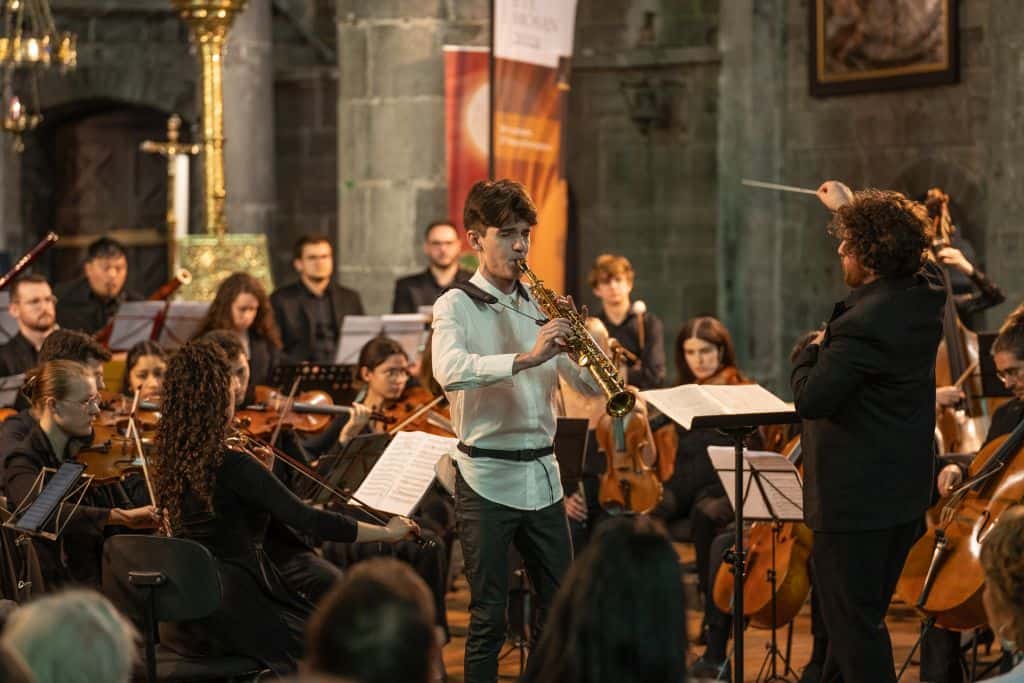
You don't know Dmitry Pinchuk yet, unless you happened to read or hear something about him, or unless you were present at the Adolphe Sax Competition (Concours International Adolphe Sax) in Dinant which he won in November 2023, or you attended the concert of 13 July 2024 in the collegiate church in the same city.
Now you're reading about this young saxophonist and it can only mean that from now on you will do everything in your power to hear this currently just 18-year-old as soon as possible live and / or on a recording. Because it 'must'. Why 'must' that then? Because this refined, thoughtful, somewhat shy, quiet young man who has just outgrown puberty gives the saxophone a new dimension and makes it a fully-fledged instrument for the classical repertoire. He does much more than that. He performs at the highest conceivable level and actually you can ask the question: is that thanks to his love for this instrument or is the saxophone simply the instrument he uses to make music to the fullest? Whatever it may be, he is a top virtuoso, he has an unparalleled technique and that virtuosity and technique are in the service of an uninhibited musical insight. He phrases exceptionally beautifully and broadly, you feel like singing along, even dancing to what is admittedly not such an inviting score. Do you really see anyone dancing to the violin concerto of Jean Sibelius or hear anyone singing along with it, let alone humming? No, you don't.
From the first sounding notes it is clear: this performance will transcend everything, this is no longer just music, this is so much more. Pinchuk delivers a performance with this interpretation that pushes many top violinists into the corner. He colours the work very richly, places perfectly balanced breaths – breathing, where does this very finely built young man get all that air from? – builds up, puts down and gives goosebumps. Yes, it can be said and written: "I was there". A historic musical moment? Certainly, and this assertion is in no way exaggerated.
The bravos and the standing ovation were not lacking. Conductor Gabriel Hollander and the organization Eté Mosan made the very best possible choice by programming this young Russian who in his own way will conquer the musical world. That is allowed, oh yes, that is allowed.
We do not forget the Etesiane Orchestra in this. It played like the better professional chamber orchestras, partly 'swept up' in the leading broad musicality of the young soloist. The church was filled with a wealth of sound that is imprinted in the ears of all listeners and will never leave them. Already at the preceding dress rehearsal we heard what the audience would be offered. Besides Sibelius, that was a warm performance, in a broadly taken tempo, lyrical, full of drama and grand sound of Beethoven's Egmont Overture which was followed by the delightful Italian Symphony No. 4 by Felix Mendelssohn. Hollander drew one long connected arc through this work with his orchestra, a work that has captivated the public and given them pleasure for almost 200 years now.
On the sidelines of this concert we learned that the young soloist, the day before the concert, was on the road for many long hours due to various travel delays and other flights, and that the airline lost his luggage. So he missed the first rehearsal with the orchestra, which meant that only one rehearsal, namely the dress rehearsal in the church itself, took place. It is certainly noteworthy that he was unanimously chosen, even before the results of the saxophone competition were announced, to be the selected candidate for Eté Mosan who would be invited as soloist. The fact that he won first prize was all the more nice as a bonus.