
On Wednesday evening, December 10, the Henry Le Boeuf hall at Bozar transformed into a space where sound and imagination met in an extraordinary way. The Orchestre Français des Jeunes (OFJ), which annually brings together young French musicians for innovative and ambitious projects, took the stage with curiosity and musical passion under the baton of chief conductor Kristiina Poska. Since January at the helm, Poska gave the evening a unique character. The concert was the first calling card of a new artistic phase, in which the orchestra presented itself with freshness and individuality.
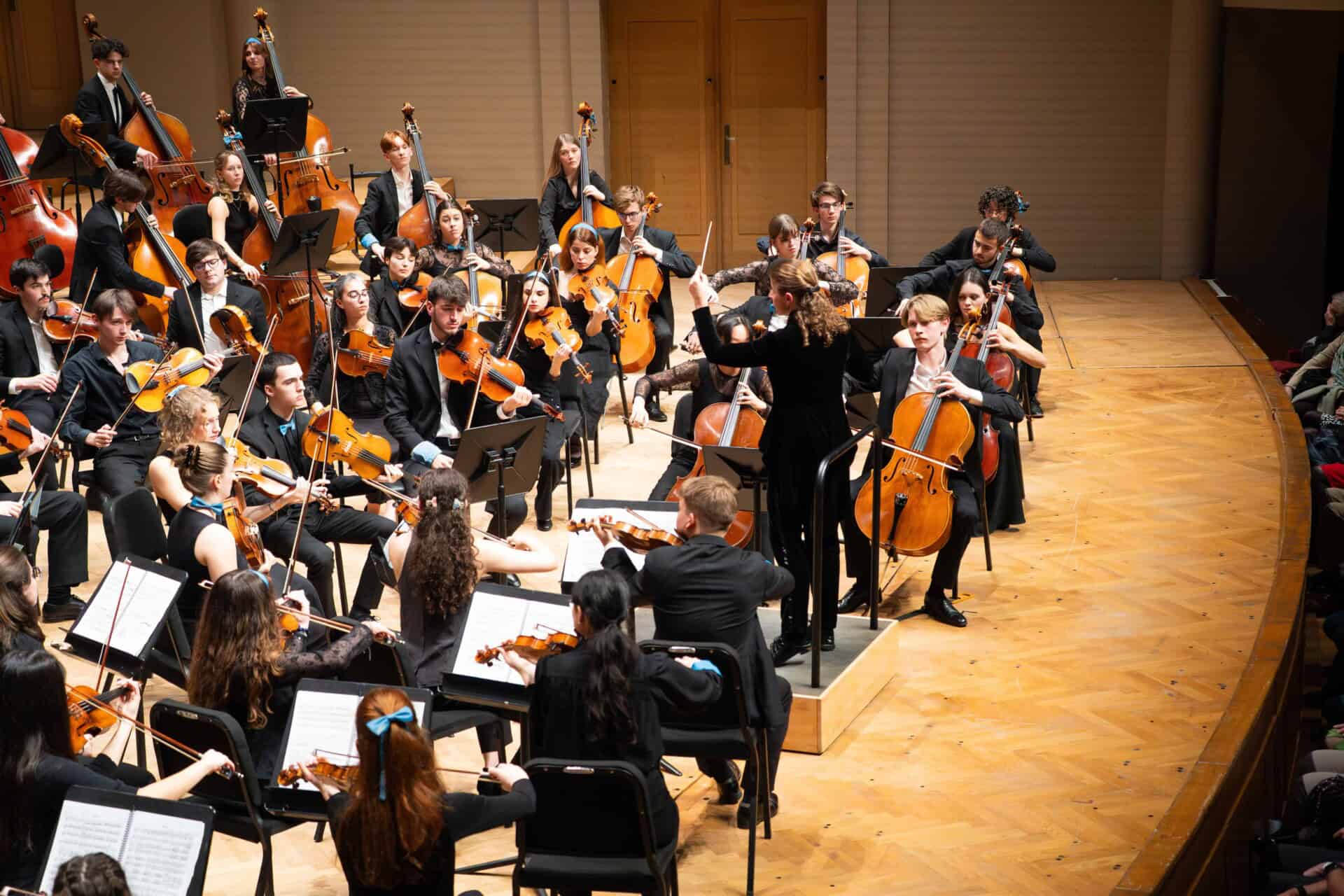
On stage, each musician wore a blue accent – in their hair, as a bow tie, on a cuff or even on the instrument – as a playful nod to "les Bleus". The orchestra wanted to bring color and joy, and it succeeded wonderfully: the subtle blue caught the eye without ever being conspicuous. The effect was both elegant and exuberant, a visual echo of the sonorous energy. And as for the sound? After this concert, it is beyond question: the OFJ plays effortlessly in the same highest echelons as the French national team.
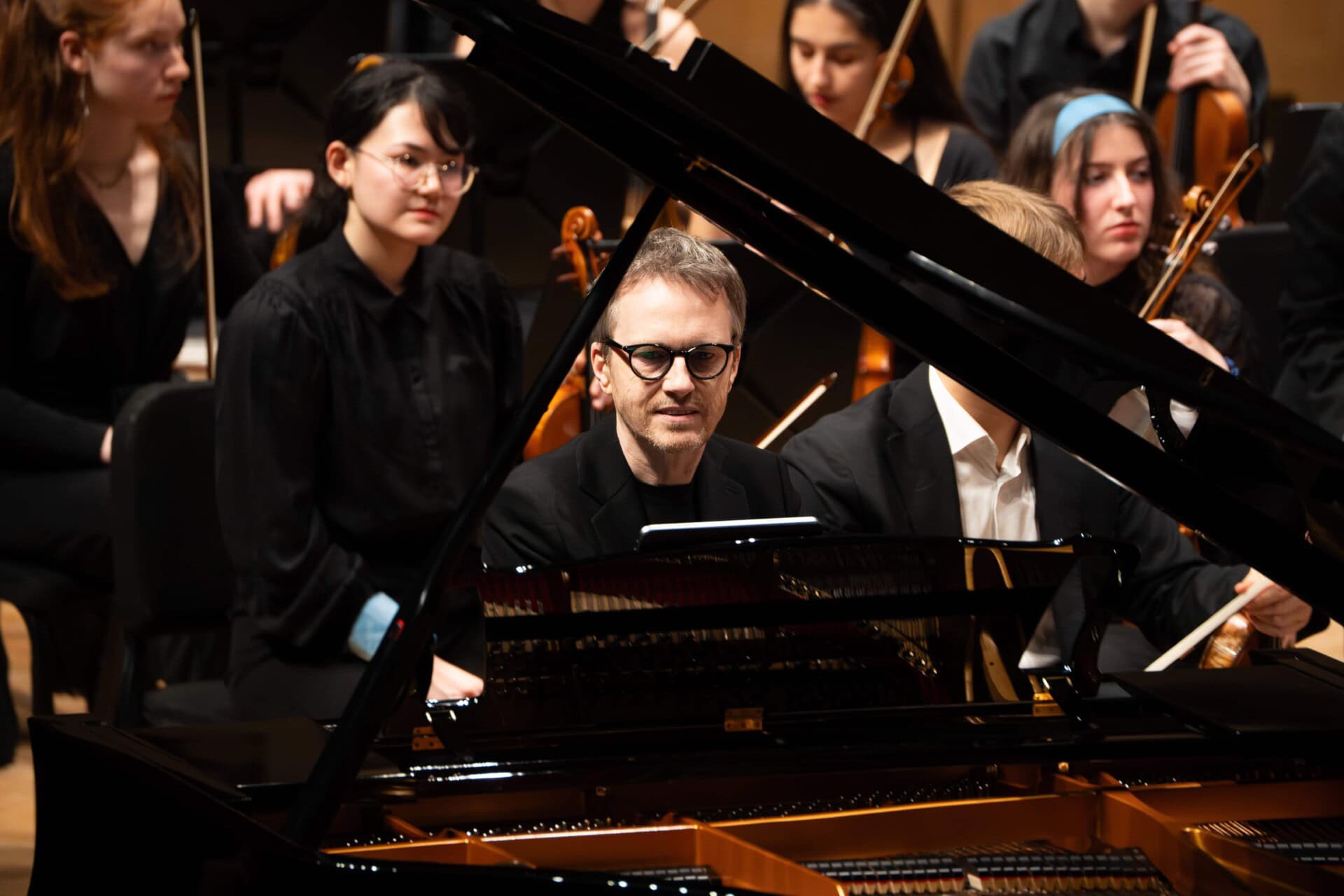
Star pianist Alexandre Tharaud joined the young ensemble as soloist, and together they created a dialogue of color, nuance and lyricism that made the evening a compelling and poetic experience.
Maresz – A landscape of sound and daring
The concert began with Recto by Yan Maresz (born 1966), a work that immediately set the tone: contemporary, abstract and refreshingly innovative. Maresz' music demands active listening. It moves in layers and dynamic textures and requires of the performers utmost precision and creative freedom. In his oeuvre, Recto is considered a key work, a study in sound space and rhythmic friction that continuously kept the listener on edge.
From the very first note, the OFJ performed remarkably well. The strings wove vibrating textures, while woodwinds and brass sent fragile sonic gestures into the hall. The interplay felt like a well-lived conversation in which every nuance mattered. The performance breathed concentration: continuous eye contact, sharpness in the ensemble and double basses that visibly radiated joy as the beating heart of the whole. One subtle hand gesture from the conductor was enough to cause a complete dynamic shift – that's how responsive the orchestra was.
The ensemble showed remarkable alertness: every breath and rhythmic shadow seemed carefully thought out, while the young musicians moved with ease through the abstract sound landscape that Maresz had outlined. The audience seemed to experience that tension, as if the hall collectively held its breath and exhaled again with each sound shift. The program notes stated that Recto was originally written as ballet music – an intriguing detail, as the quirky meter and unpredictable textures seem more likely to resist choreography. Though Stravinsky's Sacre was once also called 'undanceable'.
The composer, present as artist in residence of the OFJ, came to thank the orchestra after the performance, visibly pleased. That an orchestra during a tour takes music of its own soil with it and does not walk the well-trodden paths deserves admiration. Thus Recto became more than an opening work: it became a statement, an invitation to listen to the new with open ears and convincing proof of the maturity and ambition of this young orchestra.
Shostakovich – Smile, play and clarity
Then Alexandre Tharaud took the stage for Dmitri Shostakovich's (1906-1975) Second Piano Concerto, a work that radiates lightness and irony, with a hint of youthful bravado. Tharaud played with natural nonchalance: his fingers danced across the keys, soft and lyrical in the introspective passages, playful and rhythmically sharp in the scherzo-like sections. From the very first measures, it was clear that more than a stylish performance was taking place. The combination Tharaud–Poska–OFJ proved to be an exceptionally happy one: soloist, conductor and orchestra formed a triangle of obvious unanimity, as if all saw the same comic wink flash up in the score.The programmatic choice to switch from a contemporary sound experiment to Shostakovich's transparent clarity worked surprisingly well. The transition felt like a relaxation of the ear, without losing intellectual sharpness. Where Maresz' Recto kept the audience on edge, Shostakovich offered musically clarifying daylight: not less complex, but more playful, with an open, almost chamber-like lightness.
The collaboration between soloist and orchestra was organic from the start: a conversation in which space was given and in which every phrasing and every sound mattered, down to the smallest details. The orchestra responded with remarkable sensitivity. Strings and woodwinds followed the piano lines with attentive breath, while brass and percussion added fine accentuations. In the first and last movements, the rhythmic accuracy was particularly striking: the woodwinds sparkled, the rhythm bounced, and the young musicians visibly delighted in the quick turns and ironic accents that Shostakovich had hidden in the score.
The slow middle section, often called the heart of the concerto, achieved a truly moving depth. The strings sounded intense, breathing broadly and unexpectedly mature: a sound that not only touched Shostakovich's lyricism, but also offered a moment of hushed beauty after the playfulness of the outer sections. Tharaud played here with an almost vulnerable clarity, soft but sure, as if he let every note glow for a moment without excess.
The balance between soloist and ensemble was perfect, allowing the concerto to retain its charm and humour until the very end, without the youthful energy of the orchestra getting in the way. Moreover: that energy proved to be precisely the element that made the score blossom. The visibly shared pleasure of Tharaud, Poska and the OFJ translated into a performance in which all the puzzle pieces fell effortlessly into place – streamlined, playful and with a self-evidence that only arises when musicians completely trust each other.
As an encore, Tharaud played – after a playful quip about his forgotten glasses at the beginning of the concerto – a touching, deeply felt Sicilienne by Johann Sebastian Bach (1685-1750). With this, he underscored once more why he ranks among the most refined pianists of his generation.
Rimsky-Korsakov – Sheherazade: A tale in sound and fire
The final piece, Sheherazade by Nikolaj Rimsky-Korsakov (1844-1908), spread a lavish tapestry of sound across the hall. From the opening bars, Nicolas Debart, the solo violinist, took on the role of storyteller. His tone possessed a remarkable maturity, devoid of effect-seeking and carried by natural phrasing: warm and transparent at once. This made him not only the narrator, but he seemed almost to embody Sheherazade herself. His phrasing whispered and seduced, holding the audience to his words, as if he were whispering a story personally to each listener. Whenever Sheherazade's main theme returned, it sounded not like repetition, but like a new twist in the tale – subtly different in colour and intent, as if Debart unfolded the story more deeply with each return.
Poska's influence was strikingly visible here. With energetic but never coercive gestures, she drove the orchestra forward, while her emphasis on narrative clarity and lyrical phrasing resulted in a performance that was both dramatically articulate and transparent in its sound construction. The orchestra responded with an intensity that would put many a professional ensemble to shame: steely playing, razor-sharp entries and a glow that was palpable throughout the entire hall. The precision with which the young orchestra breathed and turned as one organism was utterly remarkable; each section seemed intuitively to sense what the others needed.
The strings undulated like warm waters, woodwinds sparkled like sunlight on the water, and brass shone in dramatic peaks without ever overpowering the strings. The harp, brilliantly played by Hélia Tahmasebzadeh, scattered twinkling pinpoints of light like stardust. The interplay between Debart and Tahmasebzadeh was positively wondrous: every dialogue felt organic and breathing, as if both musicians together were tracing a shared story. Equally impressive was the refined interplay with solo cellist Eugène Paques, who cast a darker, almost introspective light on Sheherazade's tales.
In the third movement, the orchestra sounded perhaps at its finest. Woodwinds found a crackling yet refined balance, and Debart carried the narrative with a sober intensity that is rarely delivered with such concentration. Here the music reached for the heart: not through grand gestures, but through the unforced eloquence of both soloist and orchestra. The soul of the work – that mixture of threat, desire and imagination – came to expression here in an inimitable way. Towards the end, Poska held the dramatic arc flawlessly taut: not a trace of bombast, but a majestic conclusion that kept the listener on the edge of their seat.
It became a performance in which all the tales, colours and characters of Sheherazade became tangible, carried by a soloist who grew into a true storyteller and by an orchestra that played with a maturity and musicality that are exceptional for an ensemble of this age. More than that: this Sheherazade revealed not only the narrative power of Rimsky-Korsakov's music, but also the impressive artistic potential of the OFJ itself.
Bernstein – Candide as a delightful finale
After the impressive conclusion of Sheherazade, the OFJ ended the evening with an encore of the highest order: the Candide Overture by Leonard Bernstein (1918-1990). From the opening bars, a rhythmically charged energy burst forth. Strings, woodwinds and brass functioned as one cohesive, breathing whole, while Poska drove the orchestra forward with infectious precision and playful fire. The result was a performance that immediately brought a smile to the audience's face and put the hall in a festive mood.
The rhythmic pace and light-footed irony of Bernstein were translated by the orchestra with utmost alertness: every detail was delivered sharp and rhythmically flawlessly, while the musical lines remained fluid and clear in sound. Sparkling woodwinds, energetic brass and the unmistakable drive of the percussion melted together into a vibrant soundscape in which nothing clashed, but everything moved towards a shared climax. The orchestra clearly relished the virtuosic and ironic turns that make Bernstein's music so irresistible, and the audience let itself be swept along eagerly.
As a finale, this encore number worked as an explosion of musical joy: a perfect balance between technical virtuosity, rhythmic sharpness and playful theatre. The OFJ showed here that it possesses not only impressive depth and seriousness, but also an irresistible sparkle and spontaneity. The Candide Ouverture thus became a radiant final chord that brought the evening to a close in a light, energetic and musically pleasurable way.
And yet the concert was not quite over. As the icing on the cake came an extra outburst of enthusiasm in a piece arranged by the musicians themselves. They stood up, moved around each other, danced and visibly came alive with every note. That exuberant pleasure was contagious: the audience was completely swept up in a shared release of sound and movement. The arrangement, brought to life by the young musicians themselves, filled the hall with a bubbling, irresistible euphoria — a celebration of music, play and pure joy of life.
Young talent, freshness and hope
What made this evening special was the daring: the daring of young musicians, of adventurous programming and of performances that did not shy away from taking risks. The programme testified to a thoughtful dramaturgy – from abstraction to emotion to imagination – and unfolded as a musical journey in which fire, musicality and spontaneity were central.
In the three works, the orchestra showed itself from a different angle each time: sharp and exploratory in Maresz, playful and lyrical in Shostakovich, and rich in colour and narrative imagination in Rimsky-Korsakov. Poska's conducting gave direction without forcing, with room for breath, nuance and sound. The interplay between soloists and ensemble felt organic and lively: this was an orchestra that visibly made music with pleasure and conveyed that pleasure convincingly to the audience.
If this concert is a harbinger of what we can expect from the OFJ under Poska, then the tone is unmistakably set: demanding, adventurous and deeply musical. Within a rich and diverse concert programme, this was an evening that continues to resonate. Hopefully the orchestra will return to Belgium soon, because anyone who gets the chance to hear and see these talented musicians at work should not let that opportunity pass.
This evening at Bozar confirmed that the OFJ is much more than a training orchestra. It is an ensemble that dares, grows and explores colours and nuances with acuity. In a time when classical concert halls often offer comfort and predictability, here stood an evening of freshness, poetry and promise. Youthful energy, guided by vision and confidence, sounded here not only hopeful, but utterly convincing – a celebration of music, talent and the future.