
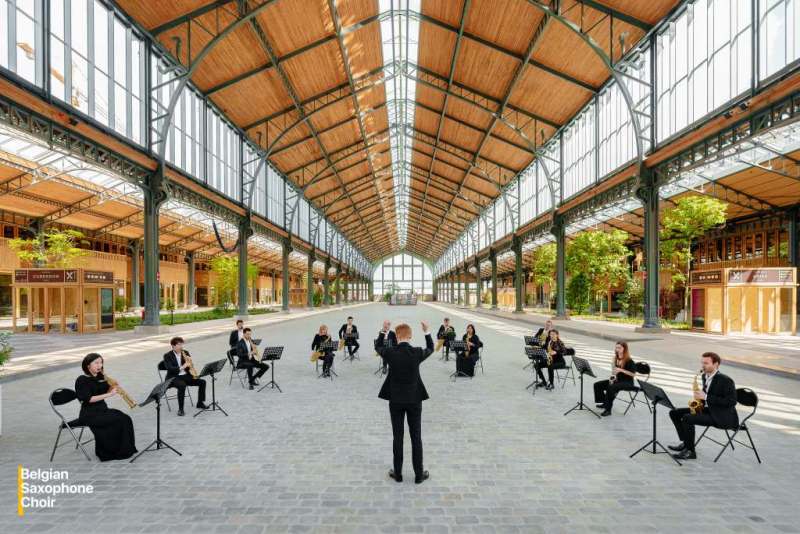
It was a lucky hit. The day I received a book for review about the history of the 19th-century music class of the Brussels conservatory, I also received an invitation to attend the video recording at Tour & Taxis of the first CD that the Belgian Saxophone Choir-BSC wants to launch in May.
So even today there is still plenty of interest in an instrument that "our" Adolphe Sax invented more than a century and a half ago and began to produce on a large scale in his Paris instrument factory. In our own country, the musical world apparently saw little in it.
Yet in 1867, a "saxophone class" started at the Brussels Conservatory. It is the history of this class that Kurt Bertels addresses. There sounded "An Unheard Sound." That is also the title of the book. It is the dissertation with which the author obtained his doctorate in the arts at the VUB. It is a book by a scholar but also by a practitioner, by a renowned saxophonist. And that guarantees a thorough and empathetic story about that fascinating period: the discovery of a new instrument, how and by whom it became established and institutionalized, and which composers saw potential in it. In the context of early music it has become evident, but here it may sound a bit odd: the author also searches for what "historically informed performance practice" can mean for the saxophone. He describes in detail how this concept took shape in the past century and how he too learned from it to be able to apply this conceptual framework to that 19th-century saxophone repertoire.
The 19th-Century Saxophone Class of the Brussels Conservatory
From 1867 until the closure of that class in 1904, the Brussels Conservatory played a pioneering role, also assisted by the founding of the Muziekkapel der Gidsen. An explicit wish of Leopold I, who had been greatly impressed by the music chapels at various royal courts. He appointed his own kapellmeister Valentin Bender as person in charge. And that Bender had been a teacher of Adolphe Sax. No wonder then that he introduced the instruments that his former star pupil later invented in his military music chapel. It was in this context that the idea arose to add a saxophone class to the curriculum of the Brussels Conservatory. A detailed description follows of the work of Nazaire Beeckman and Charles Gustave Poncelet, the first two saxophone teachers of the Brussels Conservatory (both clarinetists in the military music chapel), of their students, their didactic methods and their compositions. The saxophone oeuvre of Beeckman is discussed in the book under the questioning title: 'Brussels salon music?' That on the work of Paul Gilson is given the title "Father of the Saxophone Concerto". As a non-saxophonist, he wrote the very first "concerto" in the world in which the saxophone indeed rivals the rest of a symphonic orchestra. It marked the professionalization of the saxophone as a solo instrument. Bertels tells a fascinating story about the rediscovery of the autograph of this concerto, which made it possible for that piece to be recorded in its original version only last year. A world premiere. Gilson also composed a second saxophone concerto. That too was technically virtuosic.
Searching for a Historically Informed Saxophone Practice
Kurt Bertels adds an artistic reflection to this historical narrative. It forms a separate chapter of "applied musicology" and concerns musical practice. And in this too, the author is driven and skilled. How could it be otherwise if you have been playing the saxophone since childhood? And to study that historical performance practice, he himself learned to play on such an old alto saxophone 'Buffet-Crampon', a beautiful specimen from 1898, sought matching mouthpieces and searched for historical recordings, studied the customs of the time regarding playing postures, fingerings, pitch standard, vibrato... it all forms part of his "saxological investigation into a historically informed performance practice." Certainly a goldmine of information you will find here. Yet he did not search for the truth, but for the possibility of reconstructing that sound idiom and that practice, with attention also for that earlier repertoire. It was a learning process that resulted in two CDs: The Saxophone in 19th Century Brussels and Works for Saxophone and Orchestra by Paul Gilson, released last year on Etcetera Records.
You can only admire not only the scholar in Kurt Bertels but also the performing artist who undertook and completed this work "out of artistic inner necessity."
The Belgian Saxophone Choir-BSC
Someone else who admires Kurt Bertels is Wouter Versavel, saxophonist, responsible for artistic direction and conductor of the Belgian Saxophone Choir-BSC. He encountered Kurt Bertels for the first time on the train and throughout the entire journey they talked of nothing but the saxophone. "I was enormously impressed. And that was even before he wrote his doctorate. He is a person with a vision. Very clear in his ideas. He brought that entire Belgian saxophone story to light and also applied the idea of historically informed performance practice to the saxophone. Nobody has ever done that before, right up to those new recordings with the Symfonie Orkest Vlaanderen. We, however, play only with modern instruments and bring classical and contemporary repertoire.
The 19th-century saxophone oeuvre of Paul Gilson is beautiful, but as a beginning conductor I would very much like to discover and learn the great classical composers, and I do that by writing arrangements and transcriptions for the BSC of those well-known works by Dvorak, Strauss, Wagner. And that is an enormous challenge for us, to make that repertoire our own. Everyone knows the Siegfried Idylle but hearing it performed with that entire range of instruments from Adolphe Sax, with all the diverse timbres of all our saxophones, that certainly brings a wonderful colour."
The Belgian Saxophone Choir-BSC is a young ensemble of mainly students and graduates (between 20 and 30) that wants to grow and flourish. It regularly organizes auditions for their "pipeline ensemble". In this way they also want to expand and stimulate the saxophone landscape internationally. After a first concert in 2019 in Antwerpen and a few other projects, a CD project is now being prepared for the first time, "Serenade". Due to current corona measures, they will stream that programme on 15 May. I met them when they, fourteen in number, were making video recordings in the beautifully renovated halls of the Brussels Gare Maritime of Tour & Taxis for that first CD. The fresh and green surroundings of the halls should give that video and the saxophonists a young and open appearance and that suits them perfectly. Here no historical instruments but gleaming modern saxophones.
Their artistic director and conductor Wouter Versavel, now 25, once began with classical guitar, but when he blew a note from a saxophone one time, got to hold that instrument, he was so fascinated by that sound and fell in love with that beautiful "golden" instrument that the switch was made quickly. He is now still studying orchestra direction at the Lemmensinstituut. How do they do it? The BSC can continue to exist partly thanks to the support of the Flemish government, the Nationale Loterij and sponsors from major brands in their field such as the Paris saxophone manufacturer Selmer and D'Addario, a manufacturer of reeds and other accessories.
It is Dries Meerts, responsible for business management who must keep the ensemble financially and organizationally afloat. After all, he is also co-founder of the ensemble. A few years ago, at the beginning of his studies at the Conservatorium Antwerpen, he complained together with colleague Andrea Van Acker that there was so little contact between classical saxophone students at the various conservatories. And they wanted to remedy that. After all, we will eventually become future colleagues and it is better to stimulate each other than to compete, they thought. And so it happened, to create a central point where they can find each other and make music. Not immediately a "national saxophone orchestra" but a Belgian saxophone ensemble nonetheless.
On 15 May at 20:00 you can hear them online with their new CD "Serenade". Keep an eye on their website and social media and click on the link when appropriate. You will be surprised.
- WHAT: Kurt Bertels, "Een ongehoord geluid. De saxofoonklas van het Koninklijk Conservatorium Brussel tussen 1868 en 1904", VUB Press, Academic Scientific Publishers, Brussel, 2020
- WHAT: Belgian Saxophone Choir, artistic direction Wouter Versavel, business management Dries Meerts
- WHERE: video recording and photo shoot at the Gare Maritime, Thurn & Taxis, Brussel, 16 April 2021 for CD recording of "Serenade". Release in May, streaming on 15 May 2021
- WEBSITE: Belgian Saxophone Choir
- PHOTOS: Glare Agency, Aulos, VUB Press