
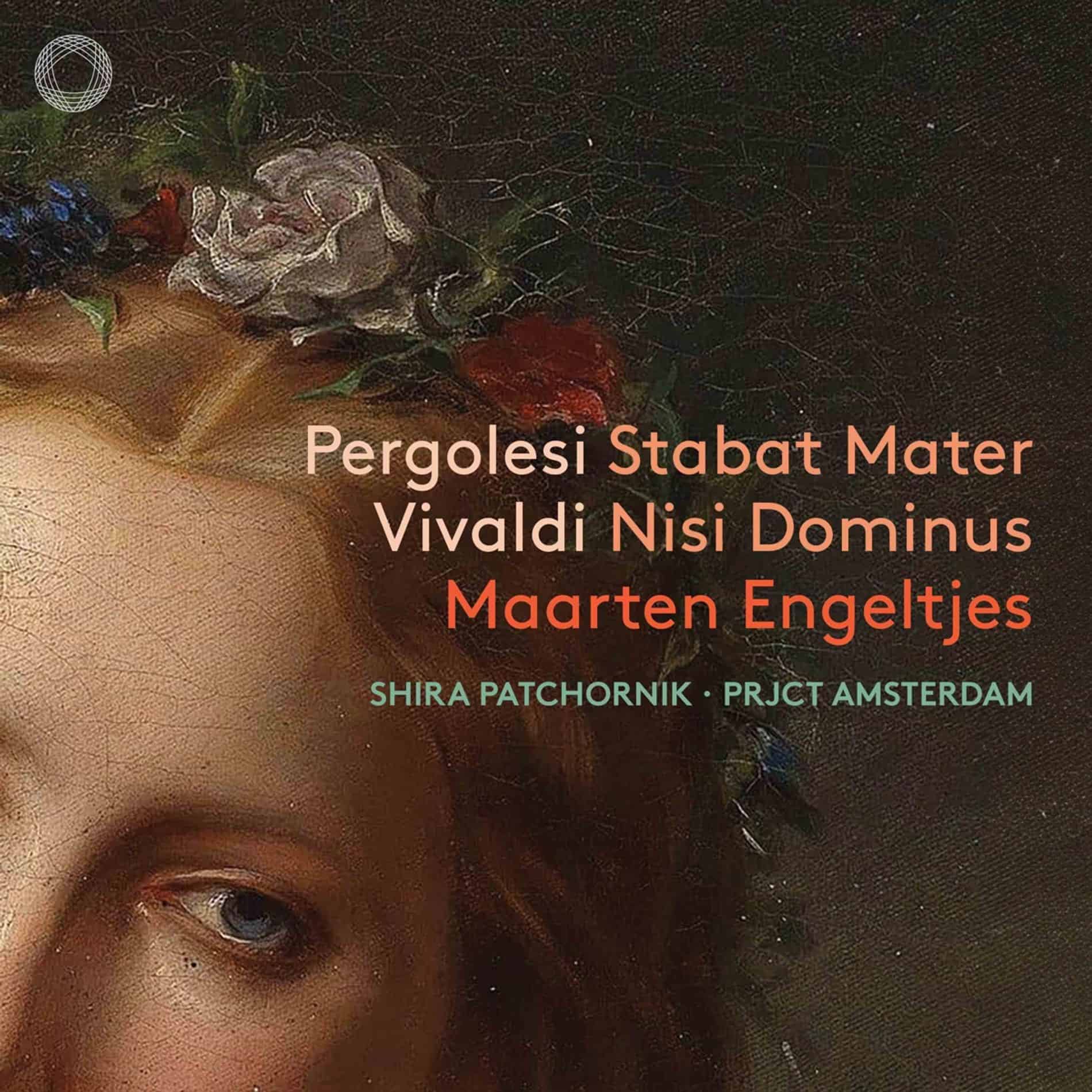
From the PRJCT Amsterdam led by countertenor Maarten Engeltjes, three albums have been released so far, with the third and also the last one now appearing for the first time on the Pentatone label. A debut that has success on its side, because this release proves to be a bullseye, especially due to the combination of craftsmanship, textual visualization and commitment. In the commentary written by Engeltjes himself (also in Dutch!) this latter aspect is expressed in the way he addresses the deeper meaning of the Stabat Mater:
'A woman who buries her husband is called a widow, a man left behind without his wife is called a widower. A child without parents is an orphan. But what are the father and mother of a dead child called?' Words from the book Schaduwkind by Dutch novelist P.F. Thomése. But there was nothing made up about this story, it had happened to him and his wife: they had lost their first child shortly after birth. Reading this immediately made me think of Pergolesi's Stabat Mater. Mother of all mothers, Maria, must witness the suffering and death of her son Jesus. We share in her despair and grief. Hundreds of composers have been inspired over the past eight centuries by this emotional Latin poem, whose author nobody knows. Perhaps that is also good. Thus this tree of words could continue to branch out over time.'
Over the course of time, the Stabat Mater has acquired a more universal meaning, as a monument that stands as a symbol for all those mothers (but also fathers) who have lost a child and the indescribable suffering this brings. Engeltjes then makes the connection between his love for his two sons ('the deepest feeling I know in my life') and the dolorosa of the mother (in the Stabat Mater the Holy Maria) which thereby becomes very close. Adding that Protestant Netherlands (I myself would prefer to speak of the Protestant part of the population) has traditionally had little use for Maria, that around Easter Bach's Matthäus-Passion is placed on a pedestal and of which the sacrifice of Jesus forms the central theme. Whereas in the Stabat Mater the gaze is directed downward, toward the foot of the cross, toward the mother.
Engeltjes then refers once again to Thomése, who in Schaduwkind sought a new language to be able to describe his experiences and feelings. As the merely 26-year-old Giovanni Battista Pergolesi (1710-1736) did in his year of death (he died from the consequences of tuberculosis), from a text that had long existed, dating from around 1300, and which was in need of considerable musical renewal. The tradition established by Alessandro Scarlatti had to be broken in this regard, and Pergolesi succeeded marvelously.
In all its simplicity, Pergolesi's Stabat Mater, essentially his spiritual testament, is characterized by its emotionally evocative quality that cuts to the bone, wherein the reinforcements from the opera that he brought in promptly placed the work outside the strict perceptual-religious frameworks of his time (the cheerfully swaying 'Quae moerebat et dolebat' alone seems to come directly from the world of opera).
The commission came from the Arciconfraternita di Nostra Signora dei Sette Dolori, also known as the Cavalieri della Vergine Addolorata, connected to the San Luigi di Palazzo church in Naples (later demolished to make way for the current San Francesco di Paola on the Piazza del Plebiscito).
Pergolesi composed his Stabat Mater as a forward-looking counterpart to the conventionally set Stabat Mater composed in 1724 by his contemporary Alessandro Scarlatti (1660-1725), which was performed just as traditionally during Lent. It says something that no more than a decade was needed to make the musical taste in eighteenth-century Naples evolve so much. Compositions of only a few years earlier were even considered 'outdated', if not banned. Pergolesi sensed this acutely and acted accordingly.
Engeltjes poses the regularly recurring question of how an artwork centuries old can be given meaning for the people of today and for a younger generation. He himself provides the answer in this lucid interpretation in which transparency is paired with depth, vocal and instrumental beauty coupled with deeply felt commitment. The rhetoric is that of historicizing performance practice and thereby far removed from myth-making or incorrect historical interpretations as a source of musically pressing visions.
Incorrect historical interpretations, they were and are of all times. For example, Count Filippo Cafarelli, who at the beginning of the Second World War published his Opera Omnia in Rome and therein without hesitation attributed almost 150 works to Pergolesi, when in reality there were no more than about thirty, some fifty later marked as 'questionable' and the remaining almost seventy had nothing to do with Pergolesi. Yet that Opera Omnia was taken seriously even in musicological circles for a long time.
The instrumental instrumentation has also been subject to various influences, undoubtedly with the low point being the musically romanticized filling in of the text and the associated luxurious orchestral instrumentation. Sometimes it went so far that in addition to the two soloists, a choir was used. It also fitted well in a romantically tinted conception, playing into the objection that the Stabat Mater had characteristics of opera in it, arias and duets provided a vital and sometimes even cheerful atmosphere, the dying Jesus 'depicted' by the descending bass notes.
Pergolesi's rich sound paintings were certainly unique for that time and made—apart from the ever-present criticism—a deep impression. Not the least praised even the Stabat Mater (Dolorosa), 'the Mother (of Jesus) stood full of sorrows', around a century after its creation, as 'the most perfect and the most moving ever composed' (Rousseau). Brosses spoke of 'the masterpiece of Latin music'. The ending of 'Quis est homo, qui non fleret' and the 'Inflammatus et accencus' can also leave no one untouched. The many chromatic and harmonic innovations, the many contrary accents and syncopations, the fabulous word paintings, the tense caesuras and the relentless dissonances: truly everything here is aimed at pure text experience. Add to this the delicate melodies that give the pleading signature of the work an almost heavenly aureole.
No wonder then that shortly after the death of the young Italian, the Stabat Mater made a true triumphal journey through Europe. None other than Johann Sebastian Bach made his own version of it around 1740, albeit to a different text, but leaving the original music as intact as possible (he did expand the orchestral material): Tilge, Höchster, meine Sünden (BWV 1083), as a penitential psalm. Just as he was also very fond of the work of contemporary Antonio Vivaldi, from whom Bach, according to his biographer Johann Nikolaus Forkel (1749-1818), would have adopted the basic principles of composition, with emphasis on harmony and form. During his period in Weimar, Bach grafted no fewer than six harpsichord concertos onto nine violin concertos by Vivaldi, plus three concertos for organ solo. To add around 1730 the Concert for four harpsichords and strings (BWV 1065) to that.
What now brings me to Vivaldi's Nisi Dominus, the cantata for solo voice and string orchestra, composed around 1717 when the composer, alias the 'red priest', delivered one work after another within the walls of the Venetian girls' boarding school, the Ospedale della Pièta. It was probably also performed there for the first time (undoubtedly with a mezzo and not with a countertenor as soloist).
Nisi Dominus ('If the Lord') is a remarkable work for several reasons. It starts with its setting, because a solo voice did not really fit at that time with a vesper psalm, whose basis is formed by the text of Psalm 127, also known as a pilgrimage song of Solomon. Another aspect is the extremely colorful character of the atmospheric work, where the opera composer Vivaldi shines through—albeit in a different way than in Pergolesi's Stabat Mater (such as the pulsating siciliana in the third section, 'Cum dederit dilectis suis somnum': 'He gives his beloved sleep'—effectively used in the James Bond film Spectre). The way Vivaldi integrated text and music elevates the cantata to a masterpiece that emanates incredible eloquence.
Then there is the word painting—I mentioned it earlier with Pergolesi—which shows how much Vivaldi was able to give the text a deep musical meaning, as in the second section, 'Vanum est vobis ante lucem surgere: surgite, post quam sederitis, qui manducatis panem doloris': 'It is vain for you to rise early, to rest late, to toil for bread'.
Whether the piece gets under the skin or not: Engeltjes thinks not, at least in relation to Pergolesi's Stabat Mater (which he apparently values more highly). But in that consideration, the text also seems to play a role, because according to Engeltjes, it concerns 'fairly abstract words about the helplessness of people when God offers no support in their efforts'. Which to my mind is not the essence of Psalm 127 (Vulgate 126). He overlooks the inspiring aspect of this biblical verse, intended as an exhortation to place trust in God and thereby acknowledge that everything comes from Him. You don't have to be religious or faithful to understand its meaning.
Nisi Dominus is, from a completely different perspective, musically as powerful and imaginative as Pergolesi's Stabat Mater. And there is, in terms of form, that inexplicable paradigm shift, viewed from the doxology: that the piece is not conceived in one section as usual, but split into two parts by the composer, titled by Vivaldi expert Michael Talbot as a 'coup de théâtre'. And how wondrous is it to hear the 'Gloria Patri et Filio Spiritu Sancto' ('Glory be to the Father, and to the Son, and to the Holy Ghost') here not in a usual exuberant setting, but slowly, contemplatively, even mournfully, with the bronze sound of the viola d'amore as an unexpected, somber atmosphere maker. According to Talbot, Vivaldi's setting of the 'Gloria Patri' means that this part of the doxology manifests itself here as a journey through a vale of tears, but also the praise of the Holy Trinity despite everything and not because of everything.
For both works it applies that Engeltjes does not lead the ensemble like a heaven-stormers (which for example the Italian conductor Diego Fasolis is), but there is no lack of drama, passion and ardor, while also the more intimate and—in the Stabat Mater—at times even sensual lyricism comes into its own beautifully. On the level of pure vocal artistry too, this has become a very memorable recording, the voices of Engeltjes and Shira Patchornik (she is only heard in the Stabat Mater) clearly and distinctly articulated, the diction flawless, the expression warm and colorful, the phrasings beautifully shaped and in both the individual solos and in the duets testifying to inventive variation.
Engeltjes holds the reins of PRJCT Amsterdam quite tightly, but the instrumental part certainly sounds authentic, sonorous, stylish and beautifully blended, in short completely in the spirit of both works. Both works thus come to life in a purely instrumental atmosphere and imaginatively, within an excellently balanced whole. The colourful contrast between Engeltjes and Patchornik - both are, also in their embellishments, stylistically in complete harmony - gives the Stabat Mater additional lustre. The latter also applies to the recording, which places transparency and sonority high on its agenda.
Finally, a brief remark about PRJCT Amsterdam, 'the young baroque ensemble around Maarten Engeltjes, formed by a permanent core of outstanding young baroque musicians with a shared musical vision', as stated on the ensemble's website. The latter is indeed a first requirement for an ensemble that operates exclusively on a project basis. I have never reviewed the first two albums (a dispute with Sony Music was the cause), but as far as this third album is concerned, I can only confirm it: that shared musical vision is there; and the interpretative realisation of it is beyond any criticism.