
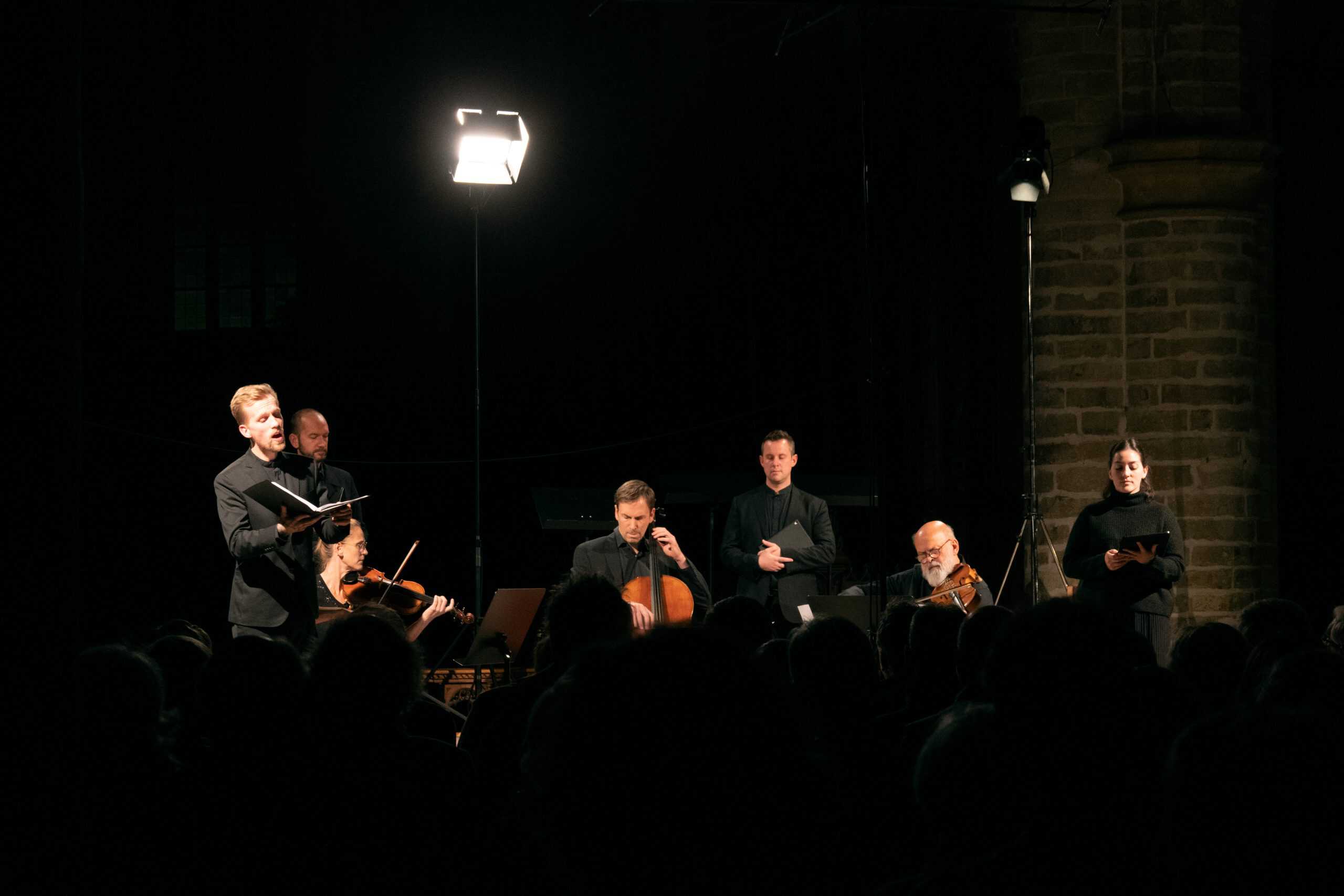
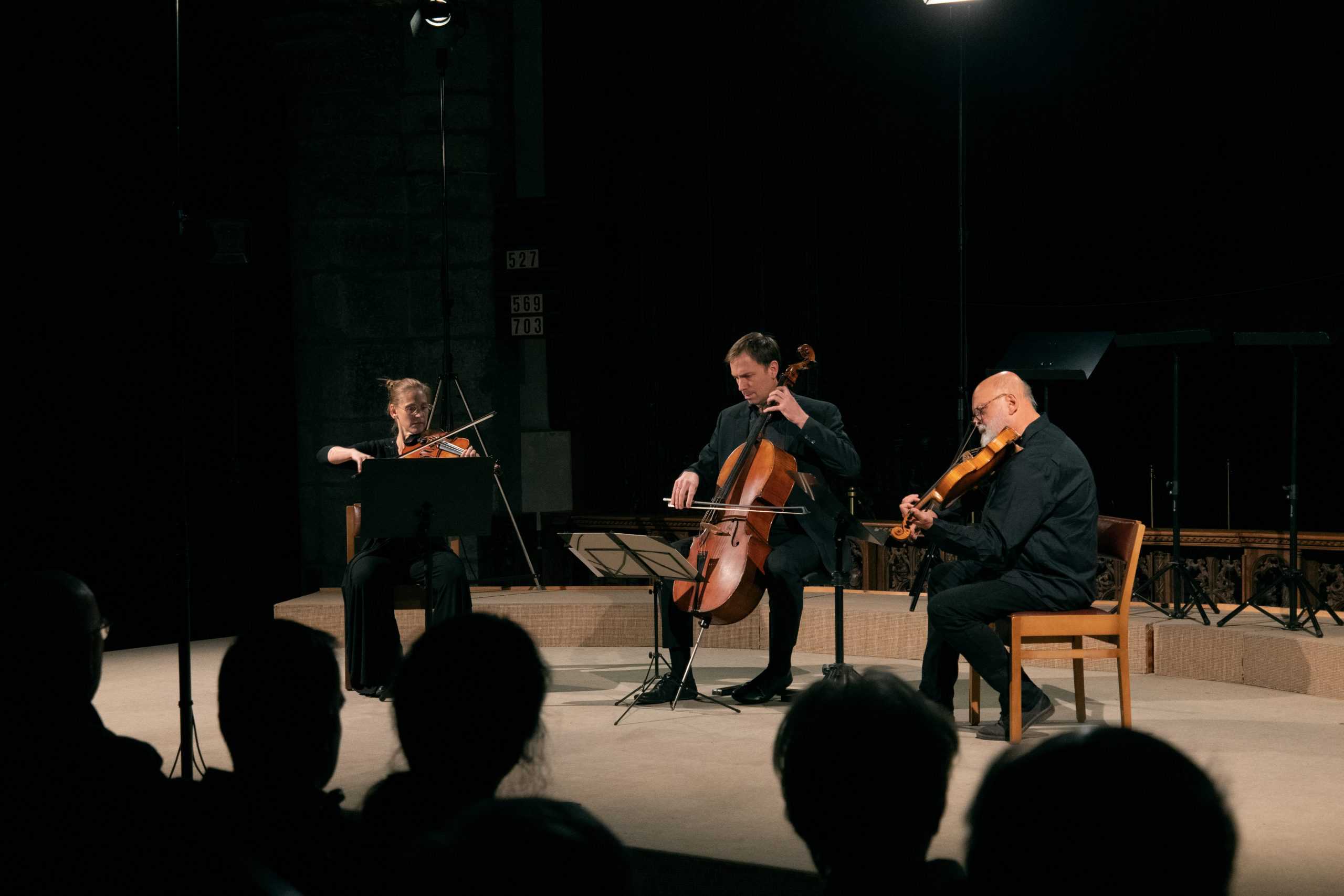
Festival 20·21 in Leuven presented yesterday Bij het kruis, a largely vocal programme dedicated to the suffering in the life of Mary. The Prague vocal ensemble Capella Mariana, specializing in polyphony and early baroque, formed an occasional duo with the Belgian Goeyvaerts String Trio, which focuses on 20th and 21st-century repertoire. A combination that was not particularly obvious, but perhaps for that very reason proved to work wonderfully.
The Leuven Sint-Geertruikerk became a centre of dialogue between old and new music, a journey from the 10th to the 21st century. The birth of Mary was sung in the anonymous Alle celeste nec non from the 10th century. This is a so-called sequentia, originally a Gregorian chant. It was inspired by the Alleluia, to which the composer added poetry and an ascending melodic line. During their concert, the four male voices of Capella Mariana walked around the audience and joined the female voice. That circular approach brought all the nuances to life and worked acoustically perfect. Moreover, the ritual meaning of the alfa et omega, which according to the Bible expresses the almightiness of God, was underscored once again.

Feast of Light
In Alleluia Pascha nostrum by Perotinus (ca.1150 - 1225), Gregorian chant is likewise the starting point but now at least two different vocal lines are added to it. In this specific polyphony of the Notre-Dame repertoire (1170 - 1250), rhythmic notation is also used for the first time. This Easter chant is a classic example of this form. The musicians did everything they could to make the three voices in the polyphonic parts of this piece dance and sometimes almost swing. Above a stable and crystal-clear basso continuo, this was a feast of Light.
Ma fin est mon commencement is a groundbreaking composition by the Frenchman Guillaume de Machaut (ca. 1300 - 1377). He took serious steps to further develop rhythmic notation. But above all, he championed the use of "formes fixes" such as the ballade, the virelai and in this case the rondeau. The song of this concert consists of two halves that are mirror images of each other. The title refers to the alfa et omega. Here too, the vocal ensemble made creative use of the possibilities of a church building with a trio of male voices on one side of the audience engaging in dialogue with a mixed duo on the other side. The syllabically circulating motifs came across well, especially since the Goeyvaerts String Trio took a restrained approach.
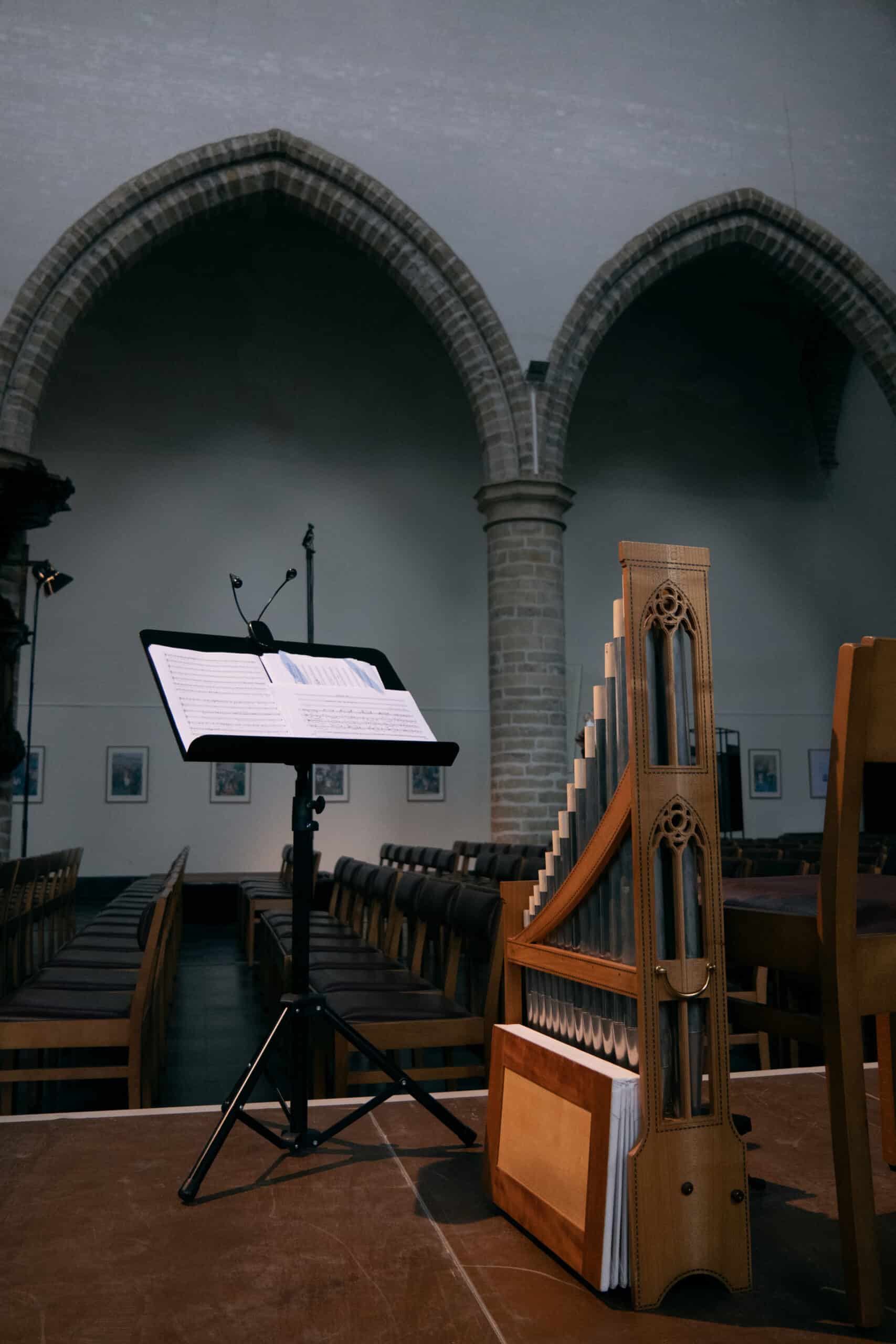
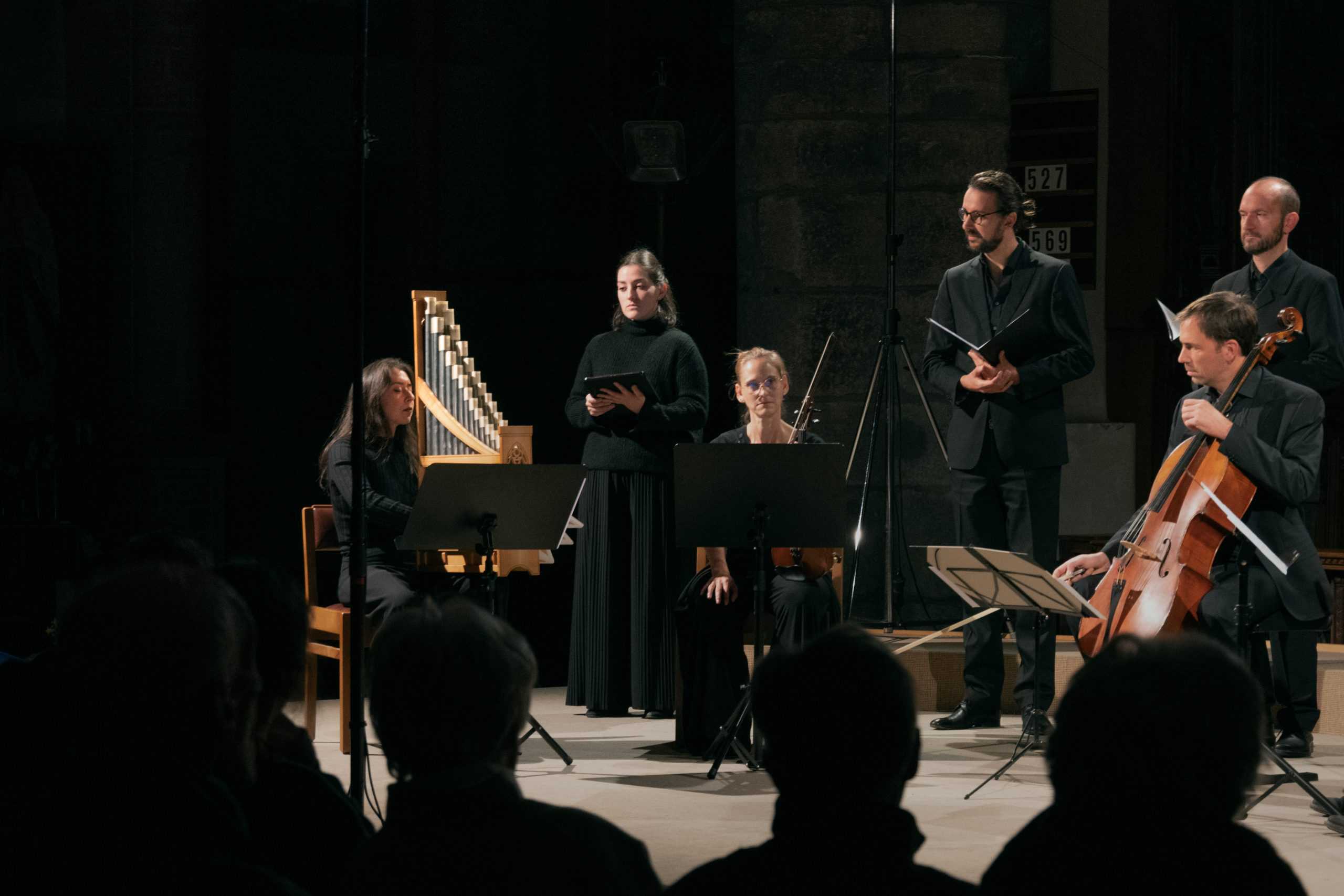
Of course, the Franco-Flemish composer Johannes Ockeghem (ca. 1410 - 1497) could not be missing from this programme. Mort, tu as navré de ton dart is a four-voice ballade in honour of the death of his colleague Gilles Binchois in 1460. The (lament) song is unique because of its mixed structure. The main text is sung by the soprano but the three remaining voices sing other texts, mostly from the requiem liturgy. In the musicians' interpretation, this time a setting was chosen with the singers positioned between the string instruments, with the addition of an organetto (Catalina Vicens). The lead role was given to countertenor Filip Dámec, who gave us a glimpse of heaven through his seamless and flowing performance.
Previous Next
Laments
The production of lament songs only really got going at the transition from the 15th to the 16th century. A good example is Proch dolor, attributed to Josquin Desprez (ca. 1450 - 1521). The song, for no fewer than seven voices, was probably sung in memory of Emperor Maximilian I of Austria. Four voices sing a text in honour of the deceased emperor and the remaining three a canon on the text Pie Jesu domine, taken from the traditional requiem mass. As for the instrumentation, the musicians did not shy away from some creativity - in this piece, cellist Pieter Stas also sang the baritone part. Soprano Elionor Martinez sang a convincing part, also because her voice was lovingly embedded in the rest of the ensemble.
The Estonian composer Arvo Pärt (°1935) has been able to boost his popularity spectacularly by rigorously choosing simplicity and refined aesthetics. The use of, for example, only the three tones of a specific triad, combined with the avoidance of modulations, leads to the absence of climax. And yet his music is not static. In his four-part choral work De pacem Domine the Gregorian roots remain within reach. The altos and basses provide smooth intervals and the tenors and sopranos meander around them, so that now and then a dissonance rears its head. Capella Mariana's approach was more a tempo than usual in this kind of choral work, which allowed a refreshing transparency to drift through the ranks. Instead of a dark and deadly serious religious consciousness, a fragrant blooming Alpine meadow unfolded here. It turned out to be a good place to linger.
The Czech composer Martin Smolka (°1959) composed Maria je on commission from Capella Mariana in 2020. It is a personal prayer in honour of Mary. The form is a litany for five-part choir and, specially for this performance, a string trio. Smolka's trademark is the use of infinitesimally small tonal intervals. He does this without the use of electronics, but relies entirely on his ear. Smolka is inspired by sounds in nature. The feather-soft fragments received an extra dose of emotional charge in this church, in the form of a self-reinforcing stillness. The short bursts of the male voices, which flanked the flat smooth lines of the soprano, worked as cooling breezes. The soft accompaniment of the organetta underscored the power that emanates from restraint.
The choice for the finale of Bij het kruis was obvious: a Stabat Mater, namely that of Arvo Pärt. This work is based on the confrontation of pain with consolation that Mary experiences at the crucifixion of Christ. Pärt's version, for three vocal voices and three strings, is also a balancing act between long and short note values, entirely in line with the text. Mary's pain was vocally translated by the soprano, countertenor and tenor. The strings took on the consoling part with energetic, sometimes even up-beat passages. Here too it turned out that the nurturing of individual tones has considerable emotional significance in relation to the tutti passages. This proved strongest in the final passage in which the fading strings made it heard that extremely softly played notes linger the longest.
WHAT: Bij het kruis - Festival 20·21
WHO: Capella Mariana and Goeyvaerts String Trio
HEARD: 29 September 2022 (Sint-Geertruikerk, Leuven)
© Helena Gaudeus © Helena Gaudeus © Helena Gaudeus © Helena Gaudeus © Helena Gaudeus © Helena Gaudeus © Helena Gaudeus


