
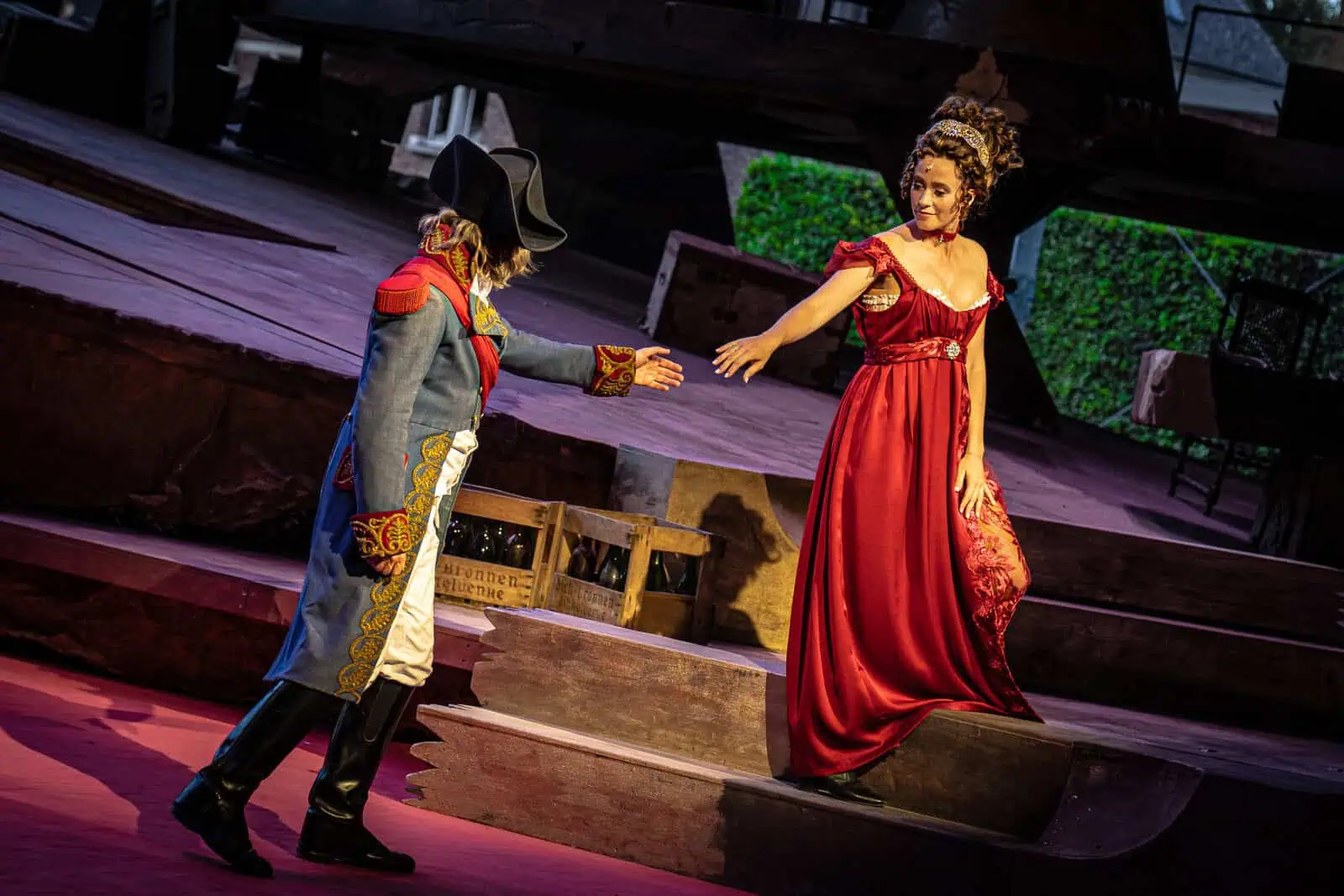
The performance takes place on the beautiful estate of Prince Simon de Merode.
The nobility is a separate cell within society with considerable power until recently. The de Merode family is one of the 5 princely families of high Belgian nobility. All current Merodes are descended from Pierre-Béranger, third brother of Alphonse II, king of Aragon. His family tree goes back no fewer than 27 generations. With nobility, we immediately associate wealth. Should we fill that 'richness' with assets or rather spiritual wealth, or both? He was brought up with the values, the criteria of the noble family 'noblesse oblige'. Since 2006, the magnificent castle de Merode has been under his responsibility. The current lord of the castle maintains and modernizes the buildings. Maintaining an ordinary house is already a task, let alone a castle with the surrounding lands. That costs money, bags of money. Thanks to the association Friends of Westerlo Castle, large-scale renovation projects were started in 2013.
Many members of the nobility or wealthy people have acted in the past and still do today as patrons for artists of all kinds. Simon de Merode is an entrepreneur through and through and the inventor, driving force and organizer of Historalia. This in a stream of consciousness, a kind of obligation towards previous generations. He wants to bring historical locations back to life. Historalia chooses a repertoire that nestles between present, past and future.
After the successful musicals 'Marie-Antoinette', 'Albert I', 'Rubens', '1830' and 'Jeanne d'Arc', Historalia now presents
NAPOLEON
The audience received two spectacles for the price of one on Wednesday evening. The solar eclipse and the complex life and history of this military leader compressed into highlights and debacles in a performance lasting over 3 hours with an impressive cast of 140 people. Napoleon, in this time span an obvious figure alongside some heads of state who also consider themselves God. There are many parallels to be drawn. The stage becomes a crossroads in time with historical costumes and resonance with the current world. History repeats itself again and again!
Decor and costumes
The set is an inclined plane in an inverted V-shape with two shutters in the middle through which large numbers of people can quickly enter and exit next to stage left and stage right. Here and there are wooden, splintered wheels (later you make the association with wagons that had to pull the cannons), heads of fallen horses and at the very back a silver branch of a laurel wreath and behind it the elegant contours of the castle.
Performing on an inclined plane is an extra challenge for actors, singers and dancers. This setup is well thought out by set designer Eric Van Der Palen and offers visually impressive images of war scenes throughout the performance. On the left and right are two more small playing areas, including Joséphine's boudoir.
Elvira Van Bavinckhoven was brought in for the costumes and she is a feast for the eyes. Make-up artist Virginie Verpoucke took care of the elaborate hairstyles and wigs with an eye for detail.
Direction and performance
Jef Hoogmartens crystallized from Napoleon's extraordinary journey a digestible story and Jelle Cleymans provided the lyrics in a mutually intertwined, inspiring musical narrative. Napoleon reflects on socio-political movements, pride and human rights, displacement and individuality. Musical director Sam Gevers composed the music in a broad range of moods and colors with some beautiful highlights. Director Luc Stevens delivered a masterpiece. He has used his experience with other large-scale spectacles here as well. Keeping such a mass of people engaged is not given to everyone. The set is used as inventively as possible, together with Roy Jonathans, who took care of the choreography.
You cannot say that 'Napoleon' is bad, but there could have been more to it. Was it the pressure of the premiere, but Jelle Cleymans doesn't quite convince as a young revolutionary and daredevil. The ambitious, strong man, visionary who ruthlessly worked his way to the top, but putty in the hands of a woman. Happiness is worm-eaten. While he fights one battle after another, his wife Joséphine, played by the Dutch Piek Van Der Kaaden, amuses herself with other gentlemen, her sweets, an actress/singer with a tantalizing sensual energy.
During the duet 'Dolce Amore' with his new bride Joséphine, the immense choir sings and dances along and they take over the entire space. The dance has a Spanish tint and looks very beautiful when they make simultaneous arm movements, but in between everyone just does what they want with their arms and that is extremely chaotic! 'In der Beschränkung zeigt sich erst der Meister'. The battle, man against man, is then cleverly orchestrated and illustrates the cruelty of warfare. Murat's sung commentary: "Who thinks about aesthetics in war?" hits hard. The audience gets some factual material from Napoleon's campaigns. We can hardly imagine it: his soldiers had to march, packed and full, 30 km per day from one battlefield to the next.
Karin Jacobs, as Napoleon's mother, doesn't have a big role, but she delivers a strong and convincing performance. An uncompromising lady with a will and wisdom. She also impresses in singing technique.
Erik Goris as political figure Talleyrand stands as a house: controlled, prominently present. A man who manipulates, but also sees through things and people. Also credible is Jervin Weckx as political figure Murat, and he has beautiful singing parts. Ludo Hoogmartens plays a dual role: Barras and Tsar Alexander. Wout Selles plays the role of Lannes, somewhat Napoleon's right hand, and Melia Loi appears as Eléonore, Joséphine's chambermaid and dresser and Princess Marie-Louise.
With Napoleon's pep talk, the soldiers and common people are deceived. The muskets crack a treat. Great victories such as the Battle of Austerlitz, where he defeated the combined armies of Russia and Austria, are covered. Young people fall in droves, drop like flies. The inclined plane makes the dimension of the massacre visible. The madness of war!
The fame of his battles spreads from mouth to mouth. Napoleon is prompted to resist the powerful Directoire. The reign of terror that brought power to the rich bourgeoisie. The regime suffered from great corruption and relied heavily on the army. He launches a coup, supported by part of the soldiers; the other half he talks around. This is followed by a grand popular festival in a round dance on the immense stage. Song and choreography are somewhat infantile, over the top. It leans towards a parody. Also here again: less is more.
Napoleon gets megalomania and has himself crowned emperor.
Particularly spicy is Napoleon's duet with Tsar Alexander; with light hopping steps they make a parody of the seriousness of the situation. Shortly after, friend Tsar Alexander becomes the enemy. Russia too wants to seize Napoleon. He gets some headwind from his entourage, but his hunger for power cannot be contained. He easily finds arguments to justify his power and violence and pulls the wool over the people's eyes. However, he fails at this mission. The audience gets a beautiful and poetic scene image to see. Snowflakes swirl down in Westerlo at a temperature of 25 degrees! Napoleon sees it's not working. Instead of supporting his soldiers, he flees with his tail between his legs to safer places, while the boys perish from wounds and biting cold.
His mother has meanwhile let him know that his beautiful Joséphine is not averse to a crooked path. That kingdom will be short-lived because no children are born and he has no male heir. In a French rage, he throws Joséphine out and latches onto his wife's chambermaid, who gives him a son later. At first he is pleased with the child, but soon after he never wants to see her again, because the child is a bastard. He takes Joséphine back in. His mother impresses upon him that he urgently needs a legitimate heir. He remarries a young Austrian princess and Joséphine is pushed aside. One of the most beautiful and impressive scenes is Joséphine's song "How dare you", in which she pours all her frustration, hatred and love. She experiences the music with every fiber of her being. Inner turbulence is filled with expression. A performance that continues to resonate.
Then Napoleon makes the ultimate mistake: Waterloo. His army is routed by a large coalition of armies: the British-Allied army and the Prussian army. Again, a wonderful song and tight choreography performed by a stunning group of dancers/singers. The choreographies with the soldiers reflect strength, resilience, but also vulnerability. A treat for eye and ear. Moving realism with a contemporary twist.
As Napoleon's leadership wanes, the laurel wreath gradually turns rust-colored. Nothing is left to chance; every detail is used.
Then Talleyrand has had enough and Napoleon is banished to the island of Elba. The final image after the greeting takes your breath away for a moment. An empty scene/battlefield full of rifles with bayonets. It leaves room for your own imagination.
'Napoleon' is a journey through history. Hats off to all performers who, at these tropical temperatures in heavy costumes and wigs under the spotlights, give the best of themselves. The many staff members behind the scenes also share in this respect. Those who love grand open-air spectacles will certainly get their money's worth. Until September 19.
A think tank within Historalia is already working on a new production. Next year 'Maria of Burgundy – the last duchess' will be seen at Wijnendale Castle