
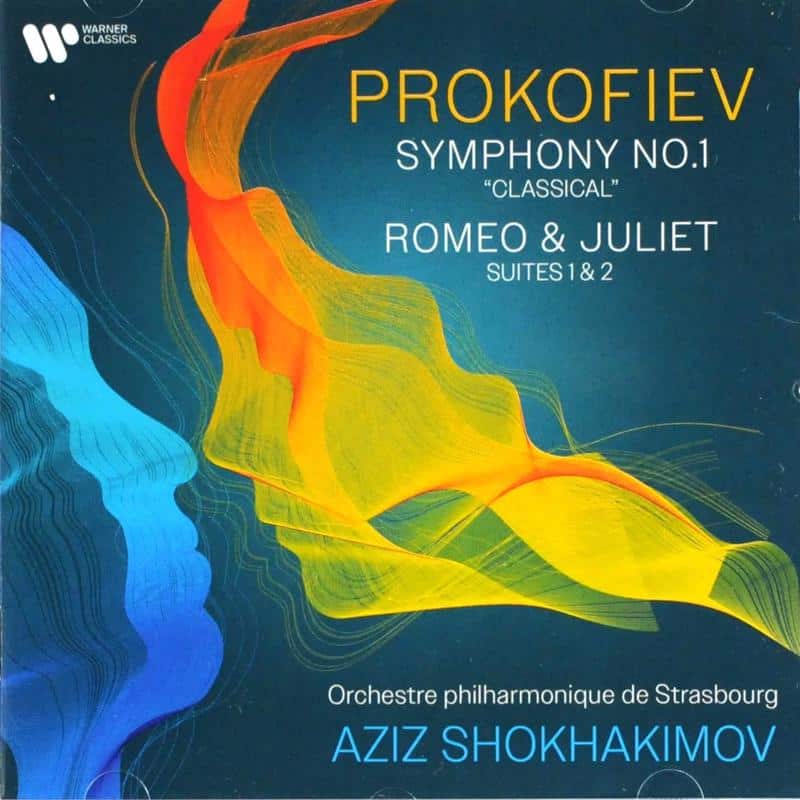
Prokofiev's 'Classical' Symphony (1917) is considered a very melodious homage to Joseph Haydn. Its neoclassical character is just as unmistakable as the spirituality that flourishes within it. Within the classical formal framework, the most delightful inventions tumble over one another continuously, and the sparkling lightheartedness is so infectious that the work soon enjoyed great popularity and still remains part of the standard repertoire of many symphony and chamber orchestras.
The same applies to the two suites compiled by the composer from his ballet Romeo and Juliet, based on Shakespeare's The Most Excellent and Lamentable Tragedy of Romeo and Juliet (1591-96), about the eponymous lovers whose fate is greatly hindered by two mutually hostile families. The tragedy that has inspired other composers as well, and which we know in various versions by Tchaikovsky, Berlioz and Prokofiev, who has portrayed the romantic love, but also the impossible love and the struggle between the Capulets and the Montagues in his ballet music in an unparalleled manner. The fact that a number of instruments are far from commonplace, such as the tenor saxophone, cornet, viola d'amore and mandolin, has not hindered the popularity of the work.
Although the dramatic progression is inevitably affected by the arrangement of these orchestral suites, Prokofiev certainly recognized that there was indeed a 'market' for it, resulting in 1936 in the first two (seven-part) orchestral suites (op. 64a and b), with a third added in 1946, the considerably less popular six-part orchestral suite (op. 101). There is also the ten-part piano suite op. 75 (1936-37).
The order of the first two suites as published by the composer is as follows:
Suite no. 1 op. 64a
1. Folk Dance
2. Scene (the street awakens)
3. Madrigal
4. Minuet (arrival of the guests)
5. Masque
6. Romeo and Juliet (balcony scene and love dance)
7. Death of Tybalt
Suite no. 2 op. 64b
1. Montagues and Capulets
2. Juliet as a young girl
3. Friar Lawrence
4. Dance of the five couples
5. Romeo and Juliet before the parting
6. Dance of the maidens with the lilies
7. Romeo and Juliet's tomb
Many conductors have paid little attention to this chronology. They chose their own order or omitted a number of sections as they saw fit. Fortunately, we do not see this in the performance by the Philharmonic Orchestra of Strasbourg under Aziz Shokhakimov, as we hear not only the fourteen movements, but also in the order prescribed by the composer.
Shokhakimov's interpretation is certainly colorful and fascinating, but it lacks the utmost sparkle and tonal refinement of the Berliner Philharmoniker under Claudio Abbado (DG). The fine-grained color shadings, the dramatically charged 'pesante' in The Montagues and Capulets, and the feather-light Dance of the maidens with the lilies are truly of a different order with the Berliners.
This line can equally be extended to the 'Classical' Symphony, because here too I give (still!) preference to Abbado, this time with the Chamber Orchestra of Europe (DG), a true model of transparency and sparkle at an almost chamber music level.