
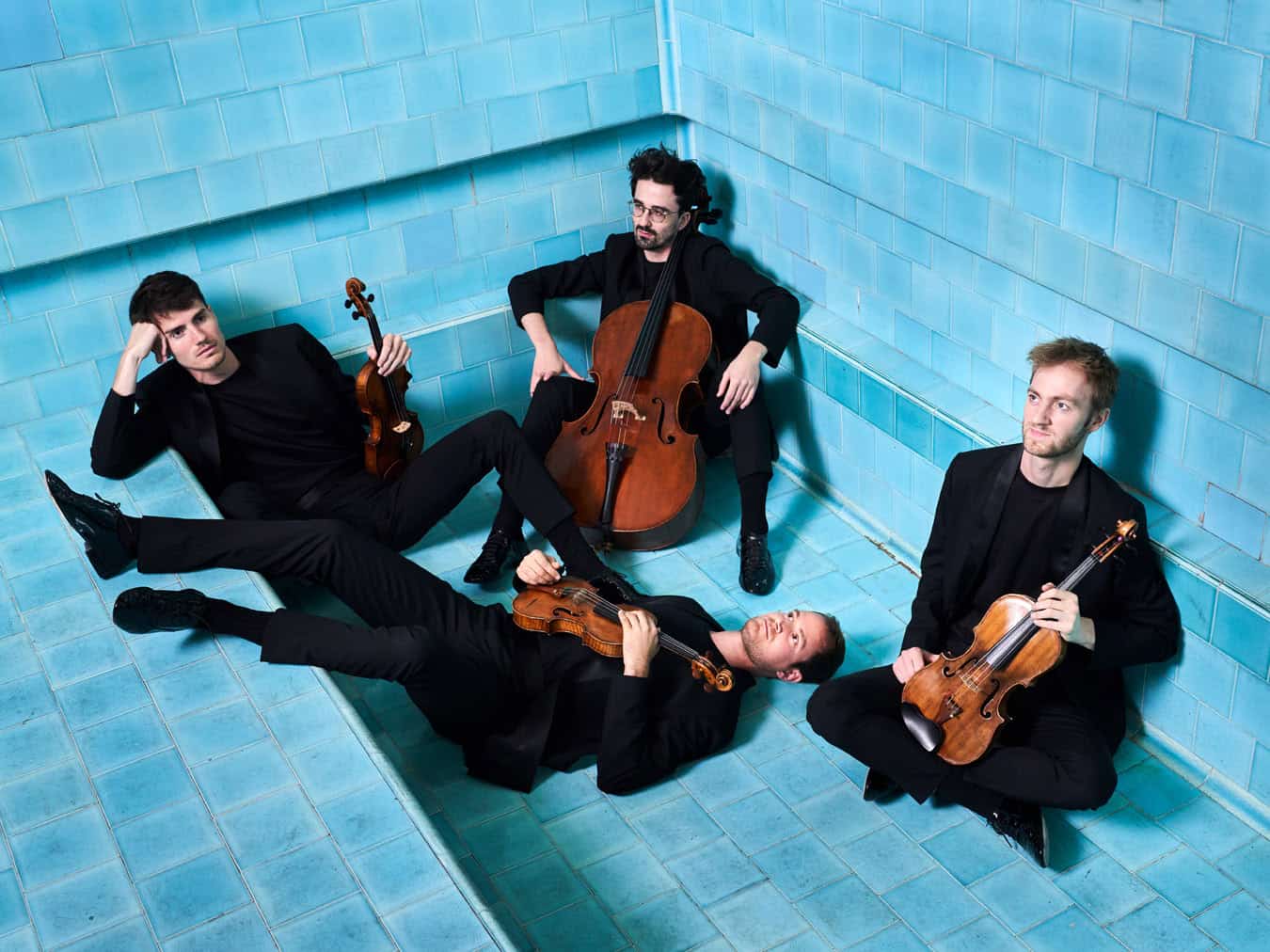
The European Concert Hall Organisation (ECHO) has named Quatuor Agate as ECHO Rising star for the concert seasons 2024 and 2025. These four energetic young men from France, who studied together in Berlin, formed their ensemble in 2016 following an invitation to perform at a concert in Corsica, which however never took place.
Nevertheless, we should be grateful for this phantom concert. Many prizes and years later, on 23 February 2024, their debut album was released on "Appassionata, le label": a compilation of the three magnificent string quartets by Johannes Brahms. The connection to Brahms is not hard to find. Agathe von Siebold was a beloved of Brahms to whom he indirectly dedicated his second string sextet. Hence the name.
At the New Year's concert of HOGENT on 16 January, however, they performed a completely different repertoire. They opened with the first string quartet, "Métamorphoses Nocturnes", by Hungarian composer György Ligeti. In this seventeen-part work, Ligeti builds further on the ideas of that other renowned Hungarian whom he so admired: Béla Bartók. Yet another Hungarian and famous figure, György Kurtág, even called it Bartók's seventh string quartet. Well yes, you be the judge yourself; this work is masterfully written. Ligeti builds further on ideas from his "Musica ricercata" for solo piano and here too follows a predetermined plan with a building element. In the "Musica ricercata" these are the 12 tones, but in "Métamorphoses Nocturnes" it is the intervals that provide the structure, though their treatment is less strict. Quatuor Agate delivered a magnificent version of this work in which Ligeti's ideas come across convincingly. A technical tour de force. After much turbulence, strong contrasts, Bartók pizzicatos, you name it, we arrive at a finale Ad libitum, senza misura with whistling glissandos where each of the four members alternately passes on the melody. The magical conclusion of this masterful composition was rendered wonderfully here.
The second piece of the evening was "The Last Flight" by Ukrainian composer Anna Korsun, who resides in Germany. The work was composed as part of ECHO, with initial correspondence between Korsun and the quartet dating from 2022. From the beginning, there was discussion of a commission for a piece about the 16th-century Italian composer Carlo Gesualdo. A piece that would tell the dark story of a composer and murderer, but from the perspective of his victims. This scene description from the programme notes perfectly describes the essence and atmosphere created at the concert: "A feudal dungeon perched on the hills of Gesualdo, low and vague sounds that seem to emanate from the entire castle, the muted notes of discordant music, and from outside, the whistling of a steady, cold, and indifferent wind." Thus Korsun.
As a finale, Quatuor Agate performed a formidable version of the string quartet in F major with which the young Maurice Ravel made his breakthrough in the early years of the last century. This work, which was praised by Debussy, whose string quartet also served as a model, has meanwhile become a true classic within the chamber music repertoire. The lyricism in the first movement, the rhythmic exuberance in the scherzo, the restraint and mysticism of the third movement followed by the dazzling finale in five-four time - what a mighty work it is. The four Frenchmen know how to handle the masterpiece of their compatriot and here too the audience was treated to a world-class performance. How do you start the year in style? Well, like this.
Want to see Quatuor Agate in action yourself? They are currently touring Europe. On 22 January you can attend their concert at Concertgebouw Amsterdam and on 12 March at the Opera in Lille.