
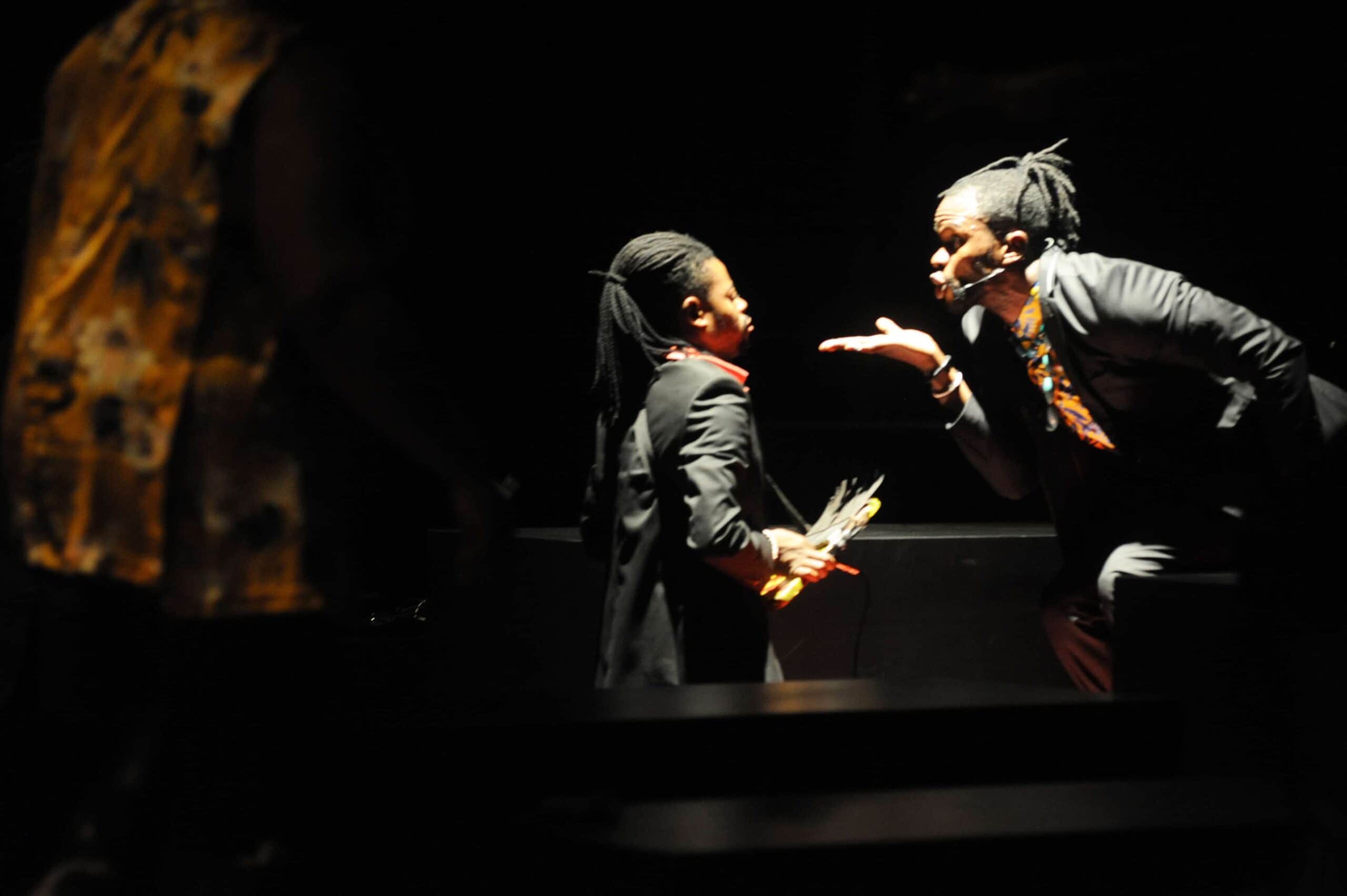
This work had its world premiere earlier this year at the Berliner Festspiele. A new production by the duo Alain Platel & Fabrizio Cassol is always received with great anticipation. They had previously collaborated on the Mariavespers (vsprs 2006), the Mattheus Passion by Bach (pitié 2008) and the Western baroque repertoire (Coupe Fatale 2014).
Both find each other in creating new stories based on familiar material, which often belongs to the classical European repertoire. Their partnership continues to astound and delight. Mozart's Requiem was unfinished at his death. At the request of his widow Konstanza, the work was completed by Franz Xaver Süssmayer. The fact that the score was unfinished allowed Cassol to break into the 'Requiem'. But he also reworked the original. He created a separate sound world that draws from music from Africa, India… which were always connected with forms of spirituality. The massive choral singing had to make way for individual voices. Fourteen musicians from different continents reconstruct Mozart's Requiem by allowing it to merge with jazz, opera and popular African music. Not a symphonic orchestra but as instrumentation: an accordion (Joao Barradas), electric guitar (Kojack Kossakamvwe), euphonium (Niels van Heerum), likembe (Bouton Kalanda, Erick Ngoya and Silva Makengo) and percussion (Michel Seba), guitar and electric bass (Rodriguez Vangama). Under the inspired direction of Alain Platel, this 'Requiem pour L' results in an incomparable warmth and overwhelming power. In this work, Alain Platel and Fabrizio Cassol as it were conjure the power that death has over us. The magical bridge between two worlds: life and death.
This world was already there when we were born and continues to exist after we are no longer among the living. There is a beginning and an endpoint for everyone. Platel does not need to invent reality. Dying can be in pain and agony, but also resignedly and gratefully for a beautiful life. The audience witnesses the final hours of a woman in a serene projection. The camera records as a silent and respectful witness. Around her a world of people who loved her and tenderly bid her farewell. L. knew she was going to die and agreed to be filmed and for the footage to be integrated into the performance. Therefore Requiem pour L is a tribute to this woman and by extension a Requiem pour Elles to all women, to all people, to life of which dying is a part.
Stage image
A large white projection screen, in front of it a few rows of grey rectangular objects that rise in steps. Immediately there is the connotation with the gigantic field of concrete blocks of the Holocaust-Mahnmal memorial in Berlin between the Brandenburger Tor and the Potsdammer Platz.
The accordionist walks onto the stage and plays a disconcerting rhythm. Gradually the actors/singers and instrumentalists trickle onto the stage and walk between the cubes. Place small stones on them, as the Jews do. We find ourselves in a cemetery. The setting around the screen is like a painting with masterful lines coloured with emotions, songs that give a general image of the world and life. A vibrating mass of moving bodies, warm and melodious voices, dancing in an explosion of vocal fireworks.
The intimate coherence of this reality is given body by the music. Music as a soothing, healing balm for things that cause each of us pain inside. The music resonates with the images on the screen. Throughout you see only the face and upper body of the dying woman. There are people around her in silent proximity. You can see this in a butterfly-light, caressing hand on her upper arm. Someone embraces her and puts a smile on her face. Her eyes are mostly closed. Now and then she looks around her. Her dark eyes light up in her pale face. Saying goodbye in converging lines with other cultures. Opposite the still body on the screen, there is nothing but movement of bodies on the stage. The music follows an unpredictable trajectory. Mozart's 'Requiem' shines through it like sunrays filtered through a forest. Boule Mpanya, Fredy Massamba, Rusell Tsiebua: vocals and Nobulumko Mngxekeza, Owen Metsileng, Stephen Diaz and Rodrigo Fereira, lyrical vocals let the different melodies flow seamlessly into each other. Performed by artists with a special affinity for African music. It is woven into their genes. Through the extrapolation of emotions, a diptych emerges. The restrained farewell of the Westerner opposed to the extroversion of the Africans. The struggle between love and death seen through ambivalent human nature.
When her end approaches, Niels Van Heertum coaxes strange sounds from his euphonium like a herald of death. Towards the end the accordionist and euphonium player depict the woman's heartbeat: slower, more irregular, faltering. Music and song fall silent several times: you only hear her breathing… ever softer. You witness how the woman gradually slips into death, her mouth falls open. Loved ones stroke her face awkwardly and tenderly. I have rarely known a full auditorium to be so silent, caught in the cocoon of this intimate event. At the end, a cappella, the beautiful Miserere sounds in a mixture of purity and tragedy. As the culmination of the performance, the entire cast dances a kind of defiant battle dance. Life goes on like a wave. Being born and dying.
A performance that lingers on the retina and emotionally as well, because of the passionate intensity, beauty and thoughtful tranquility. Alain Platel and Fabrizio Cassol guide the audience home with infinite peacefulness.
- WHAT: Requiem pour L
- WHO: Les ballets C de la B / Festival de Marseille / Berliner, music Fabrizio Cassol based on the Requiem by Mozart, scenography Alain Platel
- WHERE: deSingel, Antwerpen
- WHEN: Thursday, 8 March 2018
- Photos: © Chris Van der Burgh