
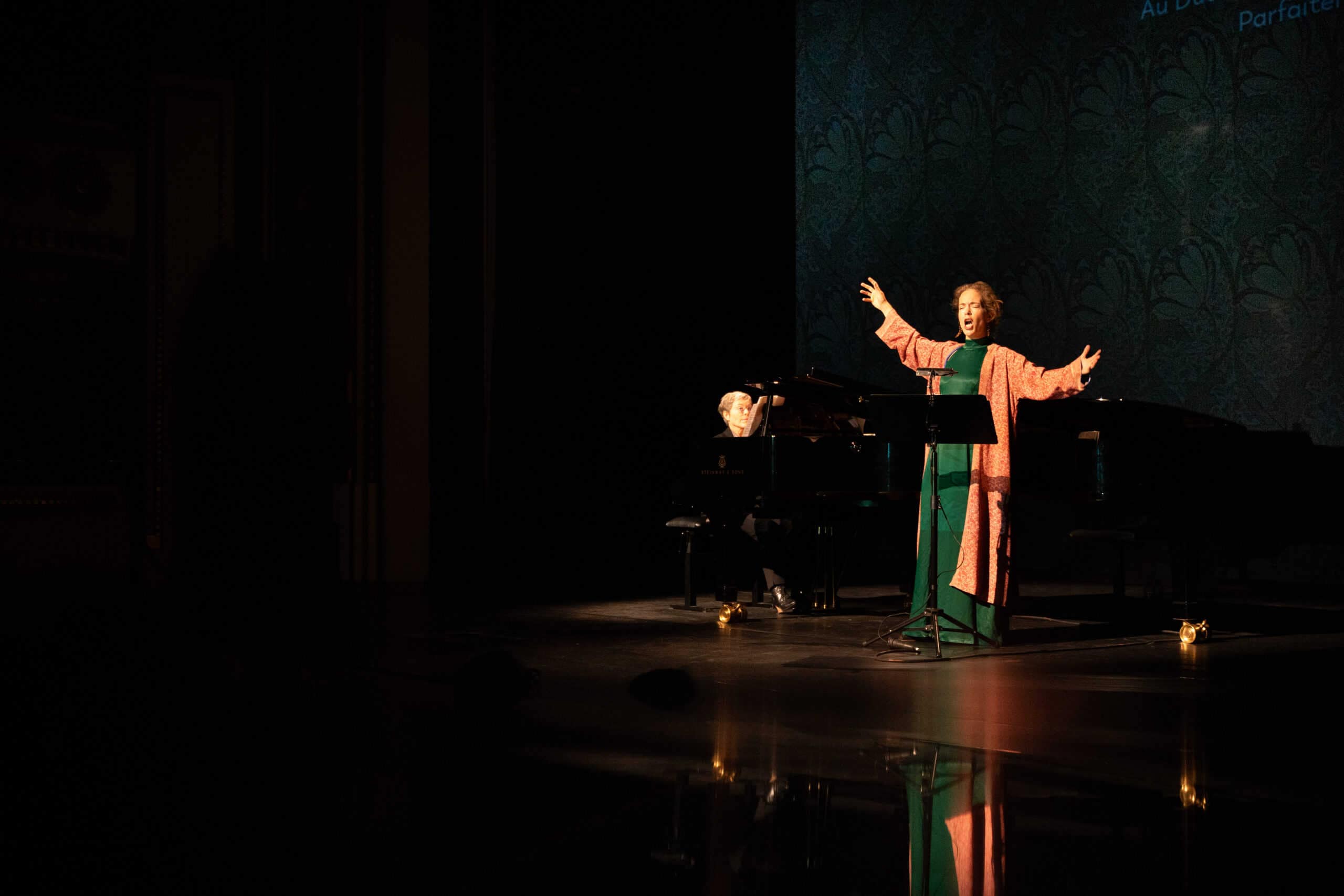
Festival 20·21 chose the French composer Erik Satie (1866-1925) as the central composer for their themed day this year. The idea of lingering in the misty streets of early twentieth-century Paris emerged visually spontaneously. In the case of Salon Satie, the second concert of the day, pianist Inge Spinette and soprano Lore Binon brought a selection of, among others, Eric Satie, Claude Debussy, Francis Poulenc and Maurice Ravel. Alternating temperaments and French chansons-avant-la-lettre sentiments reflected the atmosphere that this concert evoked. A glimpse into the past? That is certainly very possible.
Changing times
At the end of the nineteenth century, something seemed to be happening in musical circles. Classical music, which in the middle of this century had been proclaimed as a bastion of refined taste, returned with a number of composers to the intimacy – and freedom – of the (public) salon. Erik Satie was a composer who certainly made eager use of this. His musical style floated between minimalism, modernity and expressivity. It is this simplicity that made his music distinctive; including the Trois Gymnopédies (1888) and the mysterious Gnossiennes (1890-93) which, for all their simplicity, were nevertheless experimental for the period. Satie abandoned all sense of musical temporality. His music feels like a mystical tableau, or like a caricatural sketch of French life.
In the case of Salon Satie, it is a mix of both. The first part, Lent et douloureux, of the Gymnopédies is included. This sharply contrasted with the opening: the well-known Le Petit Nègre (1909) by Claude Debussy. Snapshots, ecstasy and mysticism feature throughout the concert – accompanied by texts both witty and otherwise. Don't forget, this was also the period of Symbolism: meaning and execution could well be suggestively separated. But the intention? That is always audible in the music.
Satie and friends
That is the best way to describe this selection of early twentieth-century composers. Their musical intention and style fit seamlessly together. This was also evident during the concert, which felt like a petit salon in the middle of the Leuven Stadsschouwburg. It was an alternation between sketches and scherzi – such as the aforementioned Le Petit Nègre, but also Satie's Sports et Divertissements (1914) – and weightier snapshots from the past. To give an example: Poulenc's La Dame de Monte-Carlo (1961). This was clearly a different language and world, one that felt almost lost. Is it a longing for? Possibly. There is certainly a fragile beauty in this kind of music. This applies to both piano and voice.
In this case, Spinette and Binon, seemingly faithful partners in music, were well-matched. In the case of the piano, I would certainly like to emphasize the quality of accentuation that Spinette brought to her playing. In the Gymnopédie, it was interesting to listen to where she placed the focal points of the accent – or whether they are audible at all. In the music of Satie, which shines in its apparent simplicity, it is these sounds that matter. With the necessary fragility, she sometimes deliberately placed the accent just beyond the beginning of the melody, which made listening engaging.
Binon, with a powerful voice as always, was certainly at home in the expressivity she could display in both sound production and intonation. No lost vowels or consonants here; everything came out credibly and clearly. Particularly striking to listen to is how she can glide smoothly and without loss of sound intensity between vocal registers as the music requires. It results in a lightning-fast change of timbres – from sparkling heights to a sustained middle register. For both performers, this reviewer is certainly at a loss for words. It is certainly a duo to behold again in the future.
With Salon Satie, a kind of intimate past emerged. It hovered between musical homecoming and becoming lost in what is past. There is something about early twentieth-century French arias and songs that can bring this about. The concert was certainly a hit. And Satie? He is certainly capable of many encores.
WHAT: Salon Satie (themed day Satie S'amuse), with compositions by Erik Satie, Claude Debussy, Francis Poulenc, Reynaldo Hahn, Arthur Honegger and Maurice Ravel WHO: Lore Binon (soprano) and Inge Spinette (piano) WHERE: Festival 20·21, Leuven WHEN: Sunday 8 October 2023