
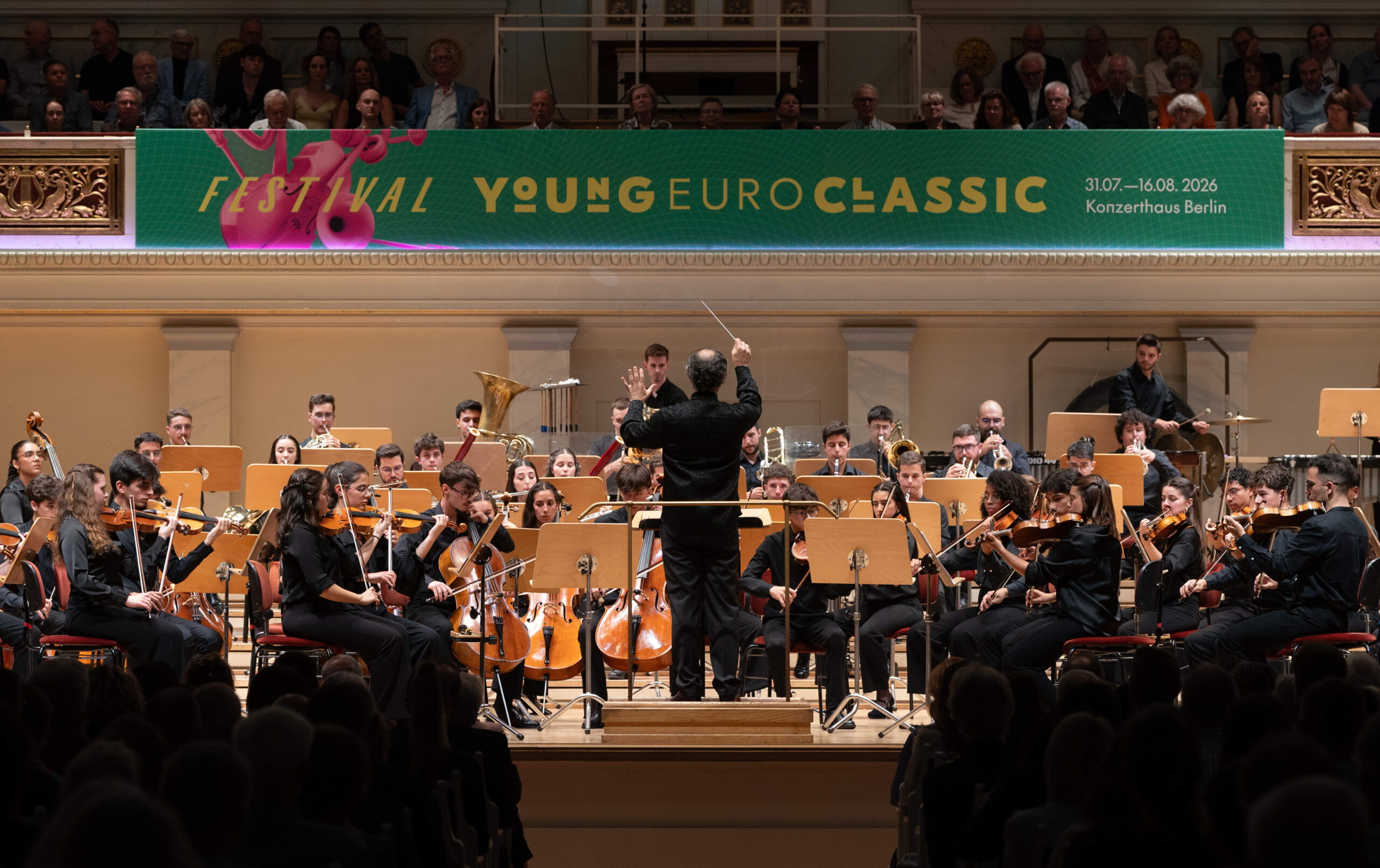
For the concert of the Jovem Orquestra Portuguesa at Young Euro Classic on Friday, August 7, I was allowed to attend a rehearsal and speak with horn player João Augusto, violinist Clara Santos, composer César Rafael and mezzo-soprano Cláudia Ribas. It became an afternoon in which words slowly made way for music.
A word that cannot be captured
João Augusto visibly searches for words when I ask him what saudade means to him. It is a feeling that arises when you love something or someone, but cannot be with them – somewhere between nostalgia and longing, he says, without ever being able to define it completely. Clara Santos immediately brings it back to her own situation: she and her fellow musicians are far from home, and it is precisely the intensity of that longing that is difficult to capture in language.
João adds to that and explains that saudade for him does not only arise from distance from home. It also arises within the orchestra itself: in the conversations, the glances, the small moments of progress during a rehearsal. When that working period is over, that feeling remains – as a memory of something that no longer exists, even though it just happened. Clara recognizes that immediately: while playing, she thinks back to what happened during the rehearsals, and those memories themselves become part of how they make music together.
Notably, João brings up the conversation on his own already at the second part of the programme. Especially the final section of Tchaikovsky's Sixth, he says, has a particularly introspective character for him – a moment when the music turns inward and leaves room for remembrance and longing. Those words come to mind again that evening when the final section sounds.
A composer between trumpet and Pessoa
César Rafael (°2001) did not begin at the piano but with a trumpet, in a brass band in his native city Vila Real – not unusual in Portugal, where the brass music tradition is strong. Only later did he feel that he not only wanted to play, but wanted to create himself. He studied composition in Évora, completed his master's degree there in 2025 and was appointed composer in residence at the JOP for the 2025/26 season – the commission that resulted in Saudades, só portugueses, its world premiere in Berlin.
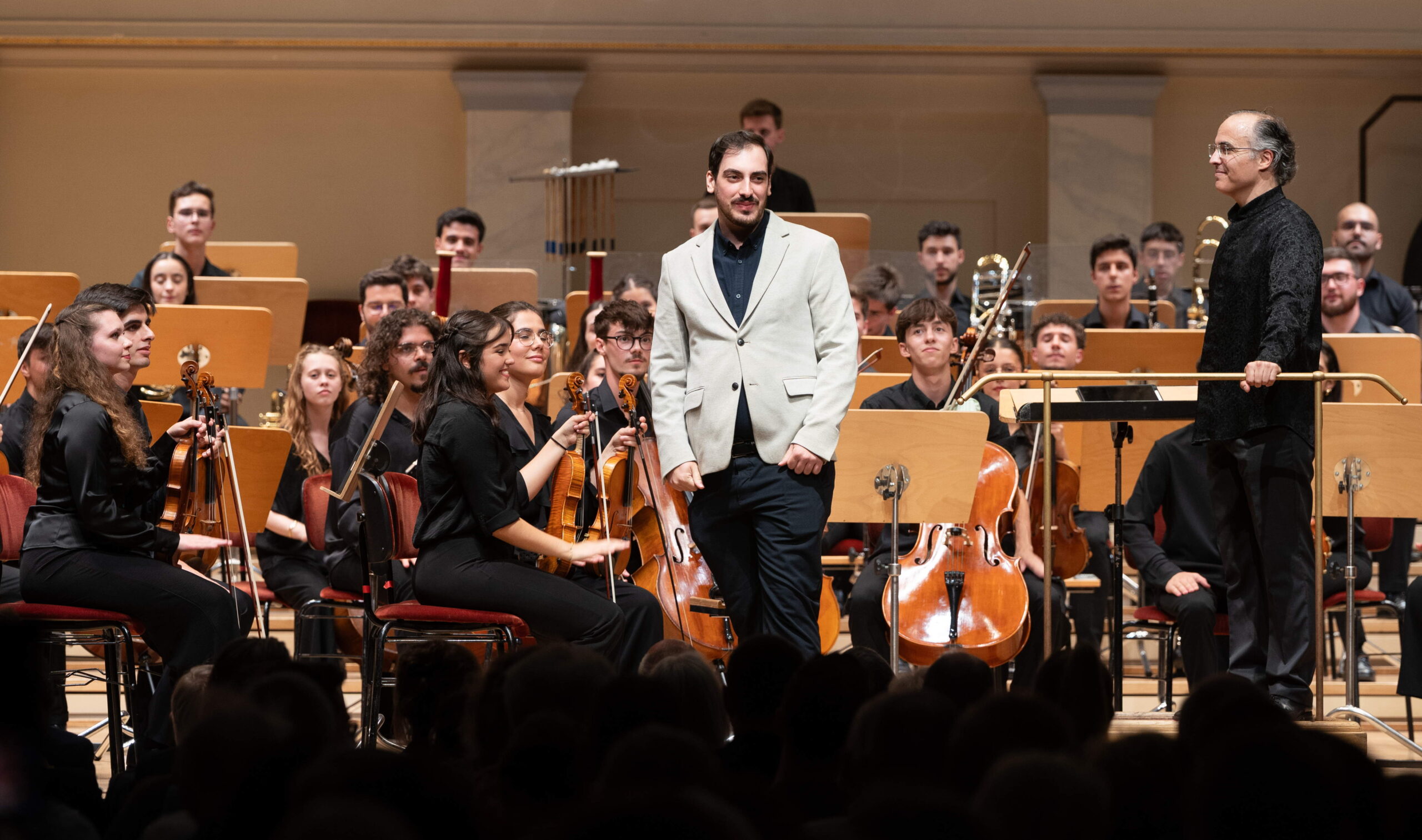 Like many young composers, Rafael is still searching for his own musical language, and he is remarkably open about it: in the beginning, he says, you base yourself primarily on your teachers, the first examples you have. In his new work, he refers to, among others, Lutosławski's Third Symphony and Mahler – influences that he does not hide, but neither does he want to let them dominate. He mainly tries to preserve his own voice among the examples that have shaped him.
In the conversation, he tells me that it was almost inevitable to build his piece around saudade, because the festival had given that as a theme. Only later, when I read his notes in the program booklet, do I discover how directly Rafael builds on Fernando Pessoa's Mensagem – the collection in which Pessoa invokes the Portuguese age of discovery. Rafael does not translate his own experience of that period, which he has no more than Pessoa does, but focuses on those who were left behind: those who saw their loved ones depart to seas no sailor had ever seen. In other words, it is not a musical illustration of a word, but an investigation into the boundary between saudade and nostalgia.
The fact that he wants to make the audience consciously search also has to do with the audience itself. Most listeners in Berlin are not Portuguese, he explains: they may know saudade as a word, but not as something rooted in their language and culture. That is precisely why he wants them to ask themselves during the listening where that saudade in his music actually is – a question that would be answered more quickly for a Portuguese listener than for the rest of the hall.
For a young Portuguese composer, this is a unique opportunity: commissions for large orchestras are rare in Portugal. That a youth orchestra offers him this opportunity – with musicians from his own generation – makes the world premiere more than a practical commission.
A rehearsal that listens to the hall
Between the conversations, I attend the rehearsal itself and see a concentrated but remarkably open way of working. Pedro Carneiro is charming and accessible, works concentrated but without distance and responds kindly to questions from his musicians. Together with his assistant conductors, he constantly listens to the balance between the orchestral groups and to how the sound spreads in the hall of the Konzerthaus: small adjustments, listened to again, adjusted. A rehearsal turns out not only to be about rehearsing notes, but equally about searching for the right sound for this space.
I also hear Rafael's new work for the first time, and it does not leave me alone for the rest of the afternoon. It is dark, almost hermetic, a narrative that does not reveal itself immediately. Where exactly is the saudade – with those who depart, those who remain, or in the longing itself? I have no answer, but know that I want to hear it again that evening.
When music takes over
The concert opens with the festival hymn that Iván Fischer (°1951) wrote for Young Euro Classic in 2011. Because I had only heard the work in wind band arrangement the previous evenings, this performance is a surprise. Now it sounds through the full orchestra, and especially the strings add a richness, warmth and breadth that give the work a completely different flair.
The overture Le Corsaire by Hector Berlioz (1803-1869) is performed with great pleasure in playing. What especially stands out is the balance between the orchestral sections – nothing seems to be in place by chance, and after what I had seen that afternoon about rehearsing in function of the hall, I now hear the result.
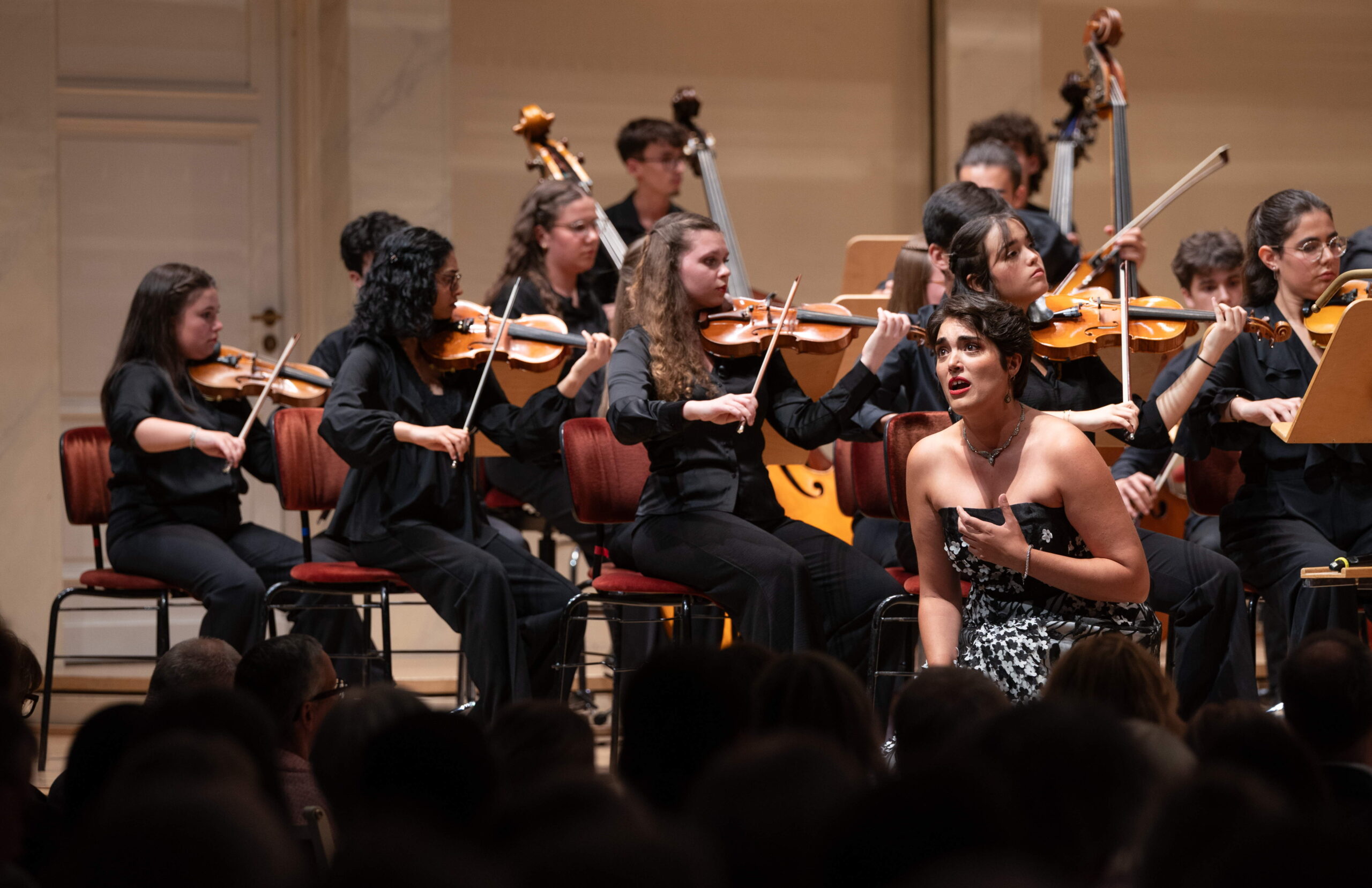 Then, without interruption, the two Berlioz songs. Cláudia Ribas brings them intimately and with feeling, but at the same time with dramatic effect: as Dido in the aria from Les Troyens, she sings not only about departure, she seems to experience it, until she sinks begging to her knees. At the great brass outbursts, her voice is occasionally drowned out, but the feeling remains intact – what a voice and what presence this mezzo has. In Sur les lagunes, her voice takes on a more intimate, inward-looking color: the man who misses his deceased beloved and must go out to sea without love stands alone again facing the water. And then I suddenly understand something about saudade that no one could have explained to me that afternoon – the music does it itself.
Then comes the world premiere of Rafael's Saudades, só portugueses. Demanding for musicians and listeners alike, yet intriguing from the dark opening in the deep strings. Fierce brass outbursts, a melancholic clarinet, music of searching and not finding. Knowing what I now know about Pessoa, those left behind, and the Lutosławski and Mahler traces that Rafael himself mentioned, I hear the piece differently than during rehearsal: less as a riddle, more as the gaze from the shore that I already sensed this afternoon. Almost like the solitary figure from Caspar David Friedrich's Mönch am Meer, gazing out over a sea that refuses to be fathomed. That the new work stirs something in the Berlin audience is evident from the applause that follows. What everyone has precisely heard or recognized, I of course do not know – and perhaps that is exactly what Rafael wanted to achieve.
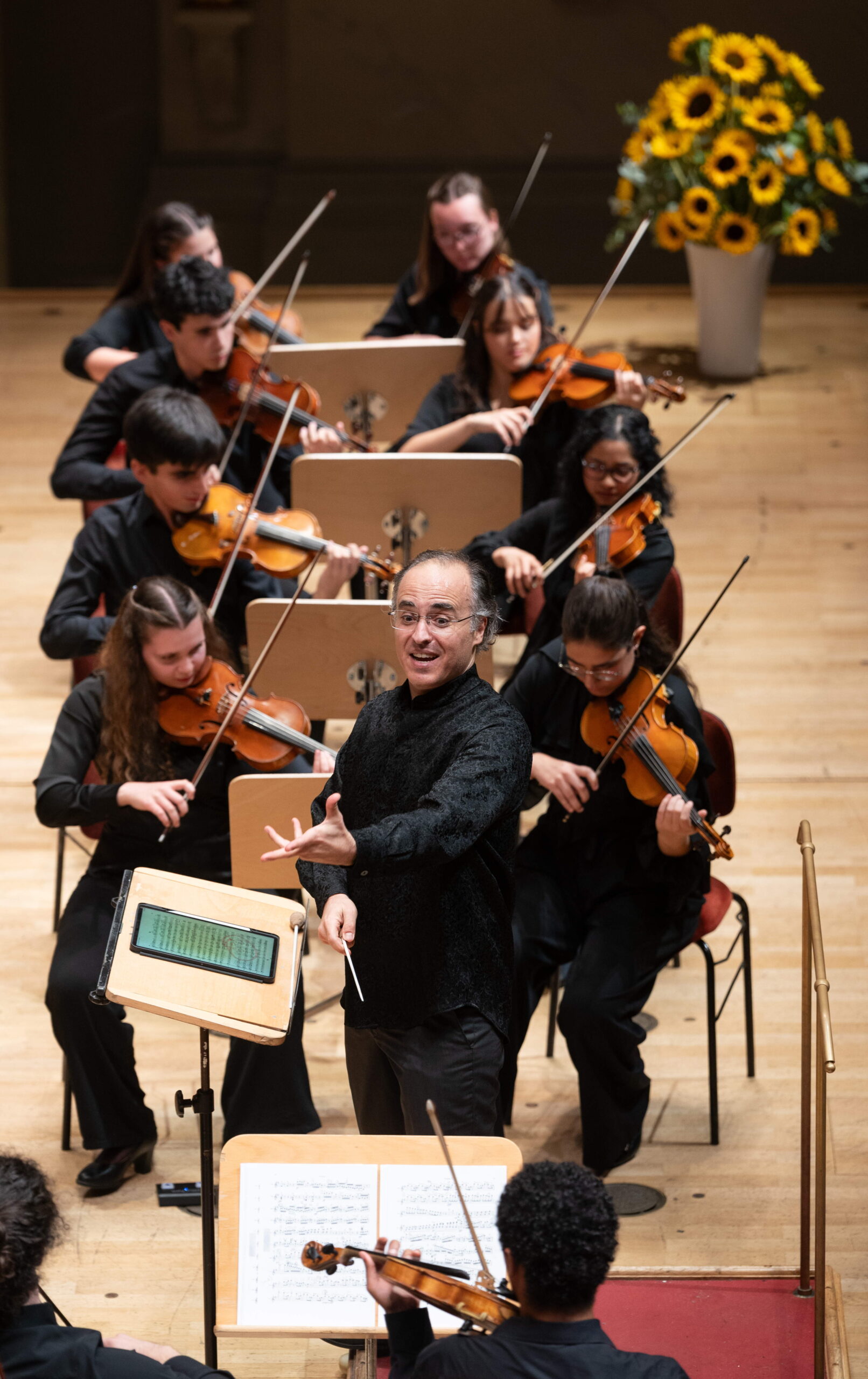 After the intermission, Pjotr Tsjaikovski (1840-1893) is heard. This Pathétique goes through marrow and bone. Pedro Carneiro takes his musicians on a journey and manages to draw an improbably intense reading from their energy. The first movement is enormously dynamic and, despite complex rhythms, surprisingly clear – you can hear that hard work has been put in – up to the climax at the end of the movement that takes your breath away. The second movement is noticeably fast, perhaps somewhat less dance-like than usual, but with an impressive role for the timpani: their rhythm, unusually forcefully worked out, makes your heart beat faster and faster. An iron-strong find that leaves you gasping for air. In the third section, the atmosphere gradually shifts from familiar rhythm to something uncomfortable: no cymbal crashes of pure joy, rather a forced cheerfulness. Kurt Sanderling once called this movement a vision of downfall, and this performance has something of that about it. The obligatory applause after the third movement breaks a arc of tension that was not yet ready to end – but perhaps it was simply necessary after three movements without interruption.
The fourth movement builds up restrainedly toward its climax. Toward the end, the heartbeat remains fierce, as if life resists with its last strength. Different from how I am accustomed to hearing this music, but perhaps precisely fitting for an orchestra of young people who are only at the beginning of their lives and from that position give their vision of this ending. It is precisely here that I hear back what João said that afternoon: this final movement is inward-looking, a moment of remembrance rather than climax for the sake of climax.
Sometimes in this performance there were moments where an instrument could have been clearer, where something did not quite line up – but with such an intense performance that is permissible, perhaps it even needs to be. Life itself is not perfect either. After the final note, there is a long silence. No one seems in a hurry to break it. After such an intense experience, I would have preferred not to hear an encore at all. But Pedro Carneiro chooses a different path. He lets his two assistant conductors take the honors and thus unexpectedly gives the evening yet another new turn.
With Vasco Ferrão at the helm, the JOP brings Movimento Perpétuo by Carlos Paredes (1925-2004), a virtuosic and rhythmic work in which the orchestra once again showcases its abilities. The atmosphere changes, the tension takes on a new form, and the young musicians seem to surrender once more completely to the joy of playing.
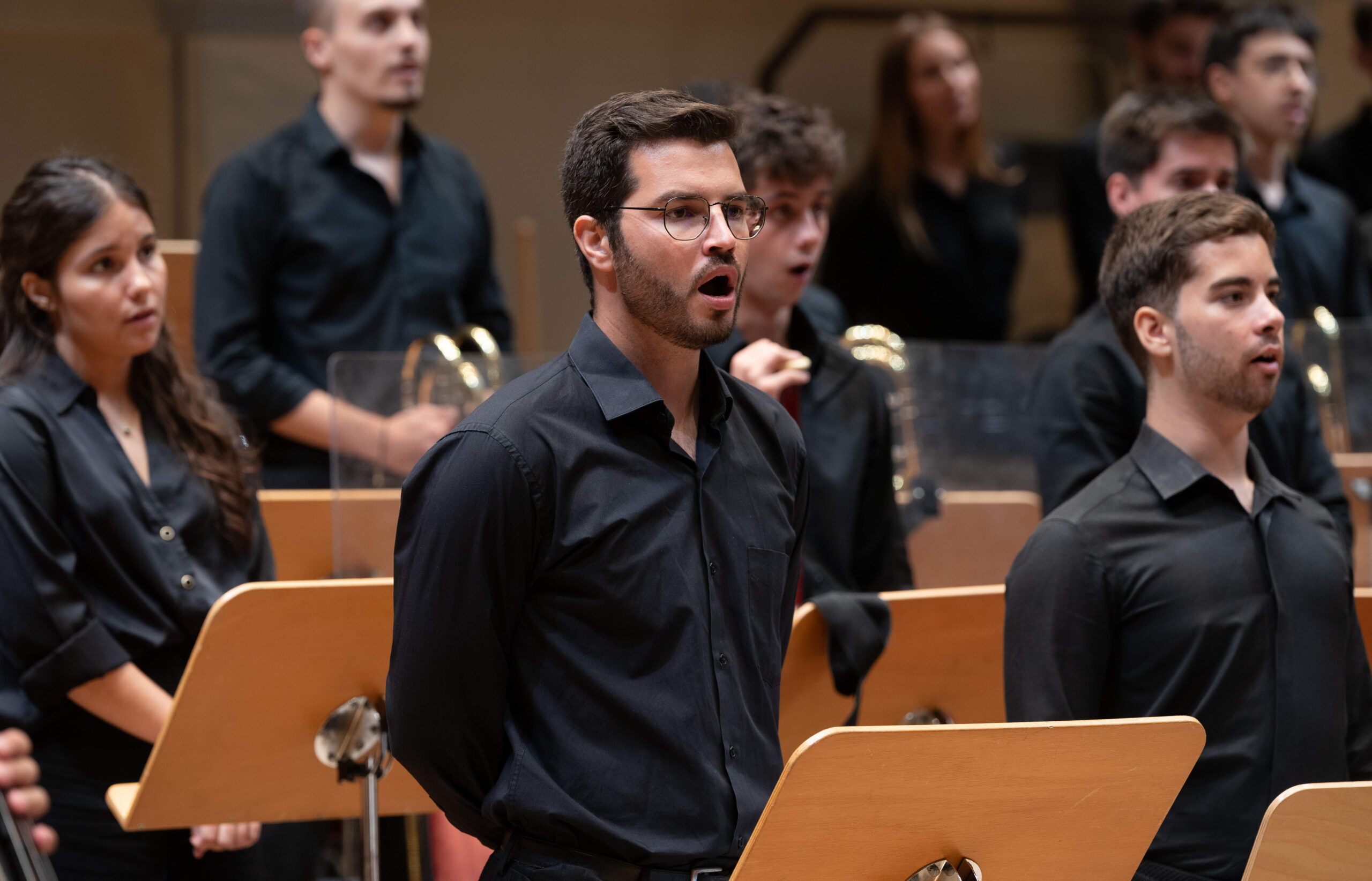 Then it becomes more intimate and at the same time perhaps the most remarkable moment of the entire evening. Under the direction of Jorge Leiria, the entire orchestra sings two politically charged protest songs by Fernando Lopes-Graça (1906-1994) that deeply move me. Suddenly the instruments are no longer the carriers of the music: the voices of the young musicians themselves fill the hall. It is a surprising, moving conclusion – and once again a striking form of saudade: music that not only looks back, but also bears witness, remembers, and preserves something of what must not be lost.
After the silence
I think back to Clara, who hoped for goosebumps. To João, who called the energy of the JOP unique. To César, who wanted especially the foreign audience to wonder where the saudade in his music precisely lies.
And perhaps the answer is this: saudade lies not only in missing home, or in the memory of those who are no longer here. It also lies in the smile during a rehearsal, in a composition that from the moment of its first sound already becomes part of the past, in the knowledge that these young musicians will soon go their separate ways – each toward their own future, while what they built here together exists only in their memory, in the music they made together and in the memory of those who were allowed to be there.
That afternoon, João, Clara, and César had tried to put words to a feeling that can scarcely be explained. That evening, those words were no longer needed.