
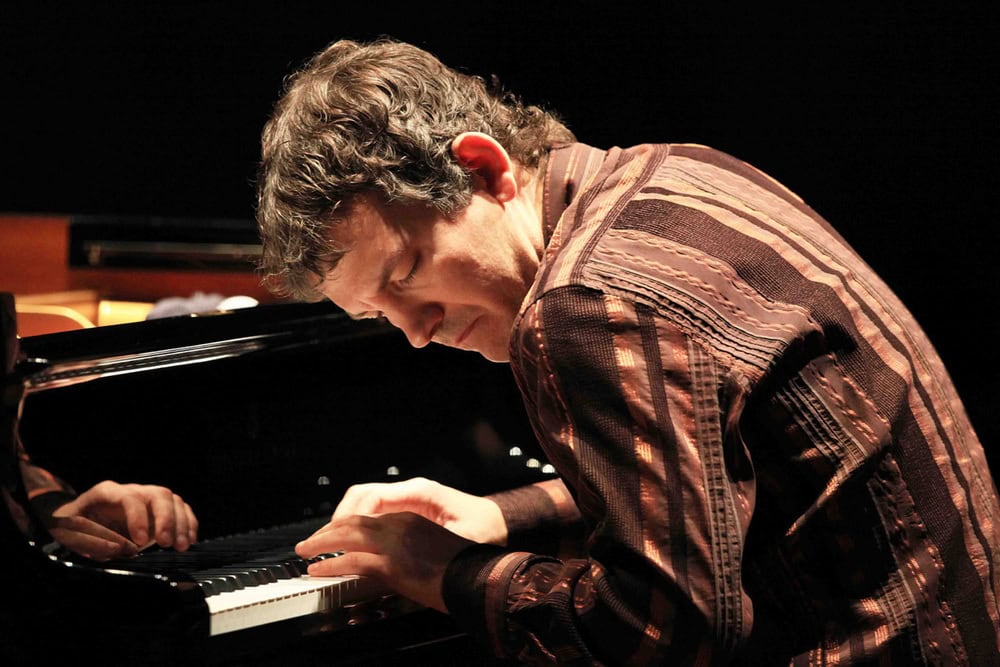
Who would want to miss a recital with Dichterliebe by Robert Schumann? One of his most beautiful song cycles. And who would want to miss Ian Bostridge singing them? One of the best art song singers of the moment. And who would want to miss Brad Mehldau, accompanying him on piano? Now that's a somewhat different question. A jazz pianist! Those two together in an art song recital? How that combination came about was a happy accident. Meeting each other, talking about music and about Schumann. A boundary-crossing project emerged from it. Dichterliebe also inspired composer Mehldau to compose his own song cycle for his friend and tenor Bostridge: The Folly of Desire. Together on stage then. The American, as always very serious, with a deeply furrowed brow at his piano, the Englishman, tousled hair and boyishly nonchalant. For that Folly of Desire, about the foolishness and especially the limits of desire, Mehldau sought texts on this hard-hitting theme from poets such as William Blake, Shakespeare, Yeats and Cummings but also from Goethe and Brecht. Bostridge sang them very articulated and so you could hear very clearly how closely the "MeToo" issue was central to that text selection. With Cummings for example: "The boys I mean are not refined, they go by girls who buck and bite, they do not give a fuck for luck, they hump them thirteen times a night."
And the music? That's harder to place, doesn't have to be either, it sounds almost abstract and he plays it seemingly unmoved. Only in Lullaby, set to a poem by W.H. Auden, could you still hear Mehldau's American roots quite well, almost a jazzy ballad.
With equal seriousness they then began Schumann's Dichterliebe. Musically quite a different, romantic color palette but textually equally about the tragedy of love and sorrow. Bostridge often sounded harsh and theatrical, Mehldau more even-toned, with restrained emotion. With these songs I want to move people, he says, and I am myself moved when I play them. For him, such a piano score is a gold mine to explore, with spare notes and many silences, and those reserved intros and long, atmospheric codas suit him perfectly. The accompaniment of that song cycle alone is a gem in itself. Brilliant. As an encore, three songs from a completely different genre. The duo performed brilliantly a couple of standards from The American Songbook, with Bostridge transformed into a crooner who outshone Frank Sinatra in that soft song about "…. The wee small hours of the morning".
His own piano concerto
Together with the Belgian National Orchestra, Brad Mehldau presented his piano concerto in a Belgian premiere the next day. But first we heard a selection from Claude Debussy's piano preludes. Work by an impressionist, arranged for orchestra by spectralist Luc Brewaeys. And that sounded not only strange in tone color but was full of beautiful orchestration effects.
You could say that Mehldau's piano concerto also begins impressionistically, but soon evolves into those typical open American sounds that remind you of Aaron Copland, especially in the brass section. And the score for the strings reminds you of those broad arrangements from film music. And in between, Mehldau plays in his inimitable style, not virtuosic but very meditative, building constructions with simple motifs, thoughtfully the way Thelonius Monk could do so beautifully. Now in dialogue with the harpist, then a jazzy riff, plenty of space left for the orchestra and fragments that should connect him with the world of classical music.
Of course another standing ovation, ending in virtuoso encores including that inevitable Blackbird from his recent Beatles CD.
A special case: jazzman Brad Mehldau solo.
ON Saturday the hall was really packed this time, young and old. Could there really be more jazz fans than lovers of classical music? But yes, it's about the star, the "artist in residence" because the Klara festival made it a three-day event. How fortunate one must be. It illustrates his star status, however humble he appears, also in the way he humbly bends over the keys of his piano. He is a writing intellectual who with broad curiosity searches for his own path in the pianistic universe, slowly growing away from the jazz idiom or rather expanding it? He improvises effortlessly through a stream of his own compositions including a beautiful Waltz for JB from an earlier album. But he also draws from, for example, the chansons of Leo Ferré in which that sad voice of the Frenchman resonates melancholically. And of course also from the Beatles repertoire, the Fab Four from his latest cd and then also from the Suite he made during lockdown including that striking title song "Remembering before all this." Brad Mehldau seems tied to no particular style, only interested in the diversity of sounds that can be drawn from a piano. And especially with those high notes far right and those dark ones far left that can be found on the keyboard. Perhaps a disappointment for those who came to hear a series of pleasant jazz standards. No, Mehldau explores his own musical mind obsessively. But when he comes up with pure bluegrass music, you hear the brilliant jazz pianist at work again. Even though he plays Jimmy Hendrix, David Bowie, Bob Dylan and yes even Georges Gershwin. Undoubtedly still an excellent improvising jazzman, who now knows how to take his audience sparingly, then at lightning speed across the boundaries of jazz.
WHO: Brad Mehldau solo and with tenor Ian Bostridge; The Belgian National Orchestra conducted by Clark Rundell.
WHAT: Brad Mehldau, The Folly of Desire and Piano Concerto; Robert Schumann, Dichterliebe (opus 48); Claude Debussy, selection from Préludes, in an arrangement by Luc Breaeys.
WHERE: Klarafestival, Henry Le Boeuf zaal, BOZAR
WHEN: 23-24-25 March 2023