
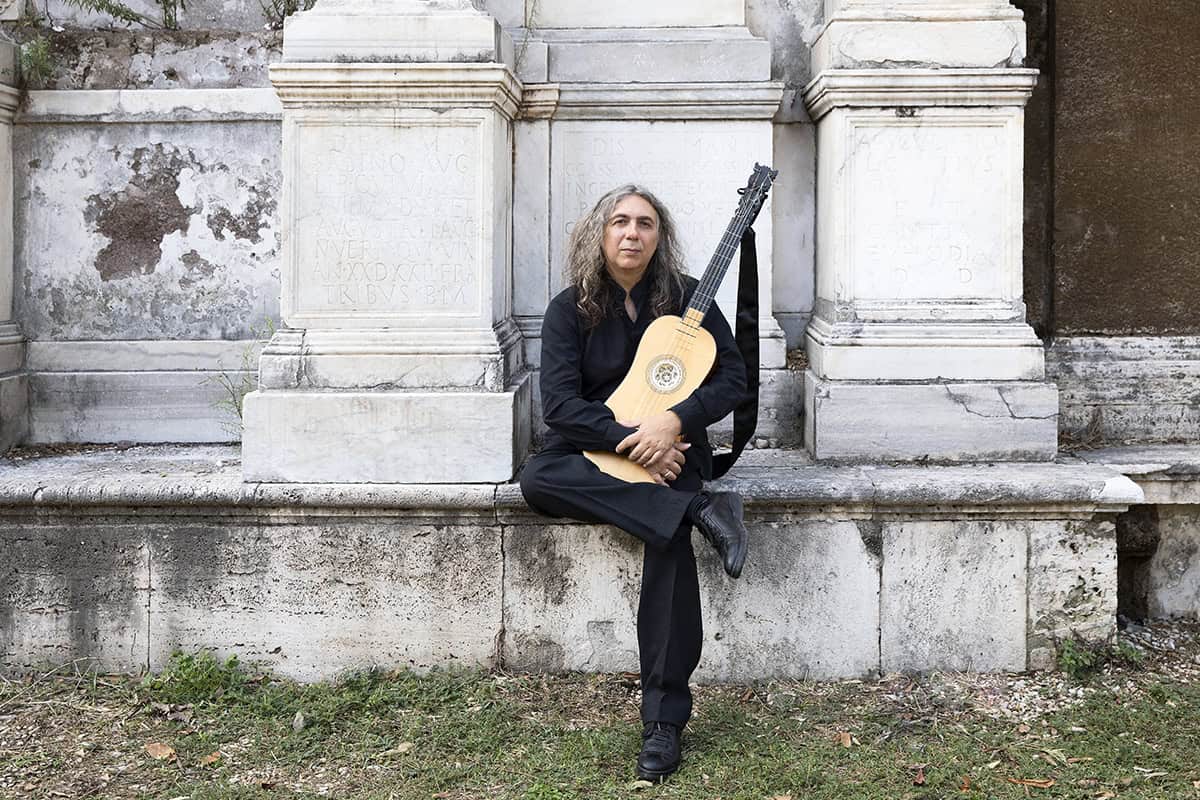
Stefano Maiorana obtained his diploma in classical guitar at the Conservatorio S. Cecilia in Rome, after which he specialized with Bruno Battisti D'Amario. He studied lute and early plucked instruments with Andrea Damiani. Subsequently, Maiorana pursued further studies in early music at Fima (Urbino) with Paul O'Dette.
Maiorana performs both as a soloist and as a basso continuo player. He is professor of Lute Performance at the Istituto Superiore di Studi Musicali Briccialdi in Terni. In 2016, he recorded his first album Intavolatura (label Fra Bernardo), dedicated to the music of Giovanni Girolamo Kapsberger (ca.1580-1651) performed on theorbe. In 2021, Maiorana recorded Entre dos almas (Arcana-Outhere Music label) with music by Santiago de Murcia (1673-1739) for Baroque guitar.
You started as a guitarist and only later turned to early plucked instruments. What made you want to explore the early repertoire?
My first love was actually the electric guitar. I started with rock music when I was a teenager. I was fascinated by, among others, Jimmy Page and Jimi Hendrix. These guitarists were my heroes and I enjoyed playing in a rock band. Then I heard the sound of a classical guitar for the first time. My father brought home a cassette with music by Segovia and then I decided that I wanted to study this instrument seriously. So I followed all the academic courses and obtained my diploma.
At the end of my classical guitar studies, two things happened that sparked my interest in early music and early plucked instruments. First, I felt that the classical guitar repertoire was too limited for me. As a classical guitarist, you often play solo, and I missed the opportunity to play with other musicians. The sound of the classical guitar is so beautiful, but in my opinion, the high-quality repertoire is not as extensive as for other instruments. I was looking for something new.
Second, during that period I had a friend who played in a Baroque ensemble. I sometimes attended their rehearsals, and when I saw them playing together, I bought a Baroque guitar so I could join in. It was a wonderful experience. I decided to make a fresh start and study again, but this time I focused on early music and early plucked instruments.
When making the transition from classical guitar to early plucked instruments, the cliché is that you have to cut the fingernails on your right hand. It is almost a ritual with which one leaves the guitar repertoire behind. Was that a difficult decision for you?
Absolutely not, because I decided to keep my nails for playing. I think there are still many misunderstandings today about historical performance practice on early plucked instruments. We know for certain that different techniques were used, especially for the right hand. For the Baroque guitar and for the theorbe, there is considerable historical evidence in which playing with nails is mentioned. Alessandro Piccinini (1566-1638), for example, wrote about the shape of the nails, and we know that Francesco Corbetta (ca.1615-1681) decided not to perform a concert because he broke a nail... In addition to written evidence, there are also images by Domenico Pellegrini (16??-ca.1682) who had very long nails on his right hand, and so on.
I decided to specialize in the repertoire of the late 16th century — a repertoire that seemed well suited to my right-hand technique. Of course, I had to deviate somewhat from classical guitar technique, but I am convinced that this repertoire is easier for guitarists who want to approach early plucked instruments.
Music from that time that was written for one particular plucked instrument could easily be played by other plucked instruments. This was possible because of the way many tablatures were written in a non-idiomatic style. You play both Baroque guitar and theorbe. How do you decide which music you play on which instrument?
Although it is possible for part of the plucked instrument repertoire to choose different instruments to play the same music, the music for the Baroque guitar and the theorbe is highly idiomatic. So there are no pieces written in tablatures that you can play on both instruments. You can make an arrangement of the original tablatures, but it is so difficult and sometimes impossible to replicate on other instruments certain special effects that are unique to these two instruments.
On your first CD Intavolatura, you concentrated on the music of Kapsberger and played it on the theorbe. On your second CD, you play music by Santiago de Murcia on the Baroque guitar. In doing so, you bring forward names that are generally not very well known. Do you think it is important to reintroduce these names to a broader audience and not to limit yourself to the great masters?
Kapsberger is one of the most important composers for the theorbe, and the same applies to Murcia and the Baroque guitar. But compared to other Baroque composers such as Bach or Vivaldi, they are indeed not famous. Yet I think we can still find something special in their music, and perhaps through a different repertoire it is also possible to find a new audience that appreciates their pieces.
Personally, I don't enjoy listening to the same piece by a famous composer repeatedly, even though you can always find something new in it. Usually, I prefer to discover new repertoires or approach a known repertoire in an unusual way. It's a challenge, and I'm certain there's an audience that is just as enthusiastic about new musical discoveries as I am.
Do you yourself delve into the archives in search of new repertoire? Or do you work together with musicologists?
Particularly for early music, musicological research is really important. It helps us performers understand the music on a deeper level. When I investigate a new composer, I read a lot of musicological research that is published about him or the artistic period in general. For this cd as well, for example, I studied many articles by musicologists. Not only about the composers or the musical instruments, but also about the artistic and political context in which the musicians lived and worked.
The music of Santiago de Murcia is diverse and features different styles, musical languages and influences. How do you experience his music as a performer and which aspects of his oeuvre have you brought to life on your album?
The aim of the album was to explore the relationship between the Italian and the Spanish style; these two are very different styles. Murcia's music makes this interesting for several reasons. First, he is one of the last composers for Baroque guitar and his musical language is advanced. Second, in his Baroque guitar tablatures he tried to push the boundaries of what was possible on the instrument. And finally, he had a very European vision and integrated different traditions into his own music.
In the album, this relationship is translated into the Corelli transcriptions and the more folkloric pieces such as Canarios [track 10] or Jácaras [track 16]. In the Corelli transcriptions - which were originally written for violin and basso continuo but are played here solely on the Baroque guitar - you must play the melody, the bass and the continuo together. To make this possible, Murcia overcame the boundaries of the instrument and also experimented with what the instrument had to offer in the variations of all the dances.
If I had to describe the composer and his music, I would say that he was a mature composer, but at the same time remained curious about the musical possibilities of the Baroque guitar.
So in putting together the programme, you really focused on the Italian and Spanish style. What are, for you, the differences between the two in the music of Santiago de Murcia?
In my opinion, there is a major difference between these two styles that is clearly evident in the structure of the music. In the Spanish repertoire (in pieces such as Jácaras, Canarios and Fandango), the music often has an open and more free structure. In the Italian repertoire, on the other hand, especially in the music of Corelli, the music is driven by a beautiful, fixed structure.
A second difference is that in the Italian repertoire, the melody plays a very prominent role, whereas in the Spanish folkloric repertoire there is a rhythmic component that gives the music its drive. It was interesting for me to investigate how the Baroque guitar could express these two different styles. This album shows the possibilities of an instrument that can be both melodic and rhythmic. In pieces such as Tarantelas [track 08] you hear a prominent percussion effect, while in the slow movements of Corelli you can listen to the lyrical beauty of a melody.
In the Spanish repertoire, I also had the freedom to experiment more with ornaments. I sought out different solutions and special effects, such as different types of golpe (a playing technique where one taps the sound box of the instrument with the fingers) or rasgueado techniques (rhythmic, fast plucking that characterizes flamenco).
Your album Entre dos almas received many positive reviews. Do you plan to release other concert programmes of yours on cd in the future?
In recent years, I have been fortunate to experiment with new music for historical instruments and discover new possibilities. Especially for the theorbo. I have a duo with classical guitarist Magnus Andersson, one of the leading guitarists for contemporary music. He plays both classical and electric guitar and I play the theorbo and the Baroque guitar. Together with Magnus, we want to continue this collaboration and try out more new pieces for this special duo.
I also performed as a theorbist in a new piece by Claudio Ambrosini (°1948) Tancredi appresso il combattimento (2019), which is an epilogue to Monteverdi's Il combattimento di Tancredi e Clorinda (1624). It was a wonderful experience to play such beautiful contemporary music.
I am also working on a new album that will be released by Arcana over the course of next year. It is something very special that reveals unexpected possibilities for the theorbo. Let me conclude by saying that I am very grateful to Outhere and especially the artistic director of the Arcana label Giovanni Sgaria, who supports me in my artistic adventures.
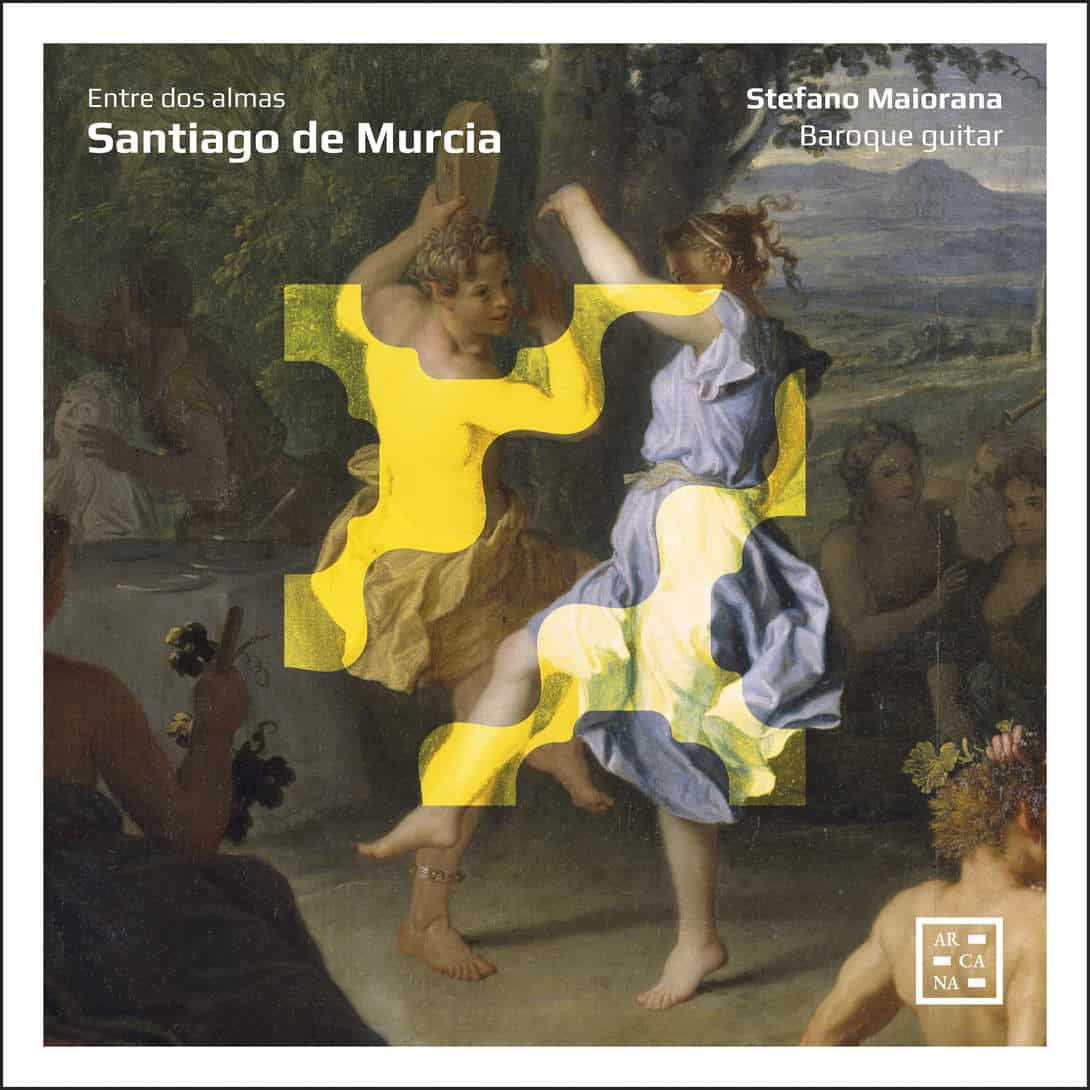
Entre dos almas
- WHO: Stefano Maiorana [baroque guitar]
- WHAT: Arcana A484
- ORDER: JPC