
Some composers you don't meet in the concert hall or via a carefully planned listening journey, but simply by chance. That's what happened to me with Giorgio Federico Ghedini (1892-1963). On an extensive box set devoted to the legendary conductor Guido Cantelli, one of his orchestral works was programmed, more as a footnote than as a highlight. What began as curiosity quickly grew into fascination. Since then, I regularly return to Ghedini's music, which seems to unfold further with each new listening. It doesn't reveal its secrets immediately, but those willing to listen discover a composer of exceptional depth, an independent spirit who never allowed himself to be seduced by musical fashion or dogma.
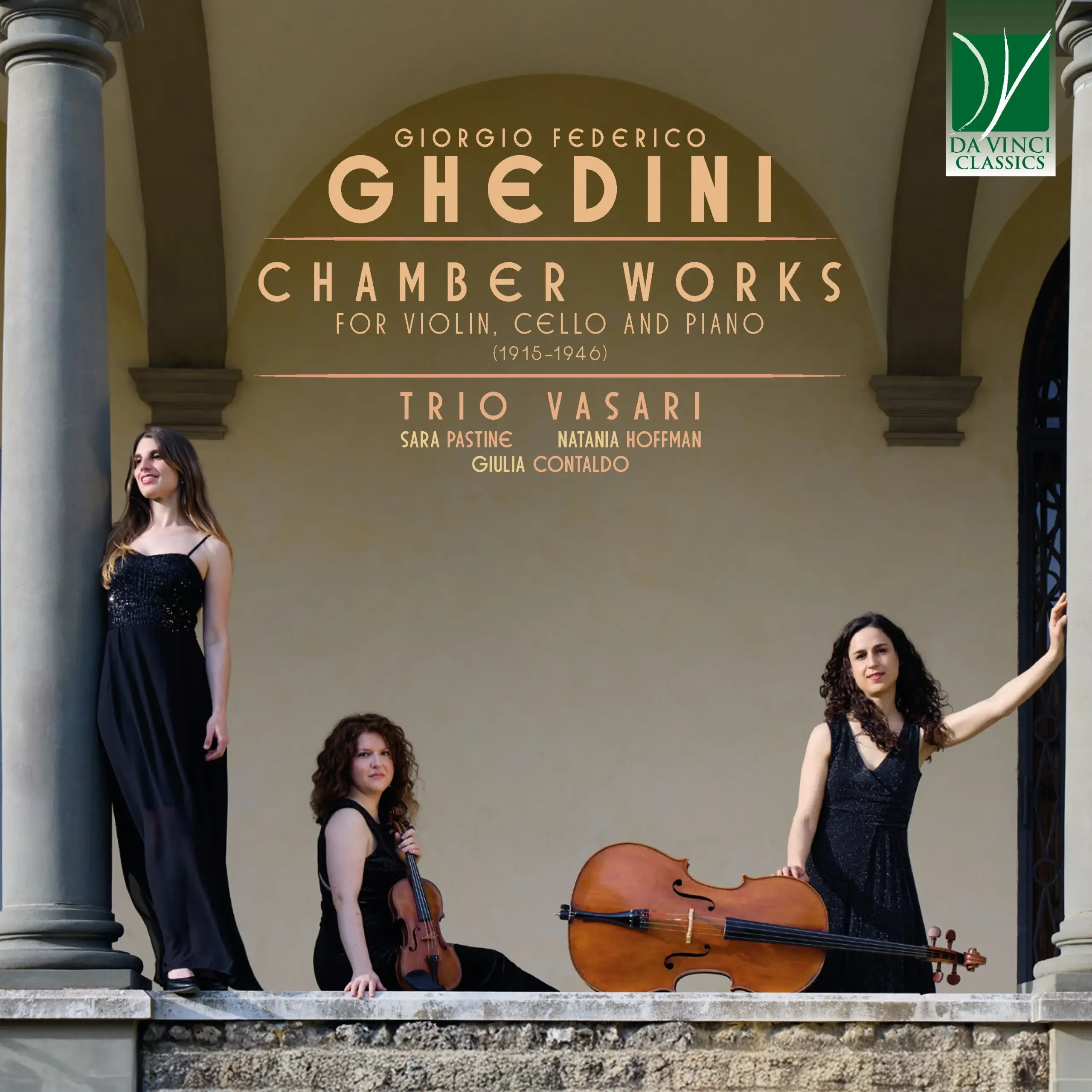
That independence is strongly expressed in Chamber Works for Violin, Cello and Piano (1915-1946), the new release by Da Vinci Classics featuring the young Trio Vasari. The program spans more than thirty years of Ghedini's oeuvre and sketches a representative portrait of a composer who, while firmly rooted in the mid-twentieth century, constantly engages in dialogue with the musical heritage of Monteverdi, Gabrieli and Frescobaldi. It is precisely this independent approach to the past that makes Ghedini an outsider in his time.
The fact that Ghedini still has not secured a permanent place in international concert life remains remarkable. Yet he enjoyed great prestige during his lifetime, not only as a composer but also as a teacher. Luciano Berio was among his students and always spoke with great respect about his mentor. Conductors such as Guido Cantelli and later Claudio Abbado also held his music dear, though a true international breakthrough eluded him. Yet Ghedini never really fit into the boxes in which music history likes to think. He was not a modernist in the orthodox sense of the word, nor an outspoken neoclassicist. His approach to the past is anything but archaeological. Old forms and contrapuntal procedures are never ends in themselves, but form the foundation for a highly personal musical language. Polyphony, an almost vocal linearity and finely balanced architecture go hand in hand with a harmonic idiom that resists easy categorization into a single stylistic direction.
You hear this perhaps most clearly in the impressive Sette Ricercari, undoubtedly the centerpiece of this recording. The title alludes to a Renaissance form, but Ghedini writes no contemporary pastiches. Each Ricercare develops as an independent musical organism in which motifs grow slowly, branch off and dissolve again. The music breathes, slows and accelerates as if it possesses its own natural pulse. The work forms both the architectonic and expressive heart of this release and presents Ghedini at the height of his contrapuntal imaginative power.
Precisely herein Trio Vasari demonstrates its great class. The ensemble understands that this music does not benefit from Romantic pathos or exaggerated expressivity. Sara Pastine, Natania Hoffman and Giulia Contaldo resolutely opt for clarity, transparency and a refined buildup of tension. Their ensemble playing demonstrates remarkable homogeneity, all the more remarkable for an ensemble founded only in 2024. Pastine's violin maintains its elegant, singing line, Hoffman lets her cello speak with warm, dark resonance and Contaldo constantly guards the architecture of the whole from the piano without ever becoming dominant.
What stands out in particular is how naturally the three musicians bring Ghedini's special tonal world to life. The contrapuntal lines remain perfectly audible throughout, while the music never sounds cerebral or academic. On the contrary: beneath the strict construction lies constant intense emotional charge. The fourth Ricercare possesses a nervous motor impulse that sometimes recalls Bartók or Hindemith, while the fifth breathes an almost hushed melancholy that points forward to the mysterious universe of Concerto dell'Albatro. Here one is not playing to impress; here music is made from a deep understanding of the score.
The smaller compositions also deserve all attention. The Canoni for violin and cello show how inventively Ghedini handles the strictest contrapuntal techniques without losing spontaneity. The Elegia drammatica and the simple Elegia are among his most direct pages. Especially in the latter, Hoffman finds a tone of restrained melancholy that deeply moves without ever becoming sentimental.
The two early Intermezzi from 1915 conclude the cd. Although young Ghedini here still draws closer to the late Romantic idiom, his characteristic features are already clearly present: the refined harmonies, the organic development of motifs and the continual dialogue between lyric and counterpoint. The playful second intermezzo, Bizzarro, receives from Trio Vasari precisely the right lightness and irony.
Technically speaking, this release also leaves little to be desired. Da Vinci Classics opts for a warm, natural recording in which the three instruments remain exemplarily balanced with each other. The transparency of the sound image allows Ghedini's often densely woven counterpoint to fully come into its own without sacrificing warmth or spontaneity. The extensive liner notes in the cd booklet also place the works in their historical context and help the listener better understand this little-known music.
Increasingly, record labels and musicians seem willing to revisit composers who have unjustly remained in the shadows for years. Ghedini undoubtedly belongs to that category. His music may require a bit more concentration than familiar repertoire, but it richly rewards that attention. It possesses a rare combination of intellectual depth, poetic stillness and craftsmanly perfection.
With this recording, Trio Vasari immediately confirms itself as an ensemble to watch closely. Their interpretations are not only technically exemplary, but above all testify to remarkable stylistic insight. And perhaps that is the greatest compliment one can give this cd: after it concludes, you want not only to listen to the recording again, but especially to turn again to the music of Giorgio Federico Ghedini. That was precisely the feeling I took away from that chance discovery on the Guido Cantelli box back then. Good music sometimes finds the most unexpected path to the listener.