
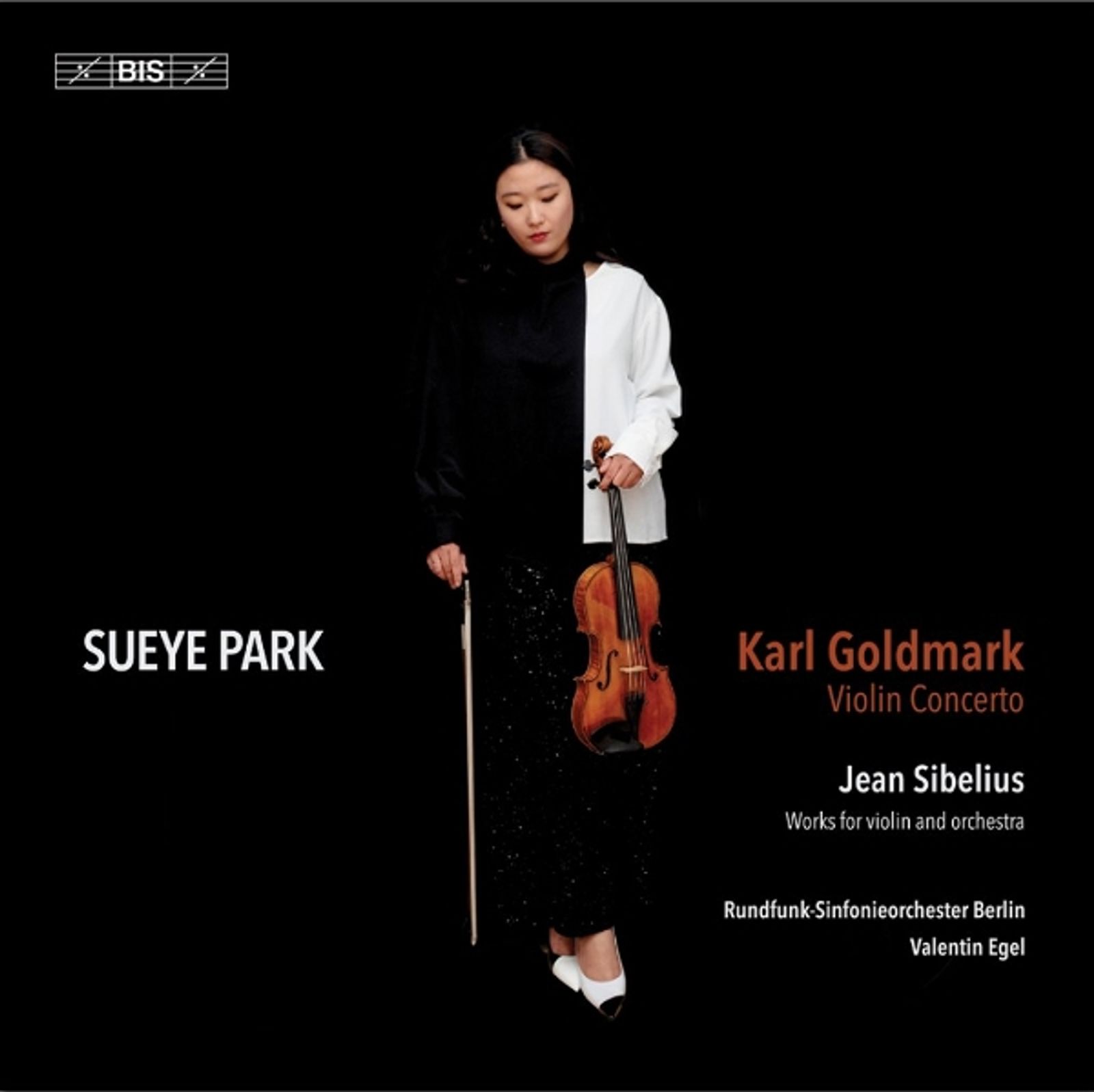
There are recordings that bring together repertoire because it fits nicely on one cd. And there are recordings that start from an idea, a historical encounter, a barely noticed affinity that only takes on meaning in the music itself. This new BIS release unmistakably belongs to that second category. That Karl Goldmark (1830-1915) and Jean Sibelius (1865-1957) met each other in Vienna when the young Finn perfected himself with the older master around 1890 for a short time is hardly more than a forgotten episode in music history. Although Sibelius ultimately developed an entirely personal musical language, that brief Viennese period did bring him into direct contact with the late Romantic tradition of which Goldmark was one of the most distinctive representatives. Violinist Sueye Park makes that historical footnote the starting point of a recital that does not so much place two composers side by side, but lets us hear how a musical idea can carry forward from one generation to the next.
The program testifies to a well-considered vision. Goldmark and Sibelius were both violinists before they chose composition definitively, sought a personal voice without renouncing their national roots, and wrote for the violin music in which virtuosity never stands apart from song. These are not spectacular similarities, but subtle affinities that this recording slowly reveals.
Goldmark's Violin Concerto opens the cd and immediately forms its focal point. It is a work that is virtually never performed today, and actually it is incomprehensible, for it remains one of the richest violin concertos from the late Romantic era. Everything breathes abundance here: long melodic arcs, broad orchestral sonorities, Hungarian rhythms that organically blend with Viennese Romanticism, and a composer who never holds back for fear of one note too many. At the same time, Goldmark remains remarkably restrained in his sense of form: behind the apparent abundance lies a carefully constructed arc of tension in which lyric and drama continuously balance each other. Precisely for this reason, this concerto demands a soloist who sees beyond the virtuosic surface.
Sueye Park possesses that gift. What immediately impresses is her tone: clear at the core, warm in color and never sharp, lyrical without indulging in charm. She plays Goldmark not as a forgotten bravura piece deserving renewed attention, but as music that still possesses its own inevitability. Technical difficulties simply seem not to exist for her. Everything sounds so natural that you quickly forget them. No less impressive is her sense of phrasing. No musical idea is forced; each phrase flows naturally from the previous one, whereby the concerto retains its natural breathing.
The lyrical middle section, the Air, forms the emotional center of her interpretation. Less gifted violinists make of this page an exercise in romantic luxuriance. Park chooses precisely the opposite path. She trusts the melody, lets it breathe without stretching it and thereby finds a poignancy that does not spring from sentimentality but from simplicity. Precisely because Park avoids any kind of effect-seeking, her restrained approach acquires a natural calm that is rare in performances of this concerto. Valentin Egel also understands that Goldmark's concerto does not benefit from exaggerated pathos. Under his direction, the Rundfunk-Sinfonieorchester Berlin sounds warm and richly nuanced, but never heavy. The orchestral sound supports, responds, and breathes along without ever overshadowing the soloist. That balance between orchestral grandeur and chamber music transparency is among the great qualities of this performance. As so often with BIS, the recording itself leaves nothing to be desired: spacious, natural, and with a balance in which both the finest orchestral details and the nuances of Park's tone production come fully into their own.
Those seeking the most passionate or extroverted reading of this concerto will find it sooner in Joshua Bell's recording with Esa-Pekka Salonen, in which the romantic abundance is sought even more pointedly. Park consciously chooses a more restrained path. That is not a shortcoming but a deliberate interpretive choice, though lovers of pronounced drama will immediately notice that shift.
After Goldmark's monumental concerto, the atmosphere changes completely. It is precisely in that contrast that this cd reveals its deeper meaning. Where virtually everyone would have chosen Sibelius' famous Violin Concerto, Park and Egel opt for three works that are performed far less frequently: the late Suite for Violin and String Orchestra, JS 185, Two Serious Melodies, op. 77, and two Humoresques, op. 87 and op. 89. With this, not only the repertoire shifts but also the perspective. The exuberant late Romanticism of Goldmark gives way to a composer who with ever fewer notes knows how to say ever more. Where Goldmark develops broad melodic lines, Sibelius seeks concentration: subtle harmonic shifts and sparing use of musical means give his music its special significance.
Here you hear how Sibelius increasingly leaves late Romanticism behind. The melodies become more austere, the gestures smaller, the significance all the greater. There is an almost Scandinavian clarity in this music: not emptiness, but space. Park senses that shift infallibly. Where she dares to sing broadly in Goldmark, she seeks quietude here. Her playing becomes more introverted, less directed at projection than at concentration. Especially the Two Serious Melodies thereby acquire an almost meditative intensity. They seem not to be played but thought, wonderfully sustained by the orchestra, in which the harp especially subtly comes to the fore.
The Humoresques too show a different side of Sibelius than the composer of the symphonies and the violin concerto. Their playfulness always remains lightly ironic, never superficial: a roguish phrase is rarely completed, a melody deflects just before it seems to settle. This demands a soloist who masters lightness and precision simultaneously, and Park finds precisely that balance between elegance and caprice that makes these miniatures much more than charming interludes. Behind that apparent lightness, moreover, lies compositional refinement, in which rhythmic shifts and unexpected harmonic accents lend the music a subtle tension.
What ultimately makes this recording so convincing is that it never gets stuck in illustrating a historical anecdote. The meeting between Goldmark and Sibelius forms no selling point, but a starting point for a broader thought about musical transmission. Not everything a master leaves behind can be pointed out in harmonies or motifs. Sometimes an influence lives on in a way of listening, in a sense of form, in the inevitability with which a melody develops. That invisible heritage resonates here again and again.
This is a recording I will listen to frequently, because few recent violin recitals are constructed as consistently as this one. Repertoire choice, interpretation, orchestral playing, recording quality and the exemplary BIS production continuously reinforce each other. Following her victory at the International Jean Sibelius Violin Competition in Helsinki in 2025, Sueye Park confirms with this recording that she is much more than an exceptionally gifted violinist. She proves to be a musician who thinks in programmes, creates connections and allows repertoire to speak anew without wanting to reinvent it. This CD proves that a historical footnote is sometimes enough to open an entirely new perspective on familiar repertoire. Not because Goldmark and Sibelius suddenly resemble each other, but because Sueye Park shows how music connects generations with each other without losing its own identity. That is precisely where the lasting value of this exceptionally well-considered recital lies.