
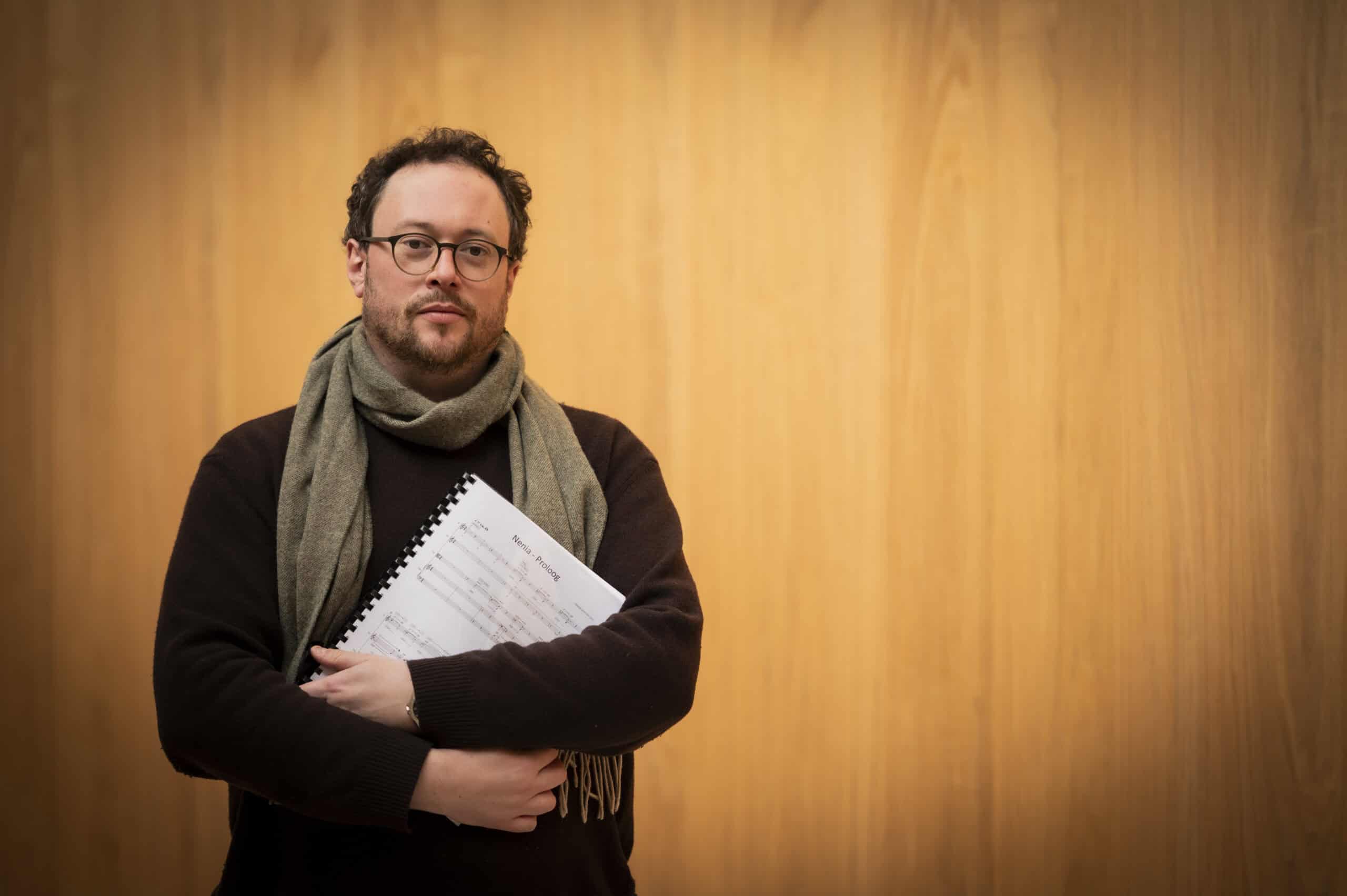
With his new Concerto for trombone and orchestra, composer Frederik Neyrinck (°1985) adds a work to the contemporary repertoire. On the occasion of its world premiere during the Antwerp Spring Festival on Thursday, April 23 (https://www.antwerpspringfestival.be/programma/the-planets), he spoke with Werner De Smet for Klassiek Centraal about his musical language, his working method and the role of the trombone within this new work, which unfolds as a personal and at the same time experimental trajectory. The fact that he played trombone himself in his youth forms an important source of nourishment for his affinity with the instrument. As a young musician, he learned what ensemble playing means through brass band and big band, an experience that greatly broadened his musical horizons. At the same time, his practice consciously moves between diverse domains: from solo to chamber music and orchestra, and from collaboration with other artists to projects that depart from existing repertoire, with also experiences in music theater and opera.
A musical language in motion
Frederik Neyrinck describes himself as a composer who moves between different instrumental configurations and consciously chooses versatility. In doing so, he likes to engage in dialogue with other artists and views his compositions as a kind of tree with branches, "whose branches sometimes touch each other to reach new directions." This way of thinking aligns with his vision of music as a continuously evolving organism, in which parameters such as pitch, rhythm, timbre and dynamics gradually evolve, without abrupt breaks.
He deliberately avoids identical repetition. Instead, he works with what he calls "transformed repetition," an approach he came into contact with during the analysis lessons of Jan Van Landeghem, partly through the work of Karel Goeyvaerts and the concept of "evolutionary repetitiveness." This way of working, even when not explicitly audible, forms an underlying layer in his thinking and writing.
His stay in Austria represented an important deepening, both musically and in his understanding of how the cultural sector works. At the same time, his foundations lie in his youth in Wevelgem, where he was active within the brass band Eigen Schoon and later in a big band; those experiences continue to work through in his practice as a performer. Also within the Platynus Ensemble, of which he was a member as a pianist until 2018, he was able to develop further by being closely involved in the creation of new work. In that context, his understanding grew of the relationship between composer and performer, with attention to notation and practical feasibility, but also to the physical character of music: breathing, phrasing and physicality, which also play a role during composition.
Sound, space and the trombone
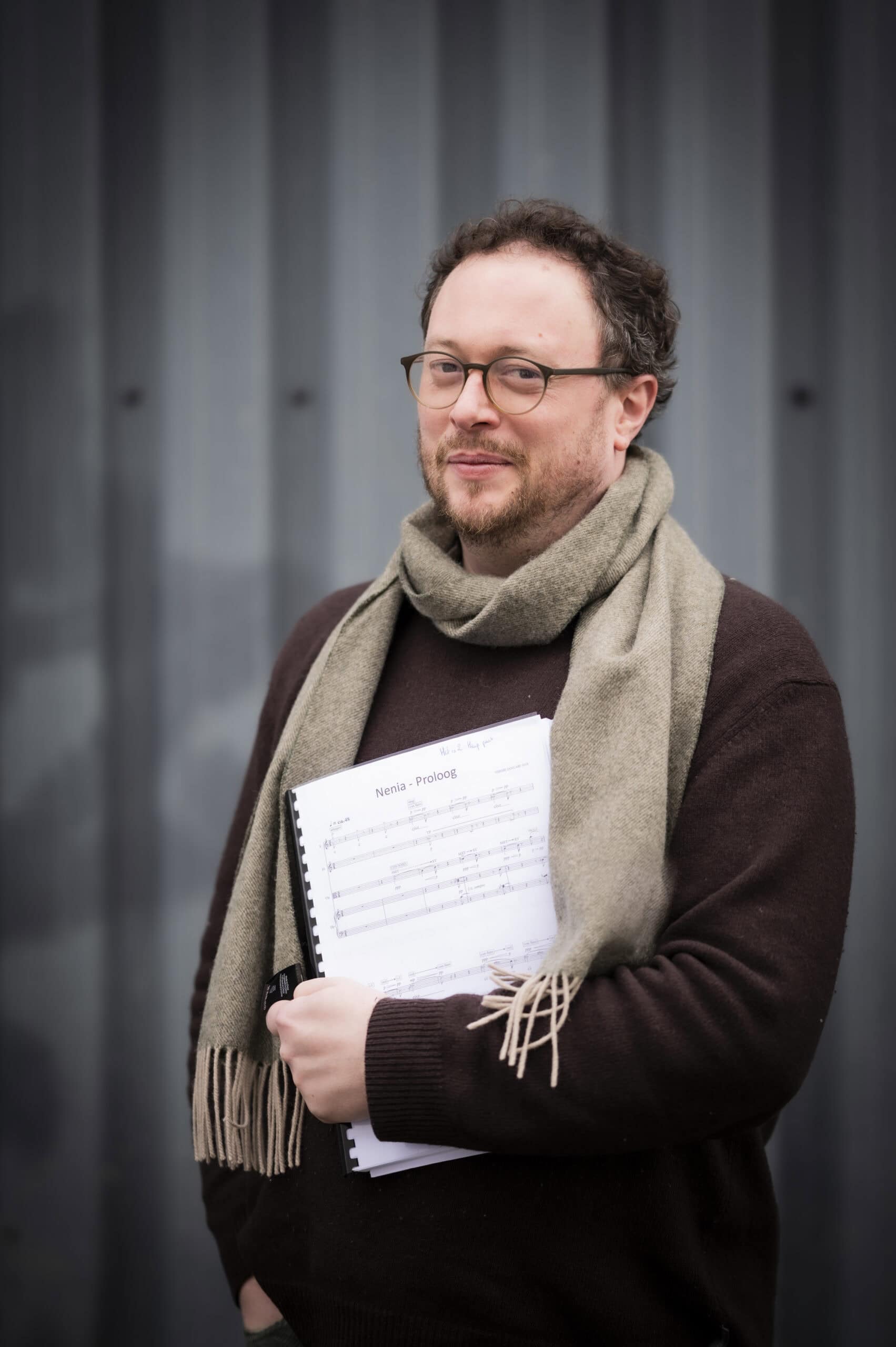 This physical and tangible aspect is strongly evident in his work for trombone. The instrument allows him to let pitches glide through glissandi and manipulate timbre with mutes, while working with tonal centers that gradually shift and thus create movement.
He wrote the concerto for trombonist Bram Fournier, with whom he works closely within I SOLISTI. The work is explicitly written to measure for the soloist. During composition, he kept this musician's sound and playing style continuously in mind, so the concerto is in a sense written for this specific performer.
The solo part is virtuosic and demanding, with passages that balance on the edge of feasibility and are also physically demanding. Due to the length of the through-composed work and the use of the high register, the piece is also an endurance test. At the same time, technical elements such as mutes, including a wah-wah mute with written-out hand movements, play an important role in the sound palette.
A central role is played by the relationship between soloist, orchestra and space, described by Neyrinck as the "physiognomy" of the instrumentation: the way instruments relate to each other and to space. In the concerto, two trombones are placed in the hall, so the audience finds itself in the middle of the sound field and sounds seem to come from different directions. This creates a tension between intimate spatial moments and more frontal orchestral passages. The three trombones function as voices that communicate with each other in space and flow into each other within a through-composed whole, without interruptions between individual sections.
Inspiration and structuring thought
An important source of inspiration for the work is the okapi, which is not used as a narrative line, but as a sonic and structural point of departure. The so-called "okapi calls" refer to low frequencies and are translated into, among other things, passages in the deep register, in which the sound of the trombones becomes almost physically tangible. This translates, for instance, in the use of very low pedal tones, which allude to frequencies that are barely audible to humans.
At the same time, Neyrinck uses characteristics of the animal to shape the overall structure of the work, without imposing a narrative or scientific framework. In addition, he draws inspiration from visual art, in particular the work of Wassily Kandinsky and Paul Klee, and from Igor Stravinsky, who managed to maintain his own voice within different styles.
The composition process typically starts with a sketch that serves as a guide, but is continuously adjusted and refined during the writing process. Neyrinck writes everything by hand and then works out the score on computer to finish it. Often the work emerges in dialogue with performers, whereby through conversations and ideas an initial concept takes further shape. He remains in contact with the soloist during the process, which also determines how the work evolves.
Doubt plays a role in this, as does the importance of material that ultimately disappears. That material can open new directions and thus contribute to the further development of the work. Even when the writing process proceeds laboriously, he continues to work consciously, also on material that is later deleted, because this yields new insights.
New Music as Movement
For Frederik Neyrinck, the listener must be free to approach the work. The okapi can provide an entrance, but imposes nothing. He emphasizes that everyone listens differently and that there is no right or wrong interpretation. The abstract character of instrumental music leaves room for personal interpretation, and that openness is part of his musical language.
He sees new music as a necessary part of a living musical fabric, in which creation keeps the repertoire in motion. Labels and categories are less relevant to him than the fact that music exists and sounds. He does not view the tension between tradition and innovation as leading, but as something that is filled in by others.
For him, composing is not an endpoint, but a process in motion. He emphasizes the present: music must have meaning today and contribute to the musical field, rather than being aimed at lasting recognition in the long term.
Outlook
With the world premiere in sight, Frederik Neyrinck looks forward to the first performance and rehearsals, which he regards as a phase in which the work develops further. In collaboration with conductor Martijn Dendievel and the performers, further adjustments are made, while clear notation leaves room for interpretation. According to him, the first performance will yield new insights, with both confirmations and surprises.
Festivals provide him with an important context for new music, as they give the audience the chance to immerse themselves in different works in a short time. Within the programming, he also sees a visual dimension, whereby titles and associations can stimulate the listener's imagination. Besides this work, he looks forward to other projects, including Adem De Stad with I SOLISTI. What continues to drive him is the search for new sound worlds and collaborations.
For Neyrinck, composing remains a movement – a process in which music continually develops and takes shape in the encounter between composer, performer and listener.
Klassiek Centraal looks forward to the world premiere of his Concerto for trombone and orchestra and will report on it. Those who would like to listen to some of his other works as a foretaste can do so here: https://soundcloud.com/frederik-neyrinck and https://open.spotify.com/artist/1OksC50mLm7lB2q3kCt4GV?si=j1bWaEJLS0yzl1pkRbMJEA&nd=1&dlsi=344d1370a3f040c3