
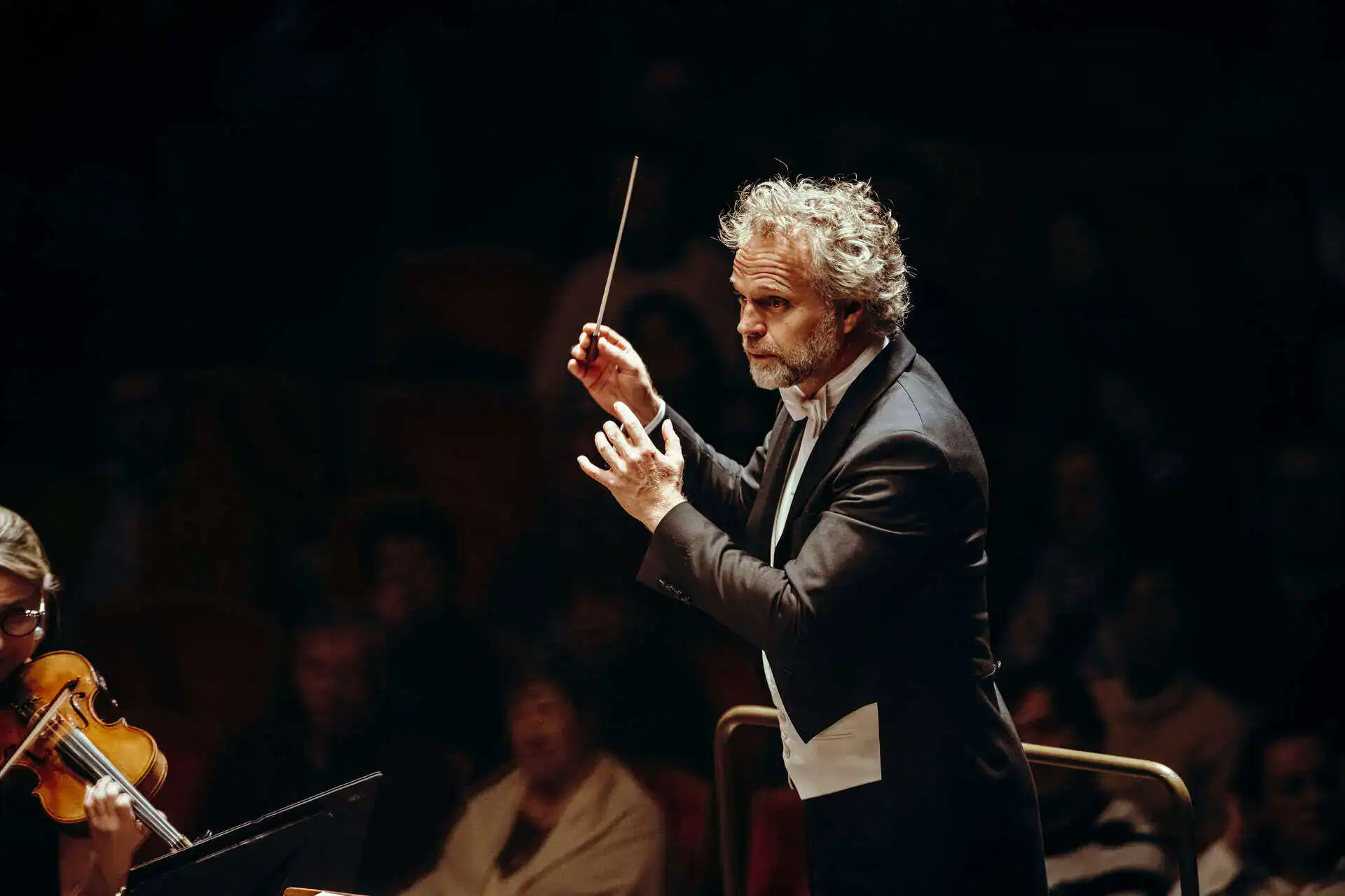
There are concerts that do more than break the silence — they let it speak. Moments when music not only sounds, but lives. Where every note breathes and hints at something unspeakable. Such an evening unfolded on Sunday, October 19 in the Elisabethzaal, where Jan Lisiecki, the young Canadian piano virtuoso, together with the Royal Scottish National Orchestra (RSNO) under the inspired and supremely assured baton of Thomas Søndergård, brought not merely a program, but a journey between turbulence and stillness. What unfolded here was a musical revelation — a rebirth of flatly-played works by Ludwig van Beethoven (1770-1827) and Felix Mendelssohn (1809-1847) that gained new lustre.
Three times gold
Striking: since the reopening of the Elisabethzaal in 2016, this was already the third time Cofena welcomed the RSNO — and each time Søndergård was at the podium. Whether coincidence or not, this concert too carried the number three within it: Beethoven's Third Piano Concerto and Mendelssohn's Third Symphony ('the Scottish'). A symbolic triptych that did not go unnoticed: this third meeting between orchestra and audience proved once again to be a complete success — proof that some collaborations only deepen their roots with time.
The war of the soul
Beethoven's Third Piano Concerto remains an inner struggle between light and darkness. The opening chords sounded like a gateway to something irrevocable — a call to resistance. Lisiecki answered with an inner glow that was restrained yet burning: strength and fragility intertwined in a language of exceptional purity. His playing was no showpiece, but an intimate confession; the piano seemed to speak without words, a dialogue with itself and the space. What stood out was the perfect unity between soloist, conductor and orchestra: everything flowed effortlessly, without tension or rupture. The choice to play the three movements attacca strengthened the dramatic line and kept the tension continuously alive.
In the Allegro con brio, piano and orchestra challenged each other in a play of shadow and light. Søndergård led the RSNO with a rare blend of precision and warmth. Every dialogue between soloist and orchestra sounded like a step in a larger story, as if Beethoven himself were listening over the shoulder.
The Largo offered no rest, but a breathing space in a world that kept moving. Lisiecki's touch was velvety, almost weightless. Silence took shape — a space in which the music continued to sing. The strings accompanied him with a gleam like breaking light through clouds. Here Beethoven was not performed, but reinvented.
The finale, the Rondo (Allegro), burst forth like a liberating storm, but instead of triumph, acceptance resonated. Lisiecki's final notes carried peace within them — the serenity of one who has embraced his storms. Rarely has this concerto sounded so complete, so balanced between struggle and reconciliation.
As we know Lisiecki from his impressive Beethoven recordings and other live concerts, this too became a memorable performance that completely captivated the audience. The applause burst forth, an expression of gratitude for such intensity and refinement.
Encore: Lisiecki gave us Nocturne No. 20 by Frédéric Chopin (1810-1849). The hall held its breath. After the storm of Beethoven, this sounded like a balm — a whisper that summed up all that words could not say.
Scotland in the imagination
After the interval, the journey shifted from the inner self to the breath of nature. Mendelssohn's 'Scottish' Symphony, under Søndergård's direction, became a broadly woven soundscape in which wind, stone, mist and light met each other.
The opening Andante con moto sounded like a horizon slowly unfolding — the strings like mist, the horns like a distant call from the Highlands. The orchestra sang of a memory of lost times: flutes that wafted like voices of old across the hills, strings that caught the fading sunlight in tones that were almost painfully beautiful. Søndergård breathed with the orchestra, giving every phrase and every silence deep meaning. The transition to the Allegro un poco agitato brought a tingling tension, as if the Scottish coastline itself stood at the edge of the hall: rugged, breathing, alive.
The second movement, Vivace, was a revelation of lightness: so clear, so nimble, so dancelike. The woodwinds darted like birds through the forest, and the audience seemed to follow their flight — smiling, still, moved.
Then Søndergård let the orchestra slow into a contemplative stillness. The Adagio breathed a hushed Scottish melancholy: strings like mist over a loch, woodwinds like glimmering sunlight caressing the water's surface. Every phrase was given space to resonate. The silence between the notes felt like a gentle breath of the landscape itself. Subtle tensions were carried like echoes through the orchestra, as if the hills were whispering their stories. The audience was drawn into an introspection of time and memory, a moment in which nature and human emotion converged. Towards the end, the movement found serene rest: a quiet breathing of Scotland, in which Mendelssohn's lyricism and Søndergård's direction merged into an intimate, almost tangible image of the land that came alive in the imagination.
The fourth movement, finally — an eruption of grandeur and emotion. Here Mendelssohn was not described, but embodied. The RSNO played with an energy that made the air tremble, ultimately coming to rest in illuminated final measures. Søndergård held the storm in his hand, but set it free — a rare balance between control and surrender.
Bis: A hushed, elegiac work for strings by Peter Maxwell Davies (1934-2016), followed by a fiery Scottish Reel that made the hall shake. Søndergård, Danish by birth but Scottish at heart, dedicated it to his 'new homeland'. A perfect conclusion to an evening that brought together music, humanity and celebration — and the resounding beginning of Cofena's 80th anniversary year.
Music as a mirror of man and nature
Jan Lisiecki remains a pianist who thinks more than he displays. His Beethoven was introspective, deeply felt and almost visionary. Eyes closed, ears wide open to every breathing detail of the orchestra. Thomas Søndergård led the RSNO with effortless mastery. His Mendelssohn was not a landscape, but a living world — music that undulates, changes and stills like nature itself. Under his baton, every nuance became meaningful, every silence full of expectation.
What happened this evening in the Elisabethzaal was more than a concert. It was an encounter — between Beethoven and Mendelssohn, Lisiecki and Søndergård, man and nature, storm and stillness.
In that field of tension we found something intangible: music that let us experience for a moment what words cannot say.
An evening in which music did not merely sound, but let us feel, breathe and live.