
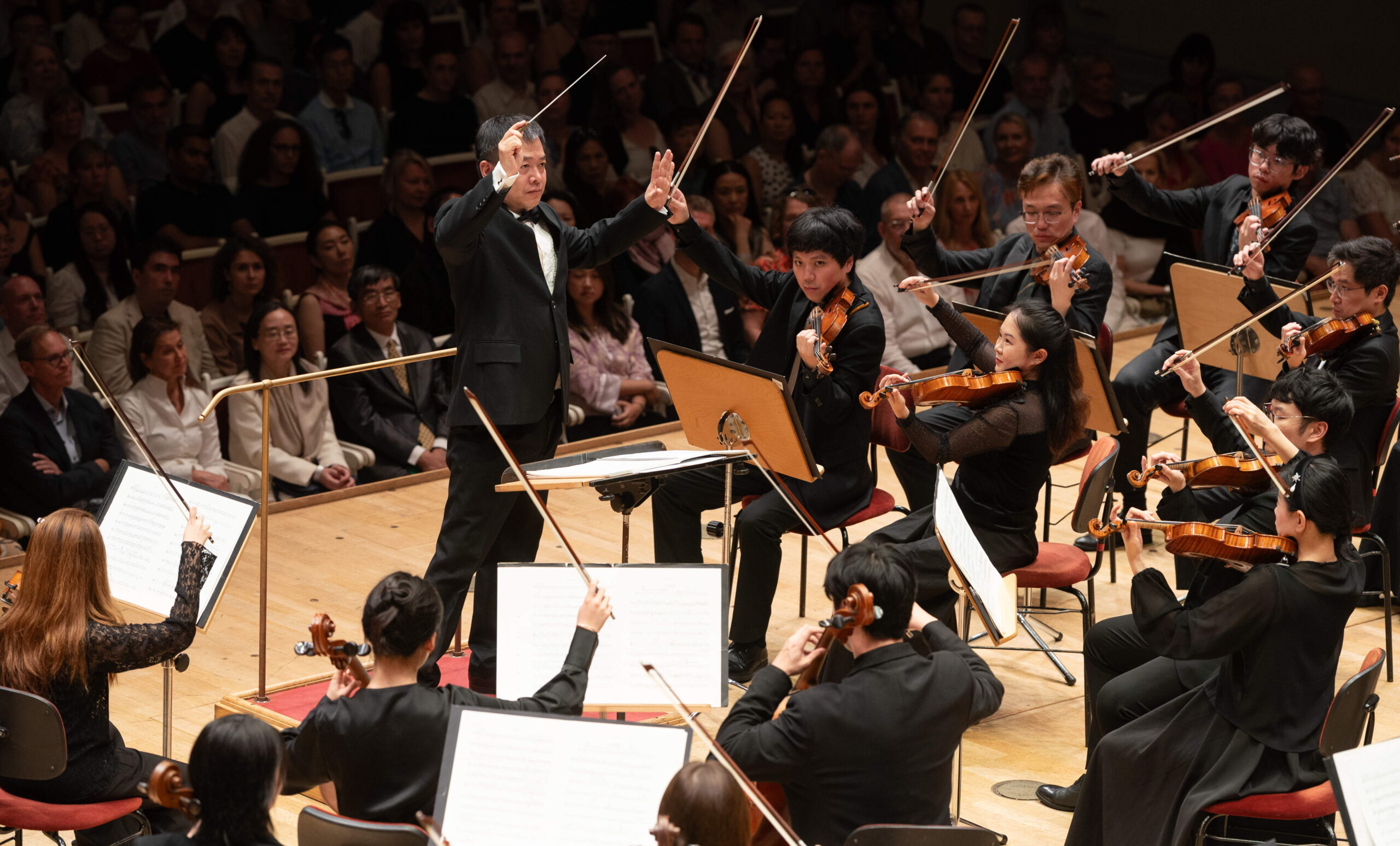
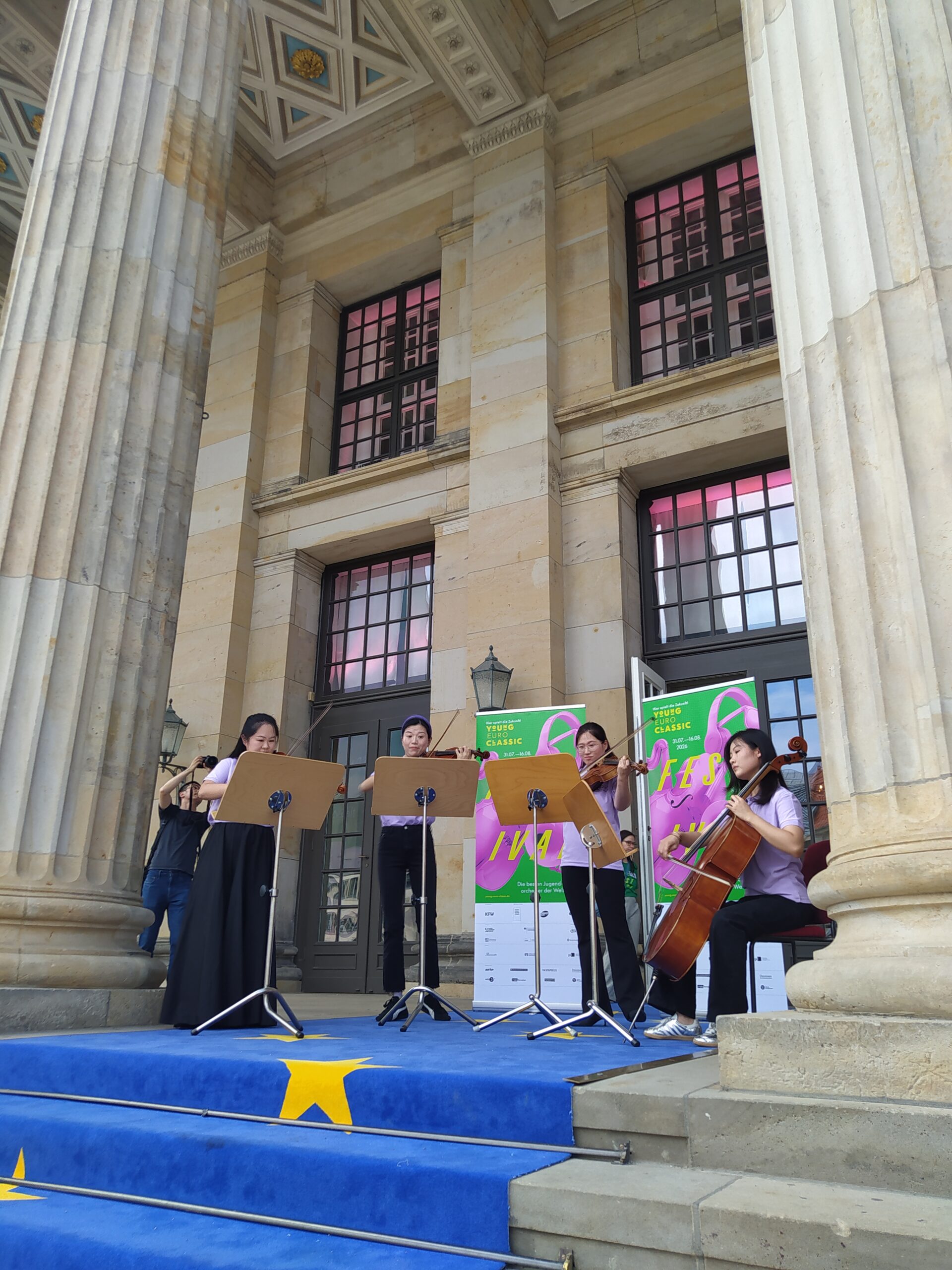
Wednesday, August 5th was a special musical day. Not only was there a concert by the Orchestra of the Zhejiang Conservatory of Music from China on the Young Euro Classic programme in the evening, but there was already plenty of music to be heard during the day as well. Under the colonnade of the Konzerthaus, different chamber music ensembles from the orchestra performed alternating works in the afternoon. Despite the scorching heat, many people stopped to watch these young musicians at work and listen to their heartwarming way of making music. It was a first meeting that immediately sparked curiosity about what this orchestra would present on the big stage in the evening.
 The Orchestra of the Zhejiang Conservatory of Music is a still young formation. The orchestra academy was only established in 2020 and brings together students from China and abroad. Through the conservatory and the Zhejiang Symphony Orchestra, they receive a strong practice-oriented education. In the five years since its founding, they have built a remarkable repertoire, including all nine symphonies of Beethoven. Their performance in Berlin is therefore much more than a visit to a European festival: it is a deliberate preparation for international orchestral life.
After the performances under the colonnade, I had the opportunity to speak with trombonist Yu Fan and concertmaster Danfeng Shen about the orchestra and the programme. Pianist Sun Yutong also gave me an illuminating perspective on the piano concerto he would perform that evening. Yu Fan pointed out that Chinese composers and musicians increasingly want to make their music heard outside of China: in Berlin, the orchestra brings, alongside Bruckner, two Chinese compositions to showcase contemporary Chinese musical culture and at the same time engage in dialogue with the Western tradition. Danfeng Shen emphasized that the stay in Europe means more to the young musicians than just performing: the encounter with European colleagues, the experience of the Konzerthaus and making music within an international festival are all things they take back to China with them.
But it was especially the subsequent rehearsal that provided a special insight into the way work is conducted here. Immediately after the chamber music performances, the orchestra rehearsal began and for the first time I really became acquainted with the two Chinese works on the programme. The first impression was one of a rich and intense sound experience. Conductor Zhang Yi knew very precisely what colour he had in mind and consulted carefully with composer Zhang Ying on the Akademische Festouvertüre. Passages were played again and again until the desired balance was achieved. Yu Fan compared that interplay to a puzzle: "We have to make it increasingly larger and ultimately bring the whole work together." What I saw during the rehearsal was therefore not a casual preparation for the concert, but a disciplined search for the right musical result.
A colourful overture
That commitment paid off immediately in the evening performance of the Akademische Festouvertüre by Zhang Ying (°1983). The work was written to mark the tenth anniversary of the Zhejiang Conservatory of Music and had its German premiere at this concert. The title obviously refers to Brahms, but musically Zhang Ying chooses an entirely different path. Her score is built from different interwoven layers and draws on Chinese musical sources among other things.
The result is easy on the ear, but is far from simple. Behind the apparent inevitability of the melodic lines lies a carefully constructed score in which the different orchestral groups continually react to each other. There are moments reminiscent of the rich orchestral worlds of Carl Orff or John Williams, but Zhang Ying clearly writes in her own language. Under the direction of Zhang Yi, the orchestra achieves a clear profile and the different instrumental groups sound particularly well balanced against each other.
The orchestra commits itself with great conviction to the new work: you hear this not only in the massive passages, but also in the many solo moments. The instrumental mastery is remarkably great here and the music sounds fresh, self-assured and is played with visible pleasure. What during the rehearsal was still a work in progress proves during the concert to be a score in which the young musicians clearly feel at home.
An encounter between two musical worlds
With Er Huang by Chen Qigang (°1951), who celebrates his 75th birthday on August 8th, that encounter between traditions then takes on a much more intimate and at the same time deeper form. The composer was trained in China and moved to Paris in 1983, where he became the last student of Olivier Messiaen. Since then his musical life has moved between China and Europe. In Er Huang, both worlds come together audibly: melodic memories of classical Peking opera are connected with an idiom in which the influence of Messiaen is never far away. "Chinese music comes from our blood," Yu Fan told me earlier that day. A simple formulation, but it immediately explains why this music feels so natural during the performance.
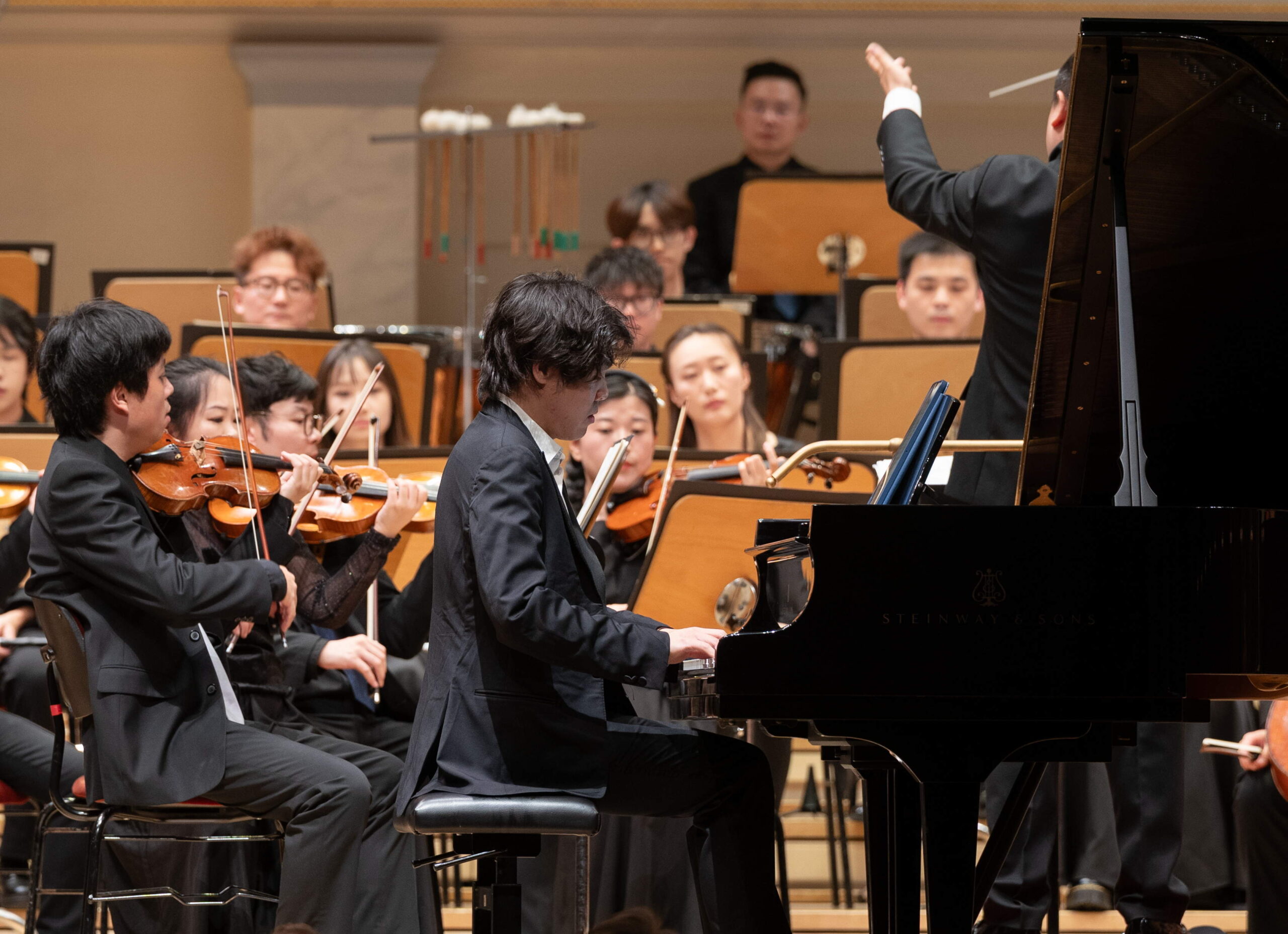 It is a fascinating score, and to be honest, this was my first acquaintance with music by Chen Qigang – a discovery that immediately makes you want more. Especially the way piano and orchestra find each other is remarkable. Sun Yutong begins with a soft, refined touch, where every note is carefully weighed. Subsequently, a dialogue emerges with the double basses, later other strings take over the conversation. The pianistic passages do not receive an accompanying orchestral sound next to them, but a reflecting response – it is as if the different orchestral groups each respond in their own way to what the pianist is telling.
Sun Yutong convinces strongly in the process: his involvement with the work is audible and palpable in every note. He does not limit himself to virtuously realizing what the score demands, but seems to continually think along with the musical development. In between, memories of the Chinese musical tradition emerge, which are taken up by the strings and sometimes develop into compelling dialogues. The orchestral palette is also impressive. At certain moments the sound bursts open with cymbals, bells, xylophone and celesta, while the piano remains fully audible right in the middle of it all. The great eruptions then receive a counterweight in passages where the music gradually becomes thinner and eventually seems almost to fade away.
Therein lies the great strength of Er Huang: nothing sounds accidental. The transparency of the score, the carefully balanced orchestration and the tension between the Chinese melodic memory and the idiom influenced by Messiaen make it a particularly compelling work. You are even moved by it. It is music that does not attempt to place two cultures in opposition to each other, but simply lets them sound together. That the performers also fully engage in this makes the experience all the stronger. Sun Yutong proves himself here as a committed soloist and the orchestra demonstrates that it can approach a contemporary score with great intensity and subtlety. I can only hope that Er Huang will one day also appear on a concert programme with us.
A Different Musical Landscape
After the intermission comes the great leap: from contemporary Chinese music to Anton Bruckner's Second Symphony (1824-1896). A brave choice for the Young Euro Classic debut, as the Second is not among Bruckner's most frequently performed symphonies. The young musicians take on the challenge convincingly: virtually every detail is audible, the woodwinds deliver particularly strong work and the double basses also receive a fine role. Even the second violins, which fade into the background in many performances, remain strikingly present. The dedication with which the orchestra plays this music certainly deserves admiration.
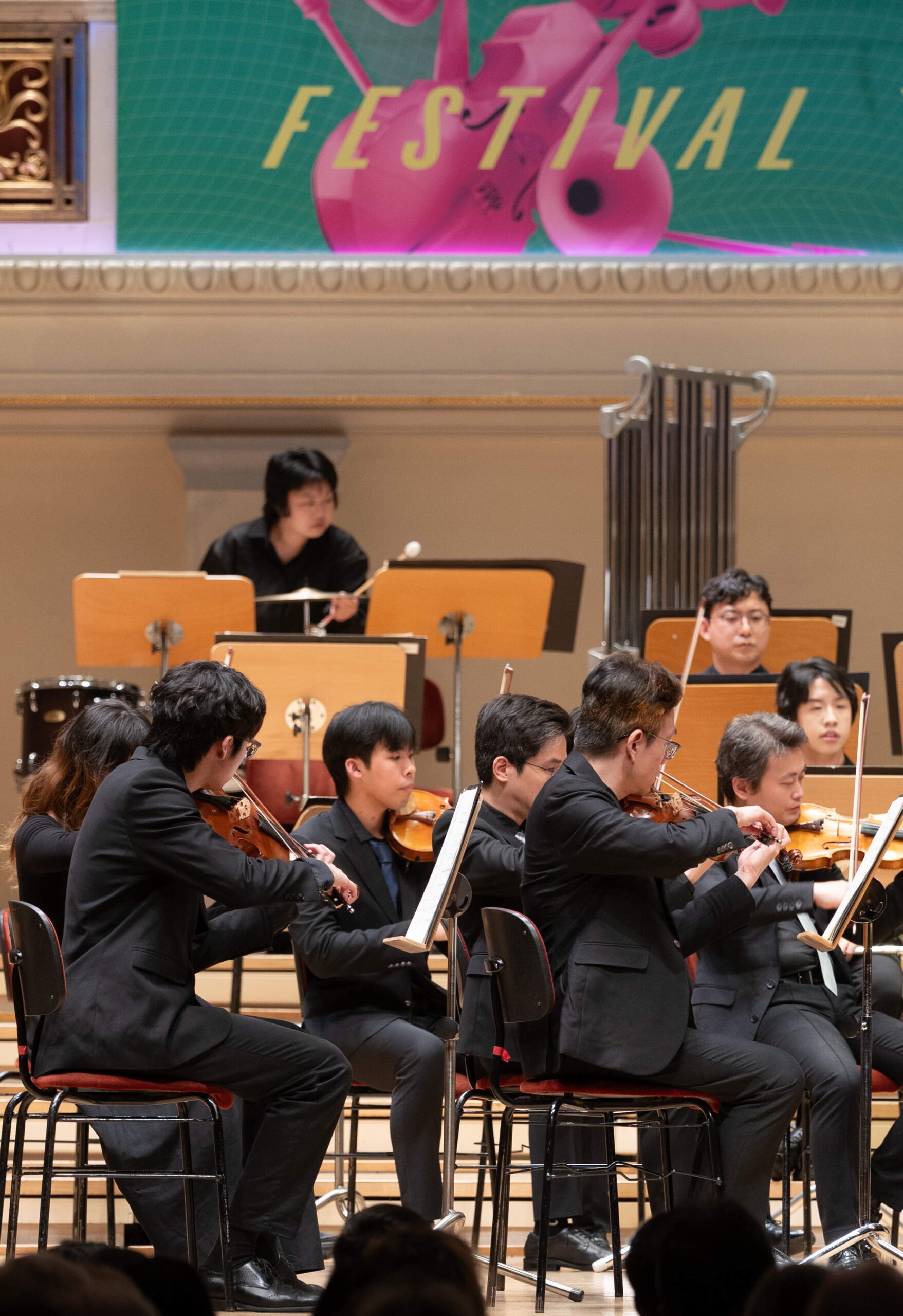 Yet a certain reserve remains after the performance. Not because the notes would be missing – quite the contrary, virtually everything is there – but because the great musical breath of Bruckner comes to life less naturally. To paraphrase Gustav Mahler: the essence of music does not reside solely in the notes. Zhang Yi keeps the whole thing tightly in hand, but his interpretation remains too controlled. The first movement, Moderato, is taken at a remarkably fast tempo and the Andante also receives little space for the meditative, almost sacred qualities that can lie dormant in this music. Bruckner certainly does not need to be played heavily or slowly, but his music must be able to breathe.
This becomes particularly apparent in the conclusion of the first movement and in the finale, where the music sometimes almost takes on the character of a march being driven towards an overly effective ending. Bruckner was an organist and his symphonies have, even when expansive and monumental, a very particular relationship to space, resonance and silence. It is precisely this quality that should be sought even more strongly in a future encounter with his music.
The choice of chamber orchestra instrumentation does not always help: at certain moments the strings are relatively limited in the face of the wind power, which makes the balance less self-evident. The choice of the 1877 version also does not make the task any easier. I myself prefer the original version, the Erstfassung from 1872, which I find richer and more exciting and which offers more possibilities for contrast and development. The later version performed here therefore demands all the more a strong interpretative vision that can sustain the great dramatic arcs from one clear musical idea. This performance remained somewhat too much at the surface in precisely that respect.
However, it would be unfair to view this Bruckner performance primarily through that lens of criticism. For a young orchestra that has made its own a large part of the classical and romantic repertoire in barely a few years, it remains an impressive achievement to set down this Second Symphony so precisely. The difference with the Chinese works was above all that there a strong artistic commitment and a natural affinity with the idiom were palpable. With Bruckner, it was primarily the careful mastery of the musical material that was convincing; the next step is to connect an even more personal interpretative vision to that.
The audience responded with particular enthusiasm. The hall of the Konzerthaus was filled to capacity and once again the strikingly young composition stood out, with quite a few children even present. After individual movements applause already sounded, which is not customary with Bruckner. Perhaps that too is a sign of what Young Euro Classic wants to achieve: music that is not approached as a museum piece, but as a living experience.
On the Way to an Own Voice
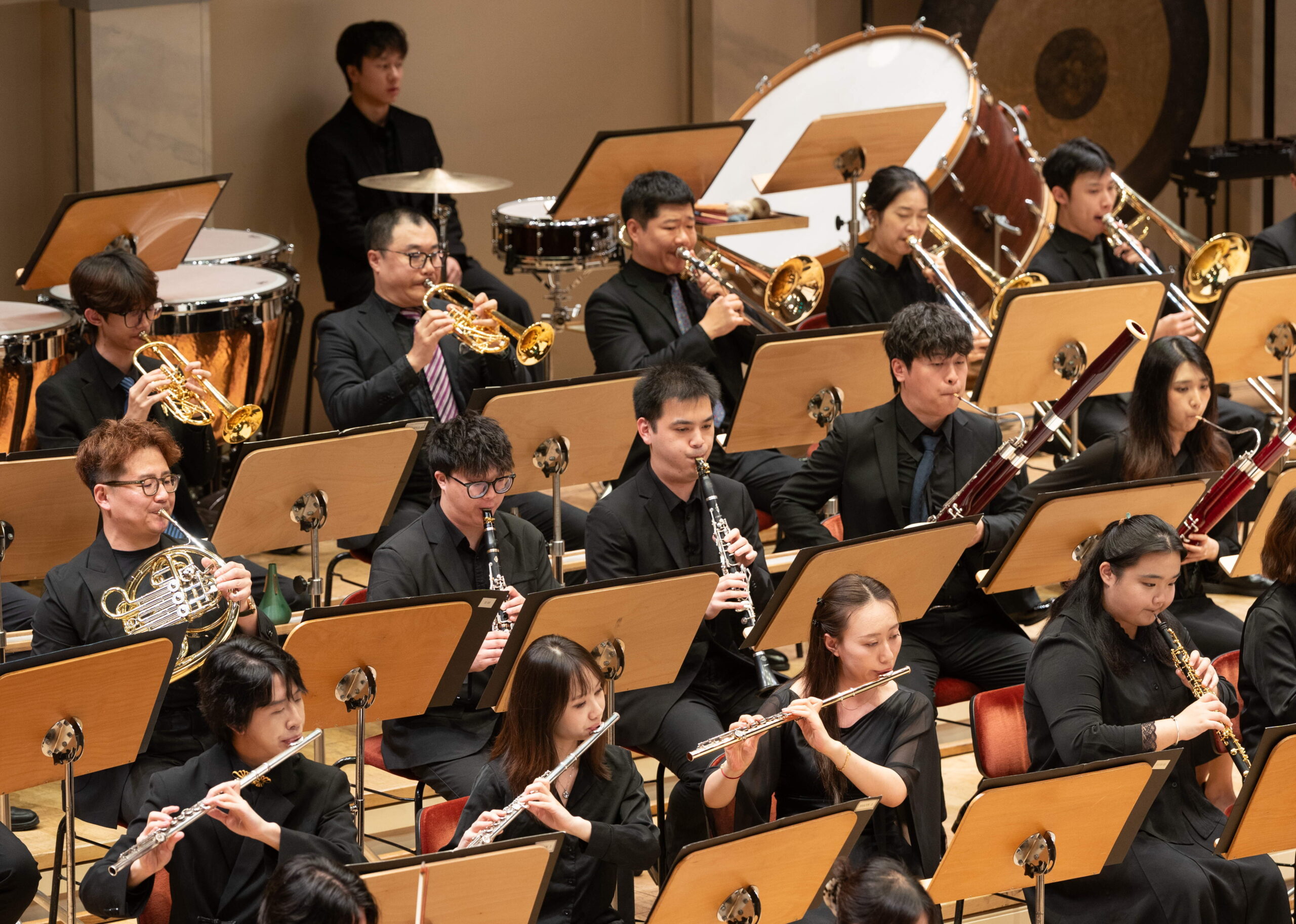 And therein ultimately lies the value of this concert. The most interesting contrast was not between China and Europe, but between music that still has to establish its place in the international concert hall and a repertoire that has been part of the European tradition for centuries. In the Akademische Festouvertüre by Zhang Ying and especially in Er Huang by Chen Qigang, it became clear how rich contemporary Chinese music can be when performed by musicians who clearly understand it from within.
"We must bring them together," Yu Fan said to me about the two musical worlds that this programme brought together, because "ultimately we live in the same world." Perhaps that is the finest summary of this evening: the Orchestra of the Zhejiang Conservatory of Music came to Berlin to let Chinese music be heard, but also to measure itself against a repertoire that originated outside its own cultural tradition.
This concert was a snapshot of a young generation very much on its way. The technical foundation is there, as are the discipline, the curiosity and the enthusiasm to discover new musical worlds. What strongly convinced today was the quality of these young musicians. From that quality, an increasingly personal musical voice can emerge. And precisely for that reason, this concert above all leaves one wanting more.