
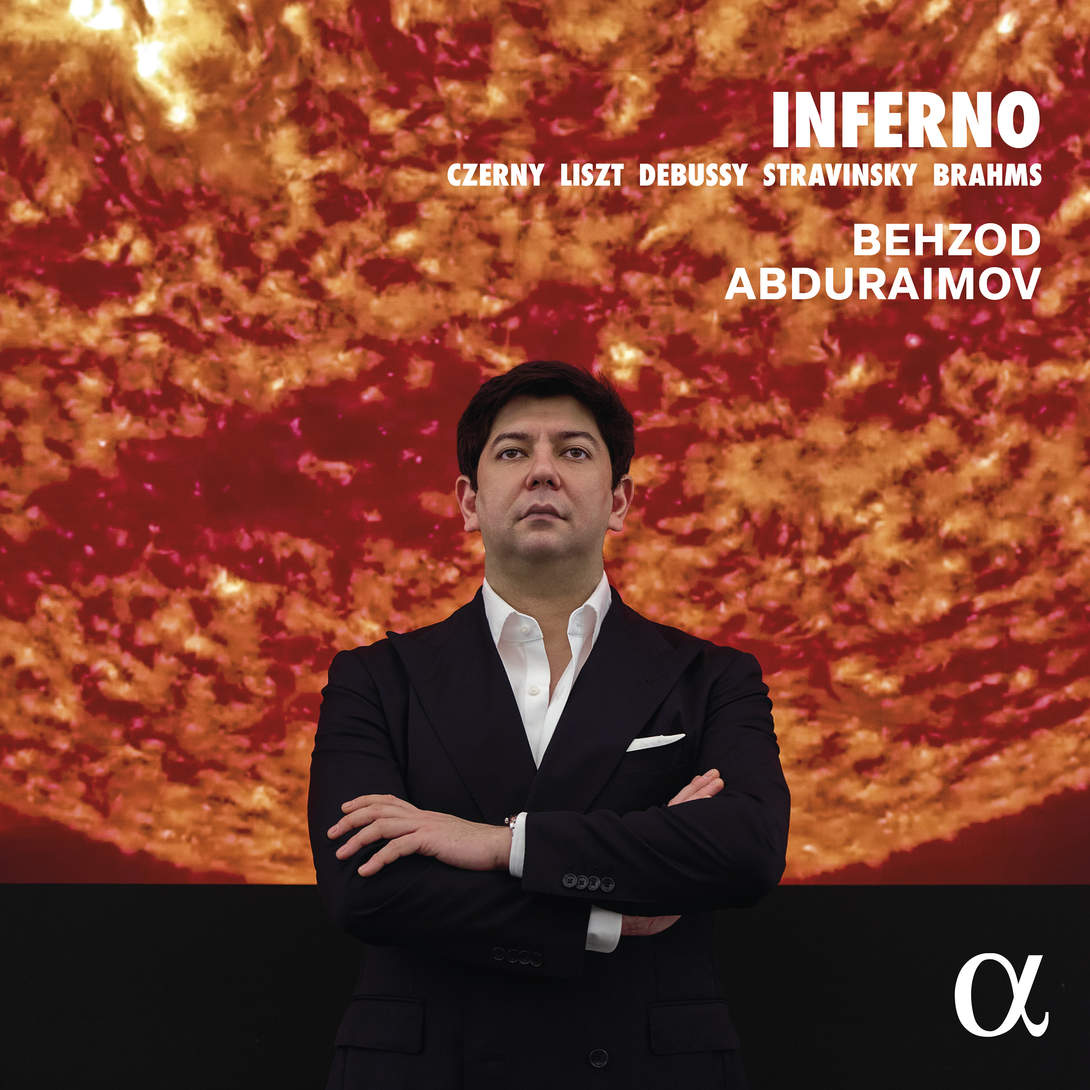
Inferno is a title that sells, and that is precisely the problem. Fire, darkness, a pianist walking through hell – the image on the cover promises a clear-cut drama that the music itself does not deliver. When you put on the cd, the first thing you hear is Carl Czerny (1791–1857), and he does not open with hellfire but with salon music: his Variations on a Theme by Rode, opus 33, is pleasant, graceful, here and there even charming in Behzod Abduraimov's hands, who gives the melodic line a bel canto suppleness. But the piece could just as easily have stood on an average recital next to Mendelssohn or Weber; it has truly nothing to do with a concept album about hell, and the only function it seems to serve here is that of a pleasant introduction for those not yet awake.
With Franz Liszt (1811–1886) it becomes serious. Après une lecture de Dante is the only work in which title and music actually coincide: the tritone, the eruptive gestures, the constant balance between attraction and disruption – here the concept is finally more than a sales argument. Abduraimov plays it with conviction too: sharp where it needs to be, transparent even in the densest chord masses, never lapsing into pure bravura. It is the only moment on the record where you forget that you are listening to a program, and simply listen to music.
That momentum is subsequently disrupted without any buildup by Claude Debussy (1862–1918). His Suite bergamasque is played soberly and colourfully – the Prélude light, the Menuet elegant, Clair de lune restrained without sentimental indulgences. The Passepied restores something of rhythmic straightforwardness, as a quiet nod to older dance forms. In short, it is neat, tasteful Debussy, without a pronounced personal stamp – music that here primarily serves as a breathing space between two extremes.
Igor Stravinsky (1882–1971) then restores the tension by force, abruptly and without transition after Debussy, and not always for the better. Three Movements from Petrushka (1921) is played here fast, robust and regularly rather rough: the Danse russe has drive but little finesse, and in La Semaine grasse the musical line threatens more than once to collapse under sheer force. Stravinsky did not want an orchestral imitation of this work but an essential pianistic piece; Abduraimov, however, approaches it primarily physically, with a harshness that yields energy but less layering and internal differentiation than in the preceding sections. If this is supposed to represent "inferno," then it is the most literal, and at the same time least refined variant of it on this cd.
Johannes Brahms (1833–1897) concludes with the Intermezzo from the Four Piano Pieces opus 119, and that choice is indeed apt: no more fire, only afterglow, a restrained lament that withdraws rather than explodes. It is a nice moment, but it comes too late to weld the rest of the program together.
For that is ultimately where it pinches: of the five works, only one – the Liszt – truly relates to what the title promises. The rest move at a distance from that idea, sometimes kindred in mood, more often simply overtaken by the logic of the program sequence. That need not be a problem for those mainly interested in outstanding piano playing, and Abduraimov plays, save for the somewhat coarser Stravinsky, generally with great precision and convincing sound control. But for those expecting a coherent journey through hell based on the title, this is essentially a competently performed, but rather arbitrarily assembled recital – recorded with the customary sonic richness of the Teldex Studio in Berlin, which provides just enough lustre to convince, but not enough to truly sustain the concept.