
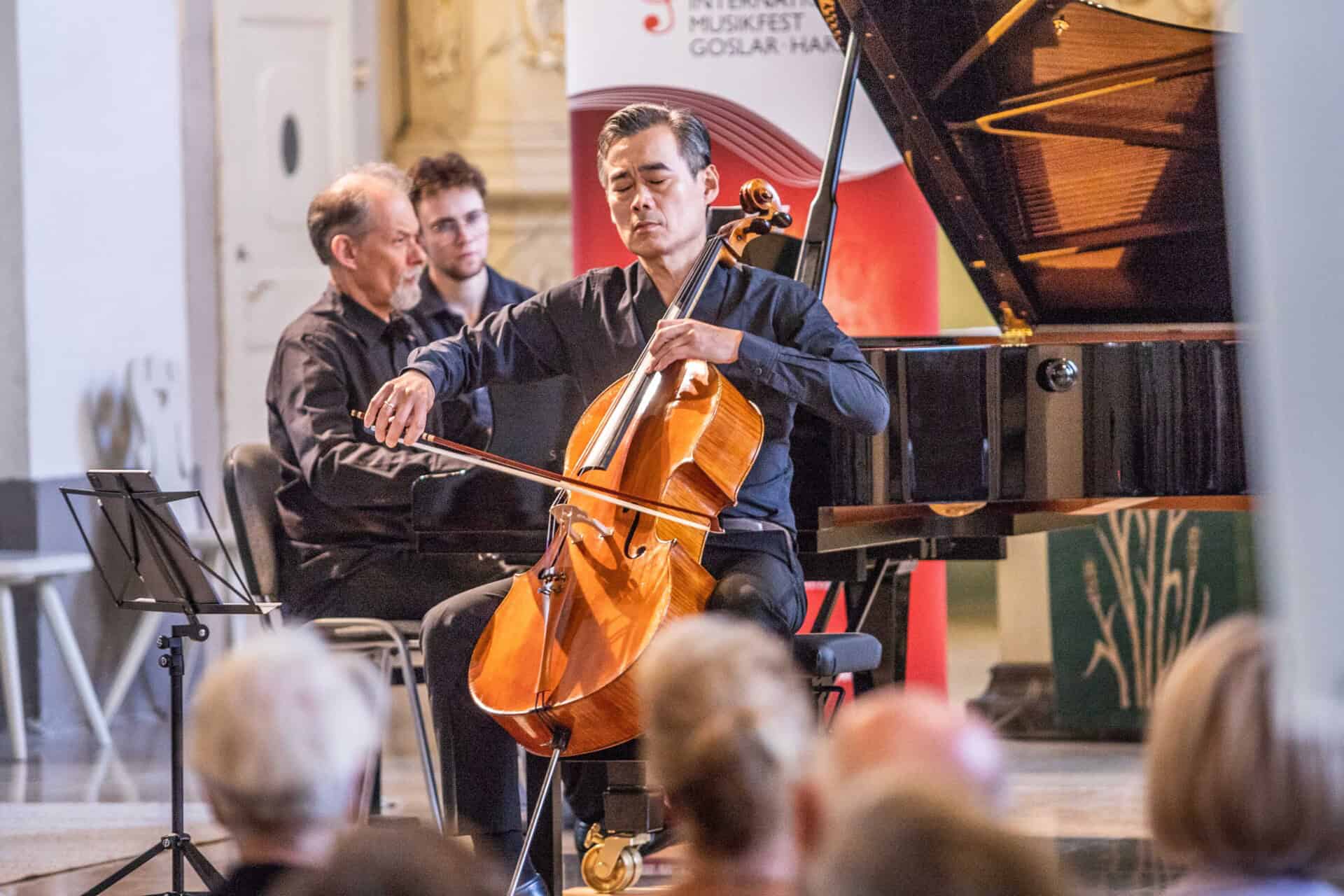
In the historic heart of Goslar — a city that with its medieval grandeur and the imposing Kaiserpfalz has borne witness to human history for centuries — on Tuesday, August 12, a musical encounter of rare intensity took place. In the baroque Stephanikirche, where acoustics and atmosphere reinforce each other, cellist Sung-Won Yang and pianist Enrico Pace filled the space with music that went beyond mere performance: it became an experience of stillness, emotion, and an almost invisible musical unity. A moment that was not only heard, but also felt — and that continued to resonate, long after the final note.
The recital was part of the Internationale Musikfest Goslar-Harz, which since 1993 has brought together top musicians at historically significant locations. With the theme Reflections, the festival this year focuses on voices that have often been underrepresented due to origin, faith, or gender. In doing so, the festival is more than a series of concerts; it serves as a sounding board for stories, memories, and human emotion — a place where music functions as a mirror of our existence.
Within that meaningful context, Yang and Pace presented a recital distinguished by an exceptional combination of technical mastery and deeply felt expression. Sung-Won Yang, renowned for his warm, lyrical tone and natural musicality, places his technique entirely in service of the music. Virtuosity is not an end in itself for him, but a means to essence. Enrico Pace, a much-sought-after pianist with an impressive chamber music repertoire, plays with rare balance between precision and inspiration. Together they form not a duo, but one voice — a collective sound body dedicated to understanding the story behind the notes.
A whisper that touches the soul
The first part of the concert consisted of works by Franz Liszt (1811-1886) — not the usual virtuosic bravura, but rather intimate, introspective pieces that revealed a different, more contemplative side of the composer. The recital opened with the Élégie Nr. 1, a meditation on transience. Yang's cello sounded like a breath: warm, fragile, tangible. Pace's touch was silken and cautious, with a natural fluidity that gave each note weight and direction. From the first moment, the program breathed a deep stillness. The silence between the notes became part of the music itself. Between the works there was no applause, allowing the tension to grow uninterrupted — a rare experience that made the recital into a meditative listening journey.
The subsequent Consolations Nr. 1 and 4 sounded like hushed miniatures: tender and hopeful, like an inner dialogue between melancholy and trust. In Romance oubliée, Yang evoked with subtle shadings an atmosphere of loving remembrance and quiet longing, carefully supported by Pace's restrained playing. No showmanship, no exaggeration — only dedication to the essence of the music. A single glance between the musicians was enough to achieve a musical moment of wonderful cohesion.
With Consolation Nr. 6 and the moving La lugubre gondola, they descended deeper into shadow. The cello glided like a funeral procession through a dark musical landscape, while the piano lapped like water beneath a slowly moving gondola. In these moments, time seemed to stand still. The atmosphere returned with Consolation Nr. 3 and Die Zelle in Nonnenwerth to reflection. The cello sounded like a thoughtful voice, the piano offering breathing space with sparse phrases. Together it evoked the atmosphere of a monastic song, a whispered prayer between two kindred souls.
The Liszt section ended in a fierce outburst with Cantique d'Amour, a musical declaration of love that developed from tender whisper to passionate eruption. Noteworthy was the alteration in the sequence of the pieces compared to their recording. This deliberate reordering worked wonderfully, which the musicians confirmed after the performance. The arc of tension was built optimally by the absence of applause between pieces. Some works were arrangements for cello and piano, but this detracted nothing from Liszt's originals. Quite the contrary: they perhaps laid bare the inner world of the composer even more raw and honestly than he himself had dared to allow.
After the intermission: an outburst of feeling
After the intermission, a clear shift in tone and expression took place. Where the first part was bathed in introspection, now a richer palette of emotions was addressed. Intensity grew, but remained always controlled. Yang and Pace surrendered themselves to the passionate expressiveness of Frédéric Chopin (1810-1849) with a deeply felt, yet never theatrical approach. Central was Chopin's Cello Sonata in g minor, Op. 65 — a work in which threat, lyricism, playfulness, and existential seriousness alternate. The Allegro moderato sounded charged and tense, the Scherzo was capricious and sparkling at the same time. In the Largo, everything fell silent: a moment of almost sacred rest, sustained by simplicity and intensity. The final section — brilliant and compelling — brought all preceding feelings together in a musical frenzy of surrender. This was no mere performance — here music was truly experienced.
As the conclusion of the official program came Introduction et Polonaise brillante, Op. 3. Here the sun finally broke through: lightness, virtuosity, and dancing energy took center stage. The polonaise was elegant and exuberant — played with evident pleasure, but never superficially. This exuberant finale felt like a liberating release after the profound intensity of what came before.
Coming to rest in gratitude
As an encore, Yang and Pace returned to Liszt, with Consolation No. 5. A beneficial peace descended over the Stephanikirche. This tender closing chord offered precisely what the audience needed: a moment of silence and reflection — like a breath after an intense conversation.
A space that breathes with the music
The location — the baroque Stephanikirche in Goslar — was a hidden gem. The acoustics were exceptional: rich, clear, and at the same time intimate. Even the finest pizzicatos of the cello reached the back rows effortlessly. The space was not merely a backdrop, but a resonant body in which music could breathe freely. Even on a hot summer day of thirty degrees, it remained cool and serene inside — a cocoon in which music and silence reinforced each other.
More than a concert
What Sung-Won Yang and Enrico Pace brought to Goslar was more than a concert. It was a poetic journey through the human soul — a mirror of love and melancholy, of comfort and letting go. No excess, no show — only pure, deeply felt music, delivered with an effortless unity of spirit. They did not perform as two individuals, but as one musical being: one breath, one intention. Music as dialogue, not as spectacle. In the context of the Musikfest Goslar-Harz, this recital embodied the festival theme Reflections in impressive fashion. The music made audible what often remains unspoken — and left the audience with a sense of connection: with the music, with each other, and with themselves.
A wish come true
For me personally, this concert meant the fulfillment of a long-cherished dream. For years I have carried with me the CDs on which these two gifted musicians can be heard together — music that moves me again and again. But seeing and hearing them together live was something I had never experienced before. When I saw their names on the Goslar poster, I knew immediately: I must be there. And it became everything I had hoped for — and more.
Goslar as a sounding board for the soul
Goslar, with its medieval splendor and cultural richness, proved to be the ideal breeding ground for this musical experience. In this historic city, within the acoustic embrace of the Stephanikirche, something rare took place: a musical breathing that lingers long — in memory, in the space, and especially: in the heart.