
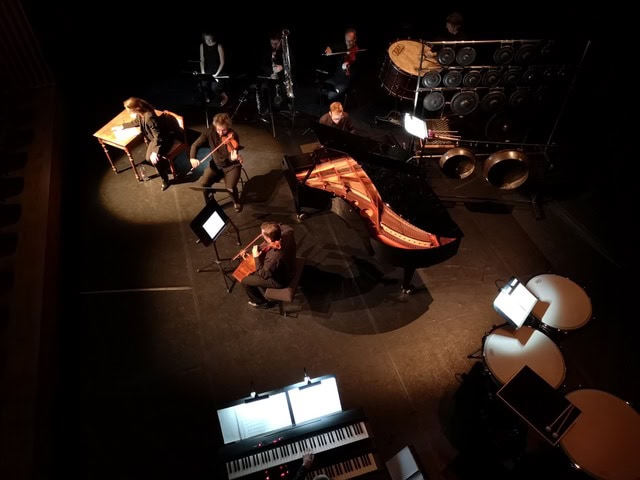
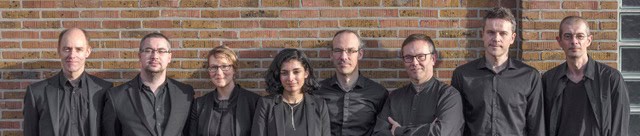
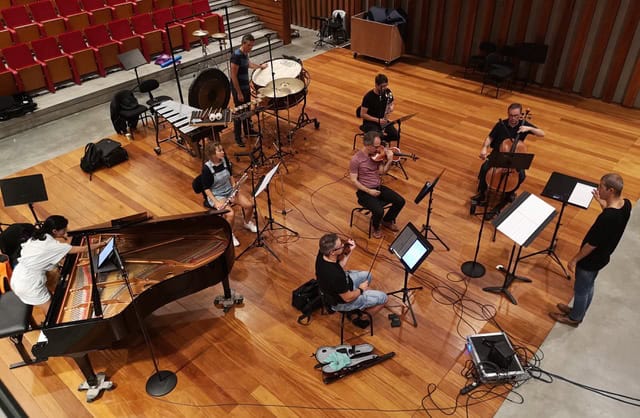
SPECTRA, ensemble for new music, presents with its new cd a tension four Flemish composers who drew their inspiration from abroad.
Karel Goeyvaerts (1923-1993), born and raised in Antwerpen, moved to Paris to learn from Olivier Messiaen that rhythm and timbre are equivalent musical parameters alongside pitch. Later he developed this into multiple series, serialism. Frederik Neyrinck (°1985) studied in Brussels, Stuttgart, Graz and worked in Vienna. Filip Rathé (°1966), conductor of SPECTRA since 1993, uses Spanish and Portuguese poetry as a starting point for most of his compositions. Luc Brewaeys (1959-2015), finally, collaborated extensively with Iannis Xenakis, Brian Ferneyhough and Franco Donatoni.
The CD opens with Goeyvaerts' Zum Wassermann for 14 musicians, a preliminary study for the opera Aquarius, or more precisely: a shortened and simplified version of the first four scenes of the first act. This is the first time that Zum Wassermann appears on CD. The Vorspiel sounds out man's futile attempt to free himself from the demands of society, respectively his failure to acquire even a minimum of individuality. A dance in the second part (Erwachen) gives the impression that man awakens from this, but the percussion makes it clear that freedom is not within grasp. The lyrical third part (Gesang) shows a glimmer of hope thanks to melodic approaches, reinforced by the harmonic textures woven into this section. The femininity of this third part gives way to hardened masculinity in the closing section (Zum Wassermann). The many repetitive movements refer to a rational approach that silences the creative elements in society.
Psychology
Frederik Neyrinck brings Gestalt VIII for mixed ensemble with "viola as quasi-soloist", written for SPECTRA in 2013. The piece is indeed based on Gestalt psychology, a school of thought that holds that the whole is greater and more important than its individual parts. Gestalt VIII is part of a ten-part series in which similar musical content is continuously viewed from different perspectives. The viola begins in this piece with a solo that is subsequently increasingly maneuvered away by duos of wind players, string players and percussion. The duos sometimes base themselves on parts of the solo, but skillfully eliminate any tendency toward individualism. The piece ends in a mysterious haze of distant sounds.
In El agua y la muerte, for small ensemble and voice, Filip Rathé declares his love for two poems by Federico Garcia Lorca. The first part, La muchacha dorada, gives an image of the lovely murderousness of a body of water in which the piano mixes innocent tinklings of the surface with dark and deadly undercurrents. Dragonflies and swallows complete the dance of death for a drowned girl. Carefully crafted resonances of the soundboard underline a sense of displacement. In Un arcángel de frío, the second poem, piano, voice and violin among others tell the story of a boy who freezes on the banks of a river into an archangel. In this, the instrumentation varies from mumbling and sighing of the (male) voice, via melodic piano fragments to hesitant violin passages that apparently have little to do with each other. Each seems to want to process the event in its own way.
Timbre
The icing on the cake is the closing piece Fêtes à tensions: (les) eaux marchent for 20 musicians by Luc Brewaeys, which also appears on CD for the first time. If you read the title aloud while omitting the article, you hear a typical Brewaeysan wordplay: beware of the marches! Or of the stairs of course. The piece is richly stocked with quotations from among others Tchaikovsky, Ives, Berg, Varèse, Beethoven and even Goeyvaerts and Debussy. The composition is dedicated to Brewaeys' contemporary Philippe Hurel, a French composer of so-called spectral works. This is a musical writing technique that places timbre at the center as a structuring element. This technique is mainly used in the first part, and as a result comes across slightly nervous. The basis for the second part is the funeral march from Beethoven's 3rd Symphony, a meditative adagio that slowly glides into a coda based on repeated percussion. The piece ends very abruptly, as if the power cuts out.
The final result of a tension is a balanced and subtly composed selection of sparkling contemporary classical work. Curious, clear, restless, and above all open-minded.
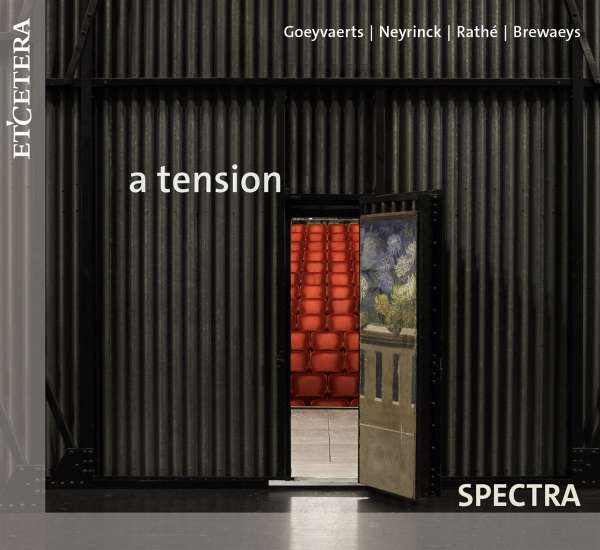
WHAT: a tension
WHO: SPECTRA Ensemble
COMPOSERS: Goeyvaerts, Neyrinck, Rathé, Brewaeys
SLEEVE TEXT: Mark Delaere
LABEL: Explicit! Records / Etcetera KTC 1759