
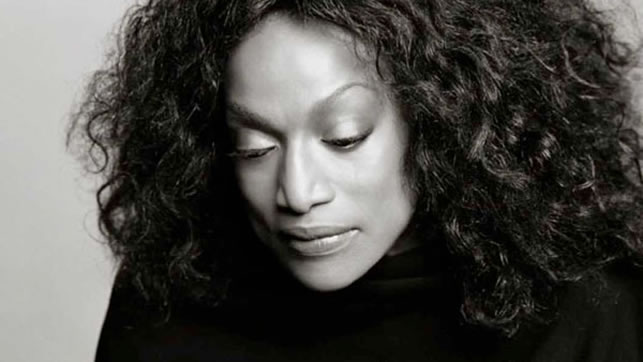
Jessye Norman: what a voice, what a presence! Everyone who saw her perform live on stage will confirm this. On September 30, 2019, the singer passed away at the age of 74. She is undoubtedly one of the most fantastic artists of the last fifty years. Presenting her autobiography is a fitting tribute. The above title is just one of the memorable statements taken from that delightful book. It was published in Dutch translation in 2015 as De muziek van mijn leven. The original title sounds somewhat 'more militant': Stand up straight and sing! With an exclamation mark.
Jessye Norman was born on September 15, 1945 in Augusta, in the American state of Georgia. In her childhood years in this southern state of America, she was sharply confronted with the segregation of African Americans. Her awareness of the struggle for equal rights and her role in it as an artist is consequently a theme that runs like a red thread through the book. Not in a preachy or pedantic way, but as something that shaped her character and motivated her to have the courage and determination to achieve her goal, not only artistically, but also as a person. The book reads as a history of her life, divided into musical parts, prelude, interlude and postlude. None other than James Levine wrote an introduction for it and throughout the book he emerges as her favorite conductor (We got along wonderfully from the very first time we worked together, p. 289), alongside Herbert von Karajan (… with whom I had the privilege of working at the end of the eighties on both a performance and a recording of the 'Liebestod' from Wagner's Tristan und Isolde" (id.)).
Breath control and vocal technique
Before we get there (in the chapter Woman, life, singer) we have been given the story of her origins and the role of music in her early years. Music was often connected with church gatherings and from an early age religion and spirituality play a crucial role in her life. Her fascination with opera originates from a broadcast of a Metropolitan Opera matinee with an aria from Lucia di Lammermoor, sung by Joan Sutherland. Her perseverance to study is on the one hand related to the strong character of the women in her family – first and foremost her mother – and on the other hand to her father's pride, whom she does not want to disappoint. Through a competition in Philadelphia she receives a scholarship to study at Howard University. From her professor Elizabeth Mannion at Michigan University she learns the importance of breath control and vocal technique to keep the voice flexible. The Interlude is devoted to her fellow singer Marian Anderson, the African American singer who has a magical influence on her and makes her realize that it is possible as an artist to overcome discrimination. Her participation in the international competition of Bavarian Broadcasting in Munich opens the door to Europe for her. The chapter about her time in Germany contains a moving account of the fall of the wall in Berlin in 1989: while she is in Dresden making a recording of none other than Fidelio by Ludwig Van Beethoven, whose theme is political persecution (p. 205). She starts her professional career at the Deutsche Oper Berlin and has the opportunity to get to know important personalities from the music world. The baritone Pierre Bernac introduces her to the lied genre, and conductor and composer Pierre Boulez introduces her to the composers of the Second Viennese School. Thus Schönberg's Erwartung becomes one of her favorite repertoire pieces. In Vienna she made a sensation in Ariadne auf Naxos by Richard Strauss. Her debut at the Metropolitan Opera in New York takes place in 1983 as Cassandre in Les Troyens by Hector Berlioz, the French composer whom she counts among her favorite composers. Meanwhile we have come to know her as a charismatic and intelligent person, full of talent but also grateful and empathetic.
Music gives wings to words
Jessye Norman gives in her book a fantastic analysis of what singing means to her. In opera she especially wants to sing stories of women with whom I can identify (p. 211). As a singer she has the ability to communicate everyday emotions and wants to explore the piece in the rehearsal process and become one with the work. Thus she is also strongly moved by the pacifism in A child of our time by Michael Tippett, and she experiences it as a fantastic privilege to perform Poèmes pour Mi by Olivier Messiaen (dedicated to his wife) or the song cycle woman.life.song by Judith Weir, which was specially composed for her. For the lied genre she has been fortunate with her accompanists, such as Philip Moll, Irwin Gage, Geoffrey Parsons and Dalton Baldwin. Strauss' Vier letzte Lieder she calls an integral part of my repertoire (p. 230). And also about Das Lied von der Erde by Gustav Mahler she writes: My gratitude that I have been able to sing these two sensational compositions by Strauss and Mahler is boundless (p. 232).
Despite her many official honors (I am the proud and humble recipient of more than thirty honorary doctorates from colleges, universities, and conservatories from around the world (p. 267) she values remaining simple and avoiding star airs. Besides honorary doctorates, she also received the highest recognition for the arts in Austria, thanks to her frequent performances in Vienna and at the Salzburger Festspiele. She was the artist who sang the Marseillaise at the celebration of the two-hundredth anniversary of the French Revolution in 1989, dressed in a specially designed gown in the French tricolor. And she sang at the inauguration of American presidents Ronald Reagan and Bill Clinton. She can pride herself on having made an essential contribution to the emancipation of African-American heritage and she is proud that she also shares the stage for this with artists such as Duke Ellington and Louis Armstrong, but also with the writer Toni Morrison (RIP, August 5, 2019), who died shortly before her. She finds it wonderful that she can count Carnegie Hall New York among her preferred venues: What a delight. What a gift for all of us! (p. 296)
And the journey continues
A somewhat wry note is now naturally struck by this title of the last chapter in the book. And yet. If we accept her reflections on the passage of time as something that can be instructive and worthwhile, then thanks to her many recordings we can continue to honor this fantastic singer with warm feelings. Her ample and flexible voice, her intense intonation for so many diverse emotions of the human spectrum, her commitment to the freedom of the individual, man or woman, white or person of color. Her awareness too of the value of true art, and of – well! – beauty. Her sense of evolution: By living, the way we think about a song, an aria, or an entire opera role changes. By living, we get more information (p. 300). Every once in a while a chapter is somewhat less relevant due to a pile-up of anecdotes that are probably only meaningful to those who experienced them – in the chapter Racism still exists for example. But this biography of Jessye Norman is brilliant reading for anyone who, through her many recordings, wants to continue enjoying her expressive and delightful voice and wants to become acquainted with her no-nonsense life wisdom. Her interpretation of the Vier letzte Lieder by Richard Straus topping the list, a benchmark in the performance of this song cycle – Gewandhausorchester Leipzig conducted by Kurt Masur. Each chapter of the biography is preceded by the text of a song or song. In the postlude she quotes a phrase drawn from her ancestors: This little light of mine, I'm gonna let it shine. One could not think of a better sentence to close this tribute.
- WHAT: The Music of My Life. Based on the autobiography of Jessye Norman Stand Up Straight and Sing! a memoir
- PUBLISHED BY: Kosmos Uitgevers
- PHOTO: © Carol Friedman