
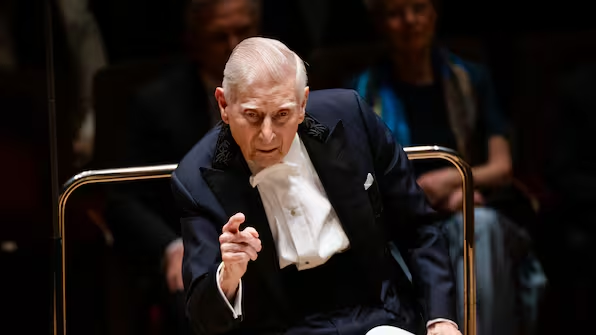
From the moment Herbert Blomstedt sits down on April 16 in the hall of the Gewandhaus in Leipzig, the tension in the space shifts. Not audible, not visible in a spectacular sense, but as a subtle shift in the sense of time: as if the clock is losing its teeth. He sits there simply, almost frailly, and yet it seems that in that very stillness something inevitable is already enclosed. What follows is not a concert in the classical sense, but an experience that sharpens listening itself.
The moment he begins the Fourth Symphony by Anton Bruckner (1824-1896), that small miracle occurs—one you cannot search for and yet unfolds as if it was always meant to be this way. The music does not merely begin; it emerges, slowly, with a naturalness that seems only possible when someone is at the helm who no longer has anything to prove.
In a conversation in Paris years ago, Blomstedt told me something that echoed in my thoughts again this evening: that for Bruckner's symphonies, he always chooses the version that offers the listener the most fulfillment. Not the musicological victory, not historical correctness as dogma, but listening itself as the ultimate measure. He already assumed back then that many people might hear such a work only once in their lives, and that it therefore had to be "complete." Whole—not in the sense of concluded, but of fully experienced.
This evening he chose the version of the second Fassung of Bruckner's "Romantische" prepared by Korstvedt, an edition that was dedicated to him as recently as 2018. The detail seems almost symbolic: a ninety-year-old taking up a new reading of Bruckner, not out of nostalgia but out of curious devotion. What was striking was something that became immediately clear: if you know him, you know that he normally conducts Bruckner without a score. This evening it lay on the stand. Sometimes he turned multiple pages at once, with a kind of thoughtful efficiency, but on those passages where essential differences in the text lay concealed, you saw him change. His gaze became sharper, his attention more concentrated, and his gestures gained an almost tangible precision. As if he was not only conducting, but rediscovering.
The performance itself proceeded somewhat slower than what I had heard him achieve before, for instance with the Wiener Philharmoniker or the Royal Concertgebouw Orchestra in Bruckner's Fourth. But that "slower" is a misleading word here. It was not about deceleration, but about expansion. The space became larger, the resonance deeper. And perhaps that is precisely what a new edition with a 98-year-old conductor can do: the tempo becomes no longer an end in itself, but a consequence of attention.
What struck me most was that the music never became heavy. On the contrary: it went inward, not outward. Every layer of sound was stripped of its outer weight to be seen through to the bone. It is not a matter of authority or finality, but of listening that continuously opens further, as if under every layer something else is still audible. Blomstedt continues to dig, as if in every score another layer lies hidden that wants to appear only to him. Not for effect, not for demonstration, but for revelation.
What unfolded this way was not Bruckner as a monument, but Bruckner as a breathing organism. Sometimes almost imperceptibly sculpted by a simple hand movement, a finger gesture that was enough to overturn an entire sonic world. The Gewandhausorchester responds to this not as an instrument being played, but as a body moving with an inner pulse it already knows. There is a mutual trust that no longer needs to be spoken.
And then there is that paradox which cannot be resolved but can be experienced: a conductor who opens the score anew, while simultaneously seeming to conduct from a memory that extends beyond paper. The pages are turned, but the music seems to have already been present in him in its definitive form.
What remains after the performance is not sensation, but quiet clarity. As if something has been left in the space that does not immediately disappear. Blomstedt shows no nostalgia, no retrospective glance, but an exceptional form of presence. He does not place Bruckner in the past, but in a timeless now in which listening itself becomes the most important gesture.
Perhaps the true miracle of this evening lies precisely there: not that a 98-year-old conductor is still on the stage, but that he lets the music breathe so completely that age, time, and history lose their grip. As if they temporarily play no role. What remains is sound, clear and stripped of everything that falls outside it.
And perhaps that is the real secret of this performance of Bruckner's Fourth: that it does not sound like a monument you visit, but like a landscape in which you may dwell. Not something that displays itself at a distance, but something into which you are taken, without its imposing itself.
In that landscape stands Herbert Blomstedt with an effortless calm. Without emphasis, without a gesture that demands attention, he simply lets the music exist. And precisely through this, everything becomes larger: every line, every breath, every harmonic shift gains space to speak without being directed toward effect.
What remains is not a conclusion, but an afterglow—a silence in which something of the music lingers, without expressing itself further.
„Das Höchste, wozu der Mensch gelangen kann, ist das Erstaunen." (Johann Wolfgang von Goethe, Wilhelm Meisters Wanderjahre)