
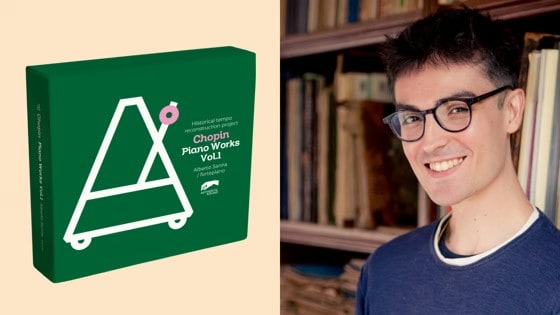
How would Chopin's masterworks sound if we performed them exactly as the composer intended? A groundbreaking new Kickstarter campaign claims we've been listening to the wrong interpretations for decades.
The classical music world is about to take a fascinating turn. A new project, launched via Kickstarter, poses a provocative question that could make generations of pianists and audiences reconsider: what if our beloved, blazingly fast interpretations of Chopin's works actually lead us away from what the composer truly wanted us to hear?
The 5-CD box set, performed by Italian pianist Alberto Sanna on a historical fortepiano, promises to present Chopin's piano music in the original tempos as indicated in his scores. But this is not simply a slowing down of familiar works – the project is based on a revolutionary reinterpretation of how 19th-century metronome markings were meant to be read.
The metronome puzzle
The heart of this project lies in what the makers call "Whole Beat Metronome Practice" (WBMP). According to their research, metronome markings in the 19th century were not read as individual clicks, but as pendulum swings – an interpretation that effectively halves the tempos and transforms them from physically impossible speeds into musically expressive performances.
"Many 19th-century metronome markings are not just fast – they are physically unplayable, even by the world's best pianists," explains Wim Winters. "Sustaining 15 notes per second and more is not a matter of discipline or talent – it is a matter of physiology."
According to the makers, this approach opens an entirely new sonic world in which Chopin appears not as a technical spectacle, but as a profound poet of time and breath. In this video, Wim Winters answers the most frequently asked questions about the Project.
[embed]https://www.youtube.com/watch?v=b2peYuUlZwk[/embed]Three pillars of authenticity
The project rests on three foundations that together should create a new listening experience. In addition to the reformed tempo interpretation, the musicians also employ "original rubato" – where the left hand remains strictly in time and ornamentation occurs only where Chopin notates it. Furthermore, they use the exact pedal markings as Chopin wrote them, something the project claims has never been done before in recording history.
Alberto Sanna, the pianist behind these recordings, came to this project after watching a video by Wim Winters about Chopin. So inspired was he by the tempo research that he booked a flight from Los Angeles to Belgium the next day to learn more. This meeting led to an artistic collaboration based on historical performance practice.
The historical instrument
The recordings are made on a 6-octave fortepiano, built in 2019 by Belgian instrument maker Joris Potvlieghe, based on an original instrument by Johann Fritz from Vienna (1816). This instrument was specifically designed for this tempo project and offers, according to the makers, an exceptionally clear and singing upper register that is essential for conveying Chopin's musical language.
The choice of a Viennese-style instrument is no coincidence. Although many listeners associate Chopin with French or later Romantic pianos, he grew up with Viennese instruments, which shaped his understanding of sound, balance, and articulation.
What to hear
The box set comprises five CDs with a broad selection of Chopin's piano works: the complete Études Op. 10 and 25, the four Scherzi, the four Ballades, and the 24 Preludes Op. 28. For works without metronome markings, the makers turned to Theodor Kullak, one of Czerny's most prominent students, whose tempo indications consistently align with Chopin's own sense of speed.
Noteworthy is the recording approach: the music is captured in the Authentic Sound studio with a fully restored Studer A80-r tape recorder from 1981, chosen for its unique spatial character and warmth. This minimalist, analog process reflects, according to the makers, the spirit of the project: simple, focused, and pure.
Listen to an excerpt here: 12 Études, Op. 10 [audio mp3="https://klassiek-centraal.be/wp-content/uploads/2025/06/Excerpt-op10.mp3"][/audio]Future plans
This Chopin project is the first volume in what could potentially become a multi-volume exploration of his piano music. Pianist Sanna is currently focusing on completing his Beethoven cycle, but with exceptional support, production of Volume 2 of the Chopin series would be prioritized for 2027.
A particular prospect is the planned restoration of an original Pleyel pianino from 1838 – the same model Chopin had with him on Majorca where he composed the Preludes. If funding is secured, this historic instrument would be used for a new recording of the Preludes, bringing them back to the exact sonic world in which they were created.
Whether this project will indeed change our perception of Chopin remains to be seen. But it does offer a fascinating opportunity to rediscover how one of the world's greatest composers truly intended his music to sound.