
Rituals form a common thread throughout the entire season of Opera Ballet Vlaanderen. Rituals are fading away in our Western society, causing both individual connection (mental stability and resilience) and collective connection (shared identity) to disappear.
The sense of community is lost. One of the most important roles and pillars of art is to bring people together, maintain and cultivate connection.
Triple bill
Opera Ballet Vlaanderen starts 2026, so to speak, with great fanfare. The triple bill 'Rites' comprises three monumentally challenging works from the symphonic repertoire with complex rhythms and extreme musical outbursts that require a high degree of virtuosity from the 70-member orchestra. The orchestra under the baton of conductor Karel Deseure provides nourishment and oxygen to the dancers.
The power of the collective is also evident among the dancers. 'Bolero X', set to the iconic music of Maurice Ravel, choreography by Shahar Binyamini, is conceived for an immensely large cast of no fewer than 50 dancers. So many dancers on a stage is exceptional. Thirty dancers from the company's own ranks supplemented by the young dancers of Junior Ballet Antwerp and the final-year students of the Ballet School. For these young dancers who are at the beginning of a professional career, a unique opportunity.
On completely different rhythms by Ravel 'La Valse', a single dancer moves, choreography by Nacera Belaza. In 'Le Sacre du Printemps', by Igor Stravinsky, one of the most revolutionary works of the 20th century, Pina Bausch created a poignant choreography for 30 dancers. Both the composers and choreographers are pioneering artists.
'Bolero X'- ode to dance – choreography Shahar Binyamini
Shahar Binyamini pushes the boundaries of traditional dance forms and developed his own vocabulary. His dizzying choreography is rich in detail, atmosphere and vibrant force. The score departs from a single rhythmic motif, which is gradually built up and taken over by different instruments: clarinet, bassoon, oboe, saxophones and unfolds in a staccato build-up.
Dancing is sailing on the seas of imagination and the compulsion of rhythm. On the first notes of the snare drum, followed by the first melody introduced by the solo flute, the front curtain slides open a few meters. A man in black tights and flesh-colored top sits crouching, back to the audience, caught in a warm spotlight. He makes strange movements. The curtain slides further open. He claims the space, moves high, low, traces diagonals. Crawls across the stage floor like a crab. Several movements evoke connotations and emotional associations. Gradually, in the diffuse light, you discern the other dancers stage right, stage left and at the back of the stage. They frame the stage sitting on their knees, arms stretched out in front of them like sprinters in the starting blocks. They are uniformly dressed.
As the musical build-up of the Boléro intensifies, one dancer breaks from the ranks and takes over, then another. Gradually, as the rhythm becomes more insistent, the crouching dancers begin to make small shoulder movements simultaneously. Center stage we see a pas de deux between two men, then a man and a woman. Meanwhile, all the dancers have also risen and make two small steps to the right, then back again. At some point, they shoot into a disordered chaos on the stage like a teeming and bustling anthill. In no time, there is order. They move in straight diagonals across the stage where other dancers continually dart through.
Towards the final notes, a triangular formation is created. A whirlwind of energy, like a flight of birds spreading their wings. A small tsunami, not of disaster, but of pure dynamic joy in a field of tension that is constantly heightened. The entire group moves simultaneously as one living organism in an entanglement of music, movement and emotion. Rhythm and acceleration like a swelling tide. Shahar Binyamini works wonders with the repetitive character and the stirring rhythm.
As the crescendo approaches, the front dancer leaps into the air, then the third, fifth row, etc. They literally jump out of bounds. Euphoric. Ravel's Boléro, an artistic challenge that Shahar Binyamini transformed with 50 young dancers into an emotional spectacle that enchanted the audience. The standing ovation and accolades lasted for minutes.
'La Valse ' - pure poetry – choreography Nacera Belaza
As early as 1906, Maurice Ravel developed the idea for a grand tribute to Johann Strauss II, under the working title 'Vienne'. War, however, threw a spanner in the works. It was not until the end of 1919, spring of 1920 that the composition was ready. It can be said with some pride that exactly one hundred years ago 'La Valse' had its scenic world premiere at the Opera of Antwerp. Sonia Korty, the intriguing but somewhat forgotten choreographer who headed the ballet company of the Antwerp Opera from its founding in 1923, had the honor. She was the first to receive rights from Maurice Ravel to choreograph his 'La Valse'. Ravel wrote to her in a letter: "One must regard 'La Valse' as a kind of Greek tragedy".
Choreographer Nacera Belaza, now taking her turn, dissects the narrative of the music in a razor-sharp solo. She breaks through our familiar way of watching ballet, dance in general. Is there a single unequivocal reality if every perception is filled in personally? The immense stage is shrouded in darkness. Center stage stands a man in a small spotlight in a dark suit. In the diffuse light, only his hands and face are visible. The spotlight widens. The circle becomes larger then smaller again.
By allowing all his senses, the dancer materializes his imagination: man and the cosmos. He draws a kind of calligraphy of sound in space. He stands unsteadily on his legs. It evokes images of a newly thrown animal still wobbling on its feet. He moves slowly in the circle of light, but also seeks out the boundaries, curious about what happens beyond. The dancer gains more confidence. Revolves around his axis. Nacera Belaza approaches poetic abstraction, although geometry has not quite been said goodbye to. An intimist, fascinating spectacle un poème choréographique as Ravel himself called it. 'La Valse' is now celebrating its centenary on the Antwerp ballet stage and invites reflection and stillness. Dancer Austin Meiteen calls the creative process of 'La Valse' a journey of letting go and allowing freedom.
'Le Sacre du Printemps' – choreography Pina Bausch - associative
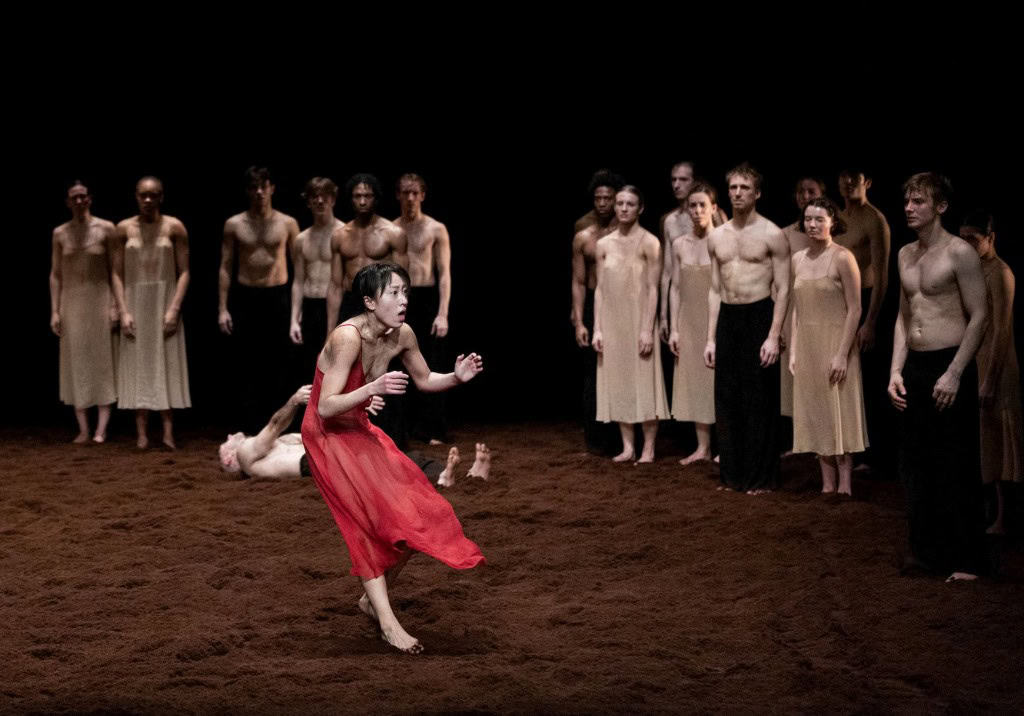
Dancing is the organization of movement on a vertical and horizontal axis in time and space. Pina Bausch explores Igor Stravinsky's composition full of play and interpretive space. His fascinating musical world reveals a continuous play of opposites: love versus cruelty, power and powerlessness. Her choreography aims to be a metaphor for a reality that demands female victims. The whole breathes an orgasmic dynamism in a fusion of physical and spiritual energy. The dancers of Opera Ballet Vlaanderen have not only a physical but also an emotional presence. They keep the audience in their grip.
The choreography 'Le Sacre du Printemps' by Pina Bausch from 1975 largely follows the original scene sequence of the libretto, but without reference to pagan Russia. The execution concentrates entirely on the sacrifice of a young woman. The theme: woman as an object of lust and victim is more current than ever. The choreography is fragmentary and aphoristic in character and has a complex dramaturgy.
The ballet floor is covered with a thick layer of peat mold, which requires more physical effort for dancing. The opening image is idyllic. In a vertical beam of light, a woman lies stretched out on a red cloth. Another horizontal line cuts through it. A girl walks forward and lifts her delicate little dress. Startled, the girls discover their sensuality. The music unfolds a carousel of feelings: embarrassment, lust, daring. Women seek solace in each other. Flock together. The men storm onto the stage, all testosterone and desire. With macho behavior they position themselves in front of the women. The leader seeks his prey. Who sacrifices themselves? The resonance of the music runs shuddering through the fragile girls' bodies. There are short stylistically elegant moments and round dances. Particularly impressive is when the women repeatedly rush towards the men and are lifted onto their shoulders. A beautiful but also somewhat sinister final image: the man lies on the ground with his arms invitingly outstretched. The victim stands in front with arms outstretched begging for help. An intense and impressive spectacle both auditorily and visually.
This triptych is an exhausting struggle every evening for both the 70 musicians and the 50 dancers. The choreographic complexity was performed and brought to life three times with breathtaking precision and focus. When the instruments fall silent and the bodies come to rest, you realize as a spectator what you have witnessed: an intoxicating journey, a wave of pure sound and dance.
'Rites' an outstanding performance!