
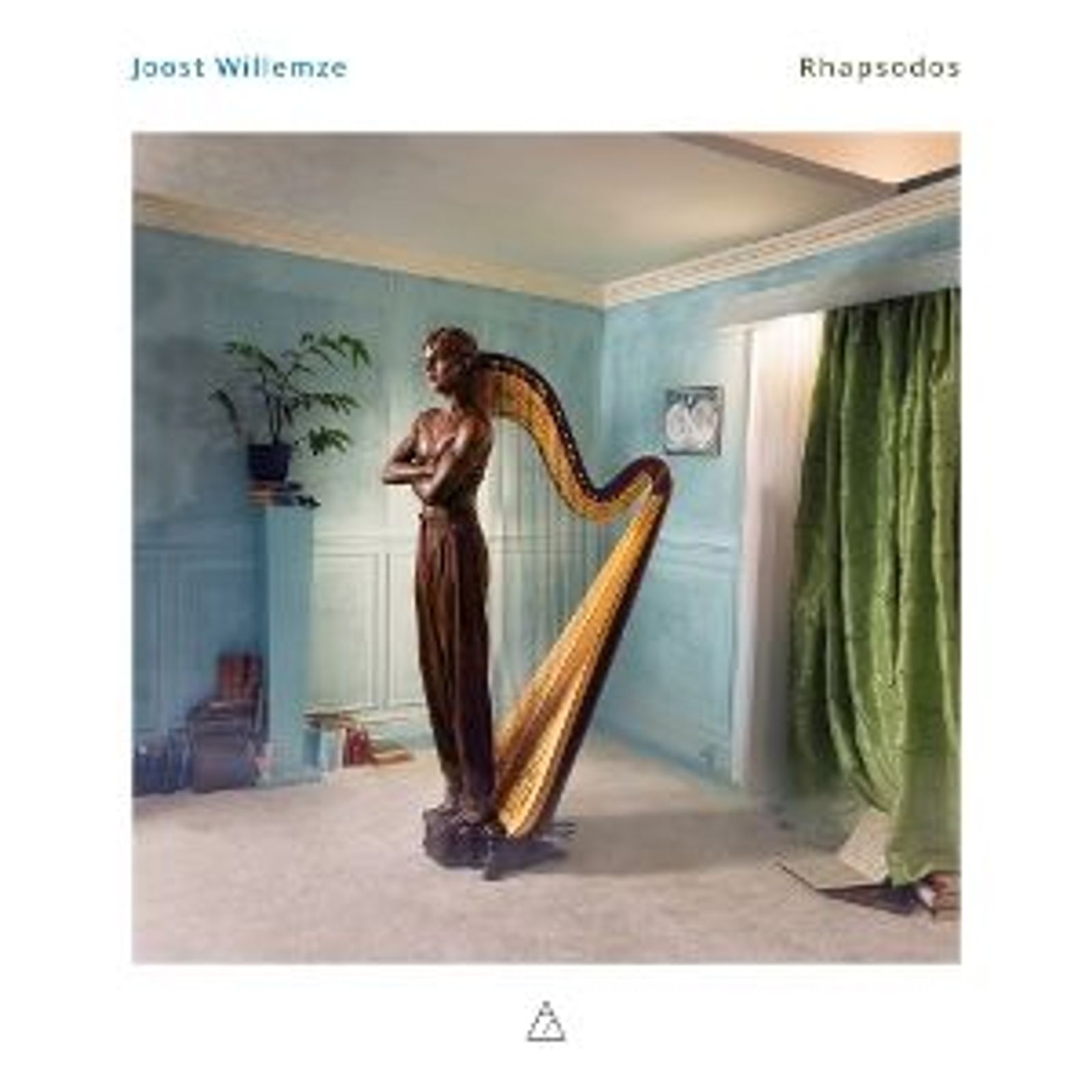
Some CDs you put away after one listen, others stay lying around – on the bedside table, in the car, next to the stereo – because you keep reaching for them again and again. Rhapsodos, the album released in March by harpist Joost Willemze, clearly belongs to that latter category. I've had this CD in my possession for several months now, and what strikes me most is that the fascination doesn't diminish as the listenings accumulate – quite the opposite. With each new session I discover another layer, a color, a detail that I missed before.
This has everything to do with how Willemze has conceived Rhapsodos: not merely as a recital, but as a personal artistic portrait: repertoire that shaped him as a musician, alongside new compositions written especially for him – something you could read about earlier on Klassiek Centraal during a conversation I had with him (https://klassiek-centraal.be/rapsodie-zonder-woorden-joost-willemze-over-zijn-cd-rhapsodos/). This shifts the album from a collection of pieces to a deliberately constructed narrative portrait of the performer himself. Willemze himself describes that role aptly: the rhapsodes of antiquity were not composers in the modern sense, but performers who gave existing material new form through interpretation – precisely the idea that carries this album.
This means the album doesn't feel like a collection of pieces, but as a whole that unfolds slowly. Those who listen to the tracks individually hear clever, fascinating pieces – sublimely played, with a technical mastery that never shows off but always serves. Those who take the trouble to listen to the album from beginning to end discover something greater: an ongoing dramaturgy, with tension that builds and ebbs, contrasts that seek each other out at precisely the right moment. This dramaturgy lies not only in the sequence of the pieces, but also in the way Willemze lets sound and silence breathe. Silence takes on an almost equally functional value as the tone itself: it structures the listening and strengthens the tension between the works. In terms of recording technique, this album is remarkably clear and intimate, with sufficient space around the instrument to allow the resonance of the strings to fully come into their own, without the recording ever becoming distant.
It is also remarkable that the program consists almost entirely of music from the twentieth and twenty-first centuries, with a pronounced place for living composers and newly created repertoire. Yet nowhere does it feel like a demonstration of 'contemporary music'. On the contrary: the works connect so naturally to each other that they form one organic whole. Willemze thereby shows that this repertoire need not be an intellectual exercise at all. In his hands it sounds pictorial, accessible and captivating, which makes the dividing line between classical and contemporary almost meaningless.
This concept is moreover given concrete form in the program choices. The album opens and closes not by chance with Marcel Grandjany (1891-1975): his Rhapsodie op. 10 introduces the program, while The Colorado Trail op. 28 concludes it. For Willemze, Grandjany is a key figure – a French-American harpist-composer who according to him writes "with a strong narrative approach" and whose music gave him, during a performance of that same Rhapsodie in a Roman palazzo, the feeling for the first time of being "a servant of a greater story". Thus the opening becomes not only a musical, but also a personal starting point for the album. In the individual works, that idea subsequently takes on a different form each time.
The album opens that mythological thread early on with Me·de·a by Anne-Maartje Lemereis (°1989), in which the tragic and murderous side of Medea is given voice as a cry of despair – an apt counterpoint to the Orpheus drama that follows.
In Trois Moments d'Orphée by Carlos Micháns (°1950), the underworld becomes palpable: a sound world that opens like a descent, dark without being ponderous, threatening without ever indulging in theatrical excess. The triptych follows the myth in three stages: the confusion after Eurydice's death, the descent to the underworld and finally the poignant image of Orpheus' singing head that continues to live on after his death.
In contrast stands Exosphère from Suite Galactique by Caroline Lizotte (°1969), which in Willemze's hands becomes nothing but lightness: sound that seems to detach itself from the earth, thin and floating, as if the harp truly enters the atmosphere to which the piece alludes. With Pearl Chertok (1918-1991), another register emerges: little scenes that remain playful and lighthearted, with a touch that radiates pleasure without becoming superficial. This register belongs to her Around the Clock Suite, a series of short, sketch-like snapshots of the day that consciously gives the listener breathing room again after the weight of the mythological works.
What moreover makes this album so thoughtful is the way in which old and new continually touch each other. Mythical images sometimes receive a contemporary sound color, as in Event Horizon: The Point of No Return, a composition by Ramin Amin Tafreshi (°1992), realized in collaboration with Soheil Shayesteh (°1989), in which electronics blend effortlessly with the acoustic sound of the harp – not as a gimmick, but as an organic extension of the sound palette. The piece depicts Orpheus' realization at the point of no return, when he realizes that Eurydice is lost forever. The work by Anne-Maartje Lemereis was also written especially for Willemze and forms an essential part of the artistic concept of this album. These composers add something that goes beyond a commissioned piece: you hear musicians who have genuinely immersed themselves in his sound idiom. The result is music that is not only written for him, but clearly came into being with him as a thinking and playing point of departure. Willemze himself remarks on this that technique for him only succeeds once it becomes "invisible" – a statement that as a listener you continually feel confirmed: nowhere do you hear effort, only surrender to the music itself. Yet in that apparent effortlessness lies a great deal of control, timing and breathing.
The Toccata by Guillaume Connesson (°1970) brings quite a different energy. Between the mythological layering and Chertok's airiness, this work introduces a rhythmic, almost percussive virtuosity. Willemze lets us hear here how versatile the harp can sound: not only lyrical and singing, but also sharply articulated, motoric and irresistibly propelling. This gives the album yet another color without breaking the arc of tension.
Willemze describes patient listening to this album itself as a form of catharsis, as the ancient Greeks knew it: intense emotions that ultimately lead to inner purification, where problems don't disappear, but where space and clarity do emerge. This is perhaps the core reason why Rhapsodos still manages to move after months of listening: not comfort in the sense of solutions, but comfort in the sense of perspective. This effect is less a result of any one specific work than of the way in which the complete album has been conceived as an arc of tension.
After months of listening, one impression remains: this is not an album that can be grasped in a single listen. Rhapsodos is a cd in which you continue to wander around: each time you discover new connections, new colors and new accents. Perhaps that is the greatest merit of Willemzes project: it continues to develop, not because the music changes, but because the listener does.