
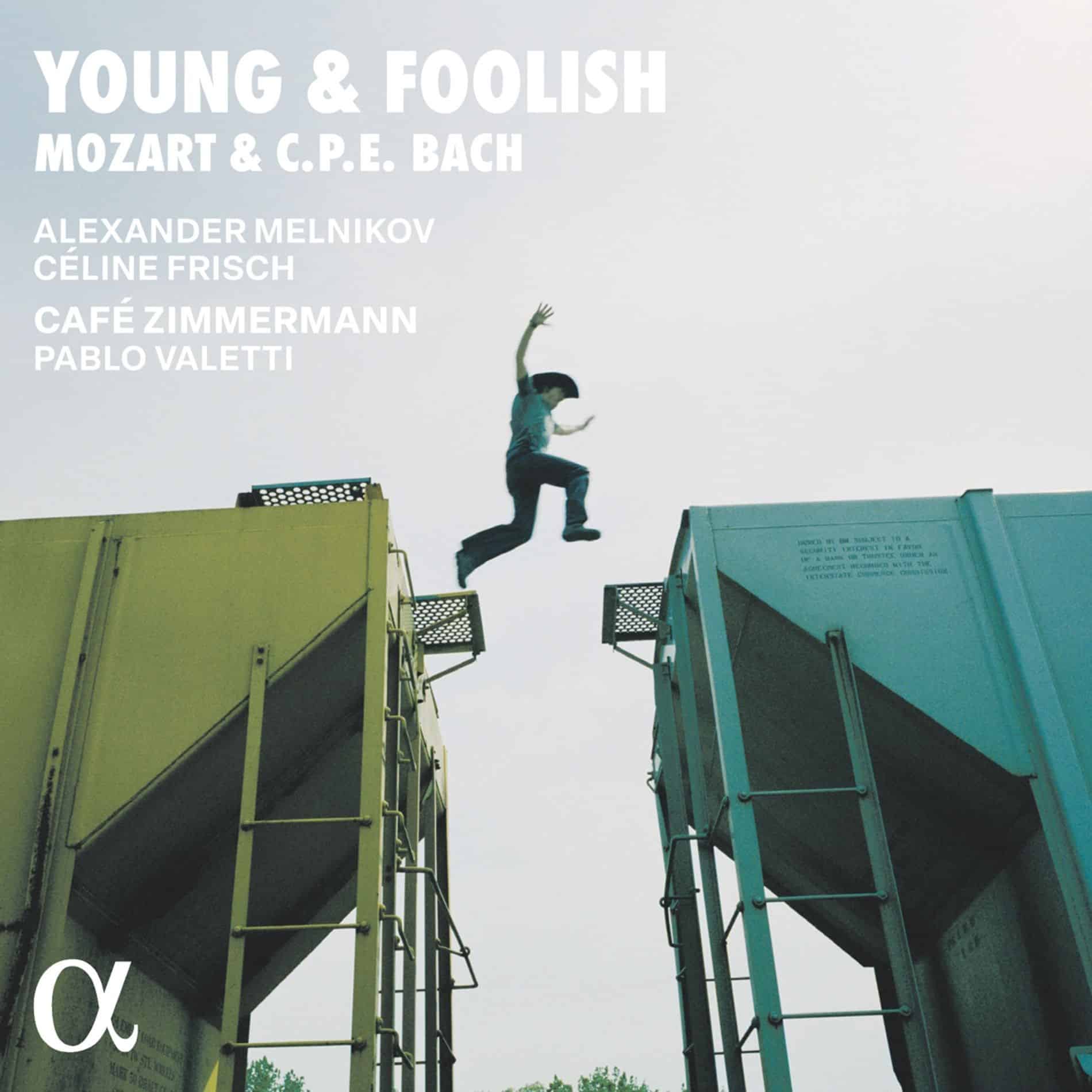
C.Ph.E.) Bach: Symphony in D, Wq 183 no. 1 H 663 - Concerto for harpsichord and fortepiano in Es, Wq 47 H 479
Mozart: Divertimento in D, KV 138 - Piano Concerto no. 17 in G, KV 453
Célene Frisch (harpsichord), Alexander Melnikov (fortepiano), Café Zimmermann conducted by Pablo Valetti (violin)
Alpha 1043 • 72' •
Recording: date unknown, Église du Béguinage de Saint-Trond (B)
The album title seems odd, because these are not juvenile works and they are anything but 'foolish', but that is also the only thing to fault it for, because the sheer joy of making music radiates from beginning to end. These performances speak with such infectious individuality (just those wonderful woodwinds!) that it will not leave anyone unmoved. The suppleness and liveliness, the enchanting dialogues, the perfect articulation, phrasing, the almost intuitive timing: it all contributes to these interpretations being a true pleasure to listen to. This also includes the pungent accents that repeatedly give the musical flow its own character. Accents that not everyone will be pleased with, but which are part of a fascinating discourse in which conventions (as if a certain 'Mozart style' were based on historical facts) have been pushed aside with great conviction.
In these readings, accents seem intended as functional 'disturbances'. They create turbulence, with overwhelming effect. Not only the pointed-playing Café Zimmermann has employed them, but the soloists too know how to handle them well. We hear it with considerable brilliance in the playing of Céline Frisch and Alexander Melnikov, two soloists with an impressive track record and profound knowledge of their craft.
Melnikov stokes the outer movements of Mozart's KV 453 in such a way that I listened to it breathlessly, with the intervening Andante as a beacon of rest and relief. Not that the chosen tempi are excessive, but rather that it is again the accents that largely determine the expressive course. Can that work? I think so, especially in view of the fortepiano played by Melnikov (after a Viennese Anton Walter from 1795), which evokes entirely different and moreover more intimate sound effects than, for example, a 'luxurious' Bechstein, Yamaha, Steinway or Bösendorfer solely in terms of sound volume. Just as the fortepiano also played by Melnikov features prominently in C.Ph.E. Bach's Double Concerto (for harpsichord and fortepiano), with Céline Frisch taking on the harpsichord part on a replica of a Berlin Mietke from 1710. Also in the Symphony in D, thanks to the use of the fortepiano as a continuo instrument, the sound effects are nothing but delightful.
No less sublime are the back-and-forth 'conversations' between the woodwinds and fortepianist, although the dynamic gradations in Melnikov are crystallized a fraction better than in the orchestra (which is not so surprising in itself). But thanks to this interpretation and this magnificent ensemble as a whole, we unmistakably hear in KV 453 Mozart as an opera composer. Musical wizardry of a special quality, when all is said and done far more important than whether or not gut strings are used (the latter is indeed the case with Café Zimmermann). Although an original cadenza by Melnikov in both outer movements might have further enhanced the artistic value of the whole.
In the cd booklet, Mozart's Divertimento is wrongly attributed a harpsichord role. The piece was originally written for string quartet (two violins, viola, cello). This is also how Breitkopf & Härtel published it in 1882 in the series Mozarts Werke Serie XIV: Quartette für Streichinstrumente, Bd.3, No.26. A harpsichord therefore has no place in it.
What is also incorrect is that according to the cd booklet Céline Frisch is assigned the pianoforte part in C.Ph.E. Bach's Double Concerto. That must of course be Alexander Melnikov. The last little error: the recording dates are missing. All in all small potatoes, but worth mentioning nonetheless. The recording technical presentation is not small potatoes, because it is excellent.