
Actually, Der Zwerg by Austro-Jewish composer Alexander Zemlinsky is anything but a crowd-pleaser. So it is interesting that De Nationale Opera in Amsterdam opens the new season with this work. A season that further contains quite a few more surprises. It is indicative of a bold vision on the genre of music theater.
Alexander Zemlinsky (1871-1942) was not really an avant-gardist, certainly not alongside contemporaries such as Schönberg or Webern. Although he remained faithful to "traditional" tonality, he nevertheless gave 19th-century Romantic music a very personal, new interpretation, unmistakably adapted to contemporary psychological content. His opera Der Zwerg is an excellent example of this.
Rightly, the opera has the subtitle "a tragic fairy tale". Zemlinsky composed the opera in 1921 based on a fairy tale from 1891 by Oscar Wilde: The birthday of the Infanta. The story is outwardly quite simple. The captivating element lies in the complex relationships between the characters and their inner world, which is entirely in keeping with the spirit of the time at the beginning of the 20th century.
The Spanish infanta Donna Clara turns 18 and at court her maids prepare a celebration for her. The most important gift is saved for last. It is also the most surprising and most fascinating, namely an hideously ugly dwarf, who is supposed to amuse her. The remarkable thing is especially that he himself does not know how ugly he is. He instantly falls in love with the infanta and sings a touching love song. The infanta plays a game of attraction and repulsion and the dwarf genuinely believes she loves him. At court, only the lady-in-waiting Ghita cares about the dwarf. She wants to break the illusion and free the dwarf from his delusion by making him see reality. His gentle naïveté is eventually brutally crushed when he is confronted with a mirror. He now sees for the first time how ugly and deformed he is. His boundless despair drives him to suicide. The infanta dances on unmoved and wishes for her next birthday a toy that has no heart.
A white rose as self-deception
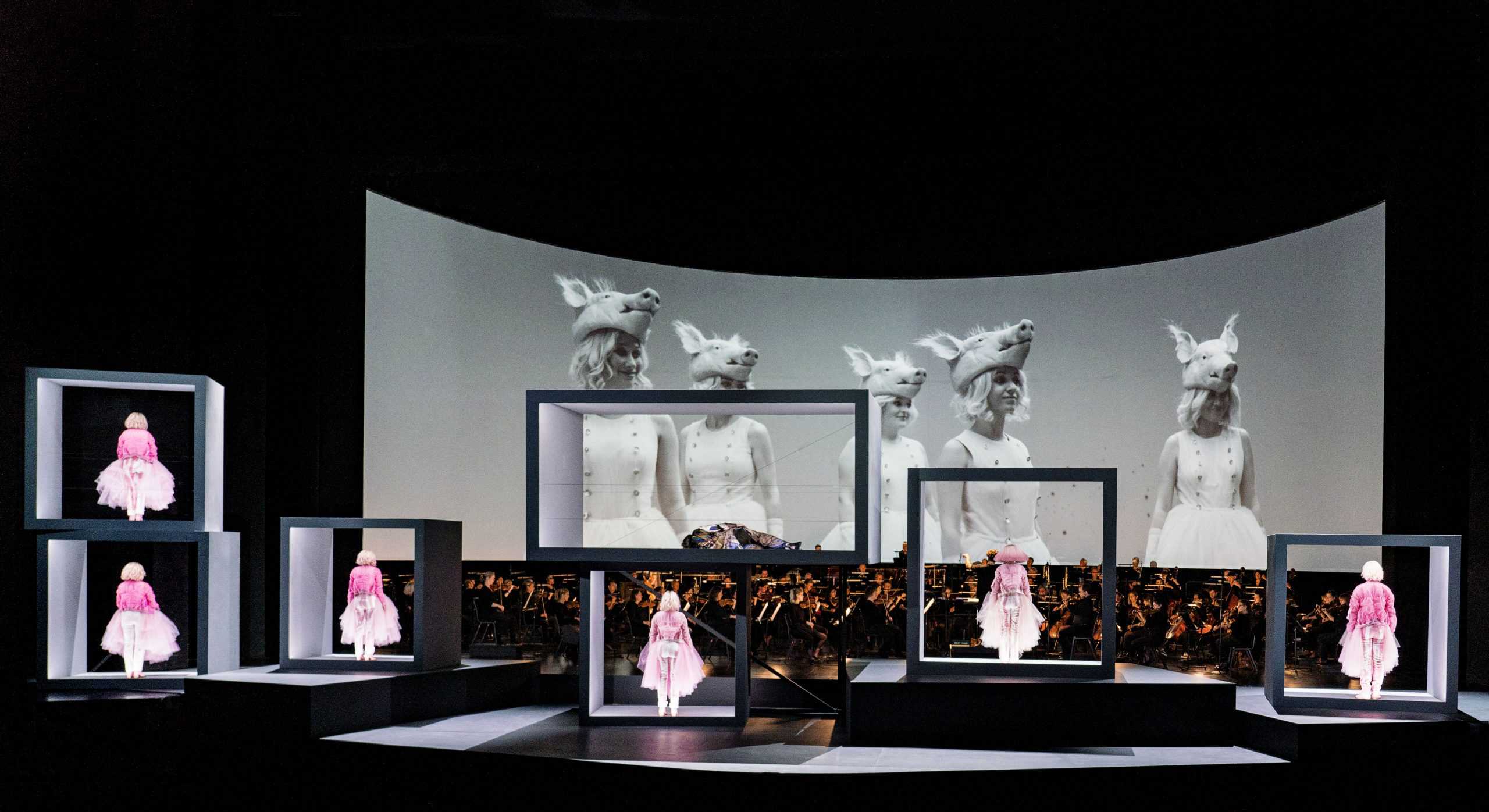
For this poignant story, which does not require much imagination to be moving, director Nanouk Leopold has constructed a very sober set. But she does play with an extremely suggestive image screen. The screen is arranged in a gentle arc all around the rear wall of the great stage of De Nationale Opera, behind the enormous orchestra, which sits on the platform. Each character stands in their own frame in front of the orchestra. This arrangement may also have been inspired by social distancing rules when the production was being prepared, but at the same time it fits perfectly with the distant relationship between the infanta and the maids. The girls cut themselves off from each other and have no direct contact with one another: each sits in their "box". Only Ghita, Clara's favorite lady, takes a step closer now and then. The Dwarf lies at the beginning on a platform in a rather gray inconspicuous outfit. This scenic realization reveals the film background of director Nanouk Leopold, who makes her opera debut with this production. In their boxes the characters are static, but on the screen they float and move in perfect harmony with their vocal line and with what they express. In the film the girls wear a soft pink mask of a pig's head and have pig's hooves. The lovely pink accentuates their slyness or hypocritical sympathy, which is their true character. Leopold explains this somewhat surprising "camouflage" by the fact that she wanted to return to the fantasy of Oscar Wilde's fairy tale, which led her to the world of animals. The Dwarf is projected on the film background as a paradisiacal exotic bird that can magnificently display its brightly colored feathers. As a gift from the sultan, he is exotic and thus an absolute outsider. The tragedy is that he has never seen what he really looks like. He interprets the infanta's attention as a declaration of love. The phrase he repeatedly sings – She has given me a white rose – thus sounds like pure and painful self-deception. His downfall is visualized powerfully by the colorful feathered garment gradually becoming smeared under a layer of mud. Gripping cinematic suggestiveness.
Gesamtkunstwerk thanks to the power of music
The visual and the cinematically successful direction of Nanouk Leopold naturally runs parallel to the powerful musical performance of singers and orchestra. Clay Hilley embodies the Dwarf with a clear and very flexible heroic tenor voice. He masterfully commands every nuance of his vocally demanding role. His lyrical love song to the infanta reveals pure emotion. His fear and especially his bewilderment at the fatal discovery of his true appearance are heartrendingly performed. Hilley completely immerses himself in this demanding character. Lenneke Ruiten as the haughty and spoiled infanta, and Annette Dasch as her counterpart, have the right vocal flexibility to convey the psychological interplay that Zemlinsky has so subtly woven into the score. Ruiten plays with an aloof hauteur, Dasch with genuine charisma.
Zemlinsky is a master at uniting the emotional complexity of the deepest psychological stirrings through expressive music. The collective star of the production is the enormous orchestra. The Nederlands Philharmonisch Orkest plays admirably in both the long phrases of the often super-dramatic tutti's and in the many solo passages. Harp and flute/piccolo stand out with extremely refined and detailed passages, while the Viennese character at the dance moments is blissfully captivating, also thanks to the delightful mandolin sound. Lorenzo Viotti takes on his role as chief conductor of De Nationale Opera with this production and this first production is successful across the board. The dramatic point in the orchestra when the Dwarf recognizes his ugliness literally gave me goosebumps. It made you leave the hall in silence.
This production also recalls the brilliant performance at De Nationale Opera of Eine Florentinische Tragödie by Zemlinsky, conducted in November 2017 by the then chief conductor Marc Albrecht. So De Nationale Opera can add a couple of feathers in its cap for the rarely performed Zemlinsky over a few seasons.
- WHAT: Alexander Zemlinsky's Der Zwerg
- VOICES: Clay Hilley, Lenneke Ruiten, Annette Dasch, Derek Walton
- DIRECTION: Nanouk Leopold
- MUSIC: Nederlands Philharmonisch Orkest, Choir of De Nationale Opera conducted by Lorenzo Viotti
- WHERE: De Nationale Opera, Amsterdam
- WHEN: Saturday 4 September 2021 (premiere) – performances also on 8, 12 and 18 September, each time at 8 p.m. (for information and tickets, click here)
- PHOTO: © Marco Borggreve