
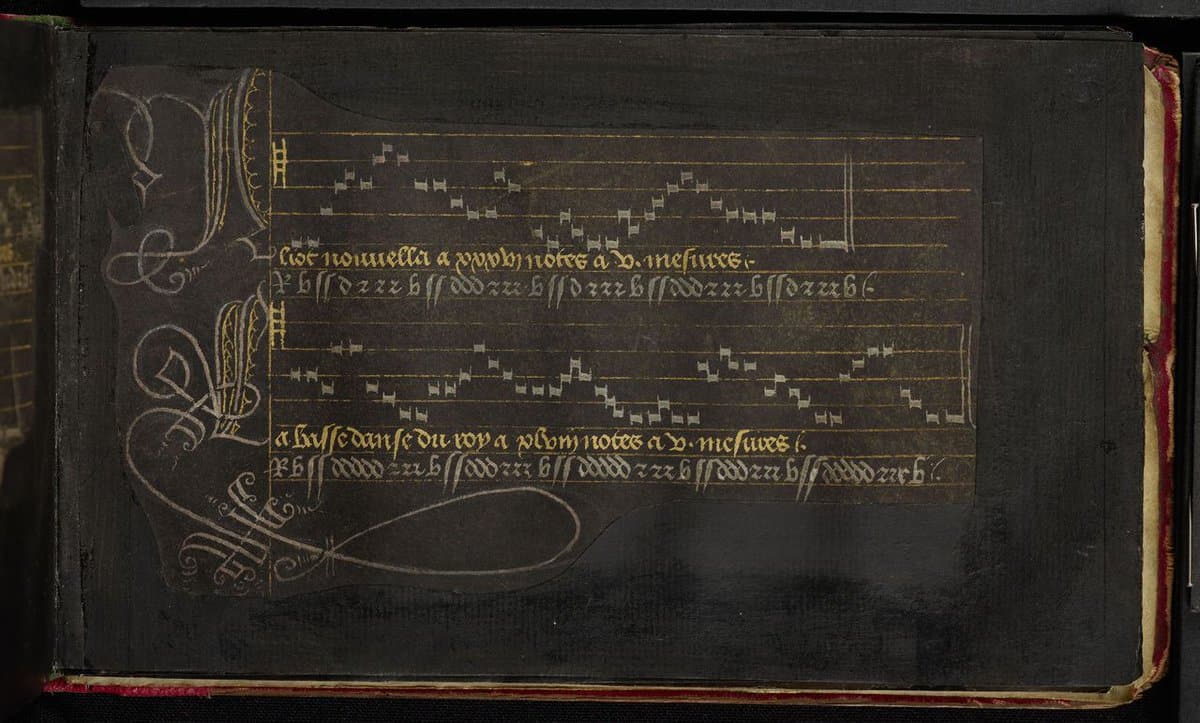
Black parchment, but few have seen it. Quite a bit of it has been lost because it is more fragile than ordinary parchment. Black parchment was extremely expensive and only the richest could afford it. Among them the fabulously wealthy Burgundians. The last of them was Margaret of Austria (1480-1530). Through her mother Mary of Burgundy she was Burgundian, but through her father, Emperor Maximilian of Austria, she became the first Habsburg to rule as governess over the Netherlands.
The booklet is in black parchment. This material was, simply because of its rarity and color – black was a color of luxury on which jewels sparkled – pure luxury. Who else than a prince would afford such a thing? The so-called 'simply living' Margaret of Austria nevertheless permitted herself such a black parchment booklet. That booklet has been preserved and it was on display on December 2 and 3, 2022 in Brussels in the exhibition halls of the KBR, the royal library where it is normally kept under lock and key as part of a magnificent Burgundian library, the 'Librije'
Why shown for only two days?
Well, who wouldn't want to see such a unique booklet? Give more publicity to such a unique exhibited booklet and thousands of people would flock to it. Right? Unfortunately, the booklet is in poor condition, the result of natural fragility, but also due to, among other things, incorrect restoration in the 19th century. Since it is so exceptional and an absolutely unique specimen, it is already a risk in itself to show it for two days to a more limited audience. No worries, however, there is a facsimile that has been exhibited more than once and also during the exhibition, where the real booklet could be seen these two days, it will be on display in place of the original. Meanwhile, a new facsimile is being created by the Alamira Foundation, the research center for early music in the Abbey of het Park in Leuven.
The original was thoroughly digitized and it yields even more remarkable results than the small booklet itself when you page through it. The details that become visible are, as it were, to be savored, the best food for specialists. It remains to be seen whether that small detail might possibly release secret messages or the like. Who knows… An exciting book could possibly be written about it: the secrets during the dances of the Burgundians and Habsburgs in the late Middle Ages and Renaissance at the court of Margaret of Austria. Court dances, 58 in total, could possibly speak to the imagination.
Basses Danses
The basses danses were very popular in courtly circles during the Renaissance. It was a refined dance that, instead of being exuberant and joyful, was much more modest with almost very cautious movements in which the dancers almost glided across the dance floor. A dance stripped of the wild behavior of the Middle Ages. In the booklet of the high-born governess there are the necessary guidelines about the steps, there is a singing line for a tenor, but the desired accompanying instruments and / or multiple singers with or without polyphony are not mentioned.
Exhibition info KBR: www.kbr.be and www.alamirefoundation.org/nl/nieuws/het-basses-danses-manuscript-in-het-kbr-museum/
Info Alamira Foundation and the booklet Basses Danses: www.alamirefoundation.org/nl/nieuws/documentaire-basses-danses-het-dansboekje-van-margaretha-van-oostenrijk/
More information about fascinating manuscripts and handwritten scores can be found on the Alamira Foundation website: www.alamirefoundation.org
Photo: © kbr.be - Danses Basses, 58 dance instructions for Margaret of Austria