
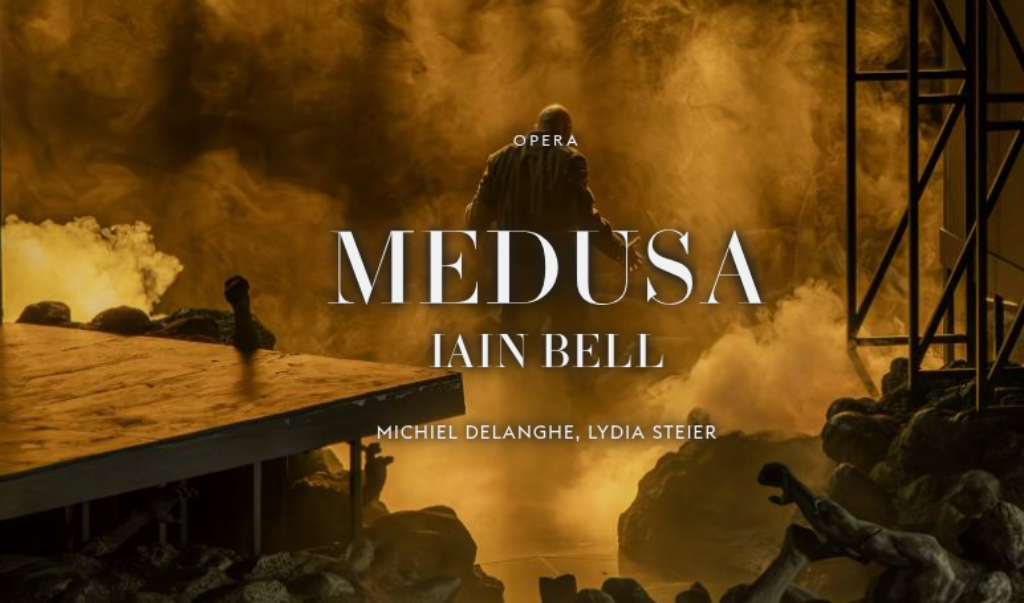
Medusa lets a lost mythological female voice sound rightfully again. She poses the question: who is she? A question we can equally ask ourselves with a Lucrezia (Borgia) or a Lucia (di Lammermoor).
Iain Bell, Lydia Steier and De Munt bring their own Medusa. Multiple questions arose that evening: "Why does Medusa need a voice? Why (yet another) mythological opera?". This makes me wonder which nerve is being touched. Why not? Isn't this precisely about the woman and not "yet another" myth?
Medusa is not only a new contemporary opera, but also a path to new interpretations and characters. Bell & Steier already look refreshingly beyond the original – male – myth.
Who/what is (the) Medusa?
The Medusa myth is widely known. Many heroes perish at her feet, until Perseus defeats her. But, who is Medusa? In pop culture, Greek mythology is sometimes summarized with "Zeus/Poseidon/… desired the beautiful x, with all the consequences that entailed". The woman is reduced to a prop that sets the game in motion. She pays the price: she transforms into a cow (Io), a bear (Callisto) or, in the case of Medusa, a gorgon with serpent hair and a deadly gaze.
"We are filling in the dot dot dot after Poseidon sexually assaults Medusa," according to team Bell and Steier. Medusa explores pain and shared trauma.1 Make no mistake: Medusa is a challenge to translate, because the hidden core revolves around sexual abuse, trauma and powerlessness – something the original myth ignores. Bell and Steier expose what Medusa's fate truly entails.
Sexual harassment and abuse are certainly not new in opera history (De Munt's forthcoming opera, the recurring Villalobos production of Puccini's Tosca, is an example of this).2 But they are often driving forces that are quickly, or even lightly, glossed over. Haven't we finally moved past that mentality? Medusa has certainly got it right.
"Sleep my starchild, sleep"
Who says Medusa (soprano Claudia Boyle), says Perseus (tenor Josh Lovell). Bell & Steier interweave their myths without doing Medusa's story injustice. This through a melodic lullaby that forms a tragic leitmotif throughout the opera. "Sleep my starchild, sleep," sing both Perseus' mother Danaë (mezzo-soprano Marie-Juliette Ghazarian) and pseudo-mother Medusa.
The orchestral composition is a threatening, dissonantly sounding hussar piece that stretches and hovers behind this leitmotif. The opera begins with an invisible, ominous ghostly choir. The male choir seems to represent Poseidon's (bass Konstantin Gorny) threatening intention. This before we even see the cruel god. The influences of Richard Strauss' Elektra (1909) are audibly present. Psychology and emotion resound in atonal dissonance. It is devoid of melody, unless painful desires are touched upon.
This alternates with the closed female world, portrayed by Athena's priestess choir. This too is cruel and disjointed. It is here that Gorny's Poseidon strikes. The opera makes excellent use of his powerful bass voice for this. The rape of Medusa is brief – banal brief – compared to the consequences that follow. The merciless Athena, impressively portrayed by soprano Mary Elizabeth Williams, rages with a steely flood of sound against her priestesses. Finnish soprano Anu Komsi (High Priestess) sets down the mad consequences of their failure with her clear voice. Madness, rage, and not a shred of pity for "the whore" who has desecrated Athena's temple. Medusa transforms: her identity is taken from her.
Act two is an introspection. The woman Medusa does not exist; she is a monster. Surrounded by her gorgon sisters (mezzo-soprano Paula Murrihy as Euryale and soprano Angela Denoke as Stheno), she feels disjointed. Her sweet voice is replaced by a desperate tone. Short melismatic sections fragmentarily harken back to belcanto mad scenes, as in Donizetti's Lucia di Lammermoor (1835). The tragic, yet also moving, duet between Medusa and "the star child" Perseus reveals the longing with which she wishes to die: her own (family) dreams brutally denied to her.
With Medusa, Bell, Steier and De Munt touch something deeply integral. It is a production that must be seen, both because of its subject matter, the composition and the talented cast. I asked Bell the question "Can we give more women in (opera) history their voice back?". I already have the feeling that Medusa is certainly not the last time we will hear these women. Let us begin, but certainly not end, with Medusa.
1 This section is a paraphrase based on the press moment with Iain Bell and Lydia Steier. This was prior to the opera premiere on 05/05/2026. 2 The 2026 opera production of Giacomo Puccini's Tosca (17/06-01/07/2026) is a revival of De Munt's successful 2021 production. The direction is by Rafael R. Villalobos.
[embed]https://www.youtube.com/watch?v=I2i0TSwLcoI[/embed]