
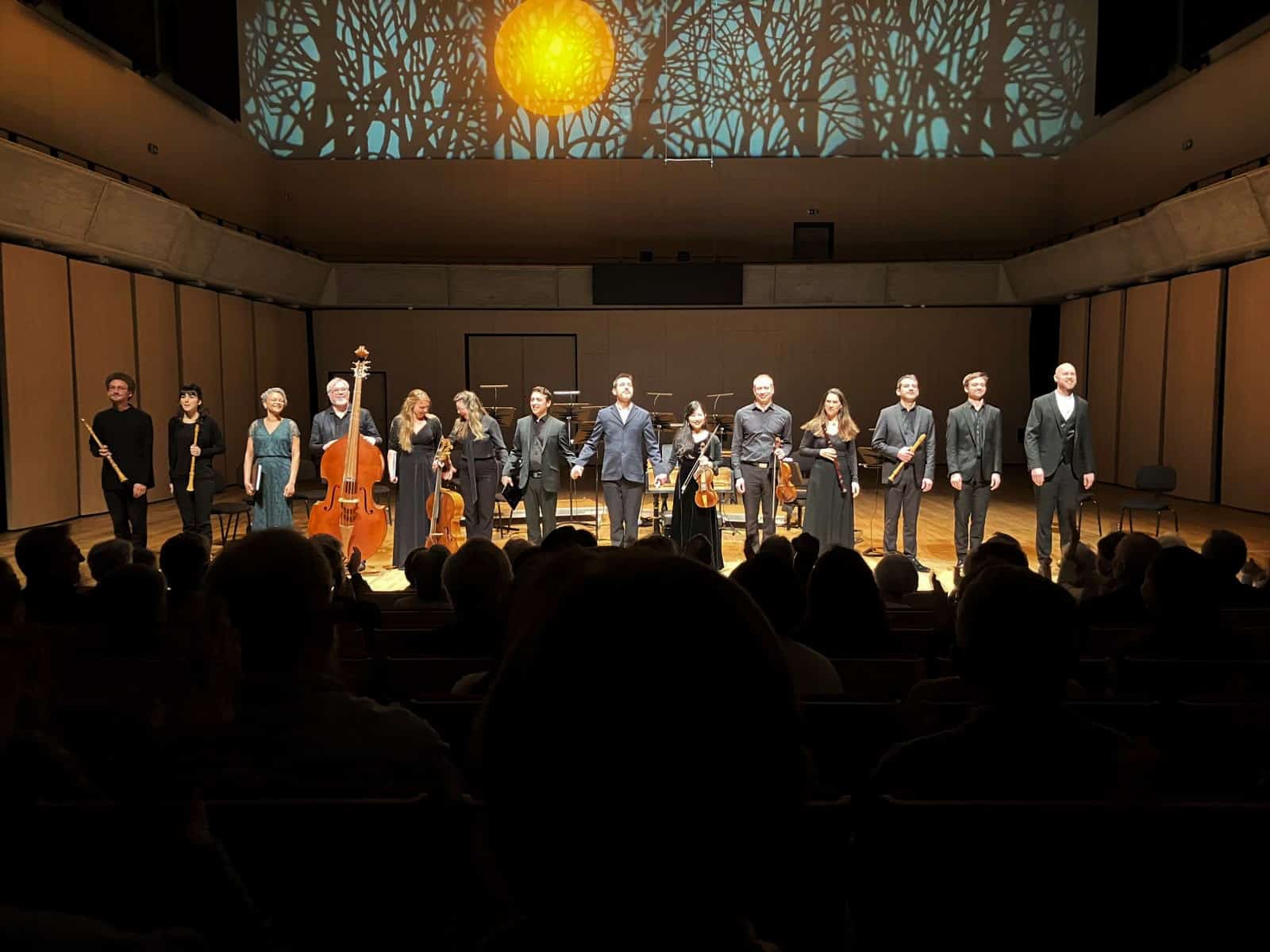
On 20 March, Olivier Fortin together with Ensemble Masques and a select cast of soloists brought a captivating performance of Georg Friedrich Händel's Acis and Galatea to the Namur Concert Hall. The spacious venue was packed to capacity, and the audience rewarded the musicians afterwards with sustained loud applause – a well-deserved recognition of an evening filled with refined musical splendour.
Händel composed Acis and Galatea in 1718 while in the service of the Duke of Chandos in England. He himself once called it a "little opera", but the work is generally regarded as a pastoral opera, characterized by its idyllic atmosphere and mythological themes. The libretto, based on Ovid's Metamorphoses, tells the tragic story of the shepherd Acis and the sea nymph Galatea, whose love is rudely disrupted by the jealous Cyclops Polyphemus. The first act exudes a dreamy pastoral beauty, while dramatic tension builds in the second act, culminating in the death of Acis and his ultimate transformation into an eternally flowing river. This contrast between the two acts was particularly well illuminated in this performance.
The vocal soloists excelled in expression and musicality. Rachel Redmond brought a radiant soprano and subtle phrasing to create a captivating and sensitive Galatea. Hugo Hymas and Philippe Gagné as Acis and Damon performed their parts with lyrical elegance, while Marie Pouchelon added extra colour with her warm mezzo. Tomas Kral stole the show as Polyphemus with an extremely expressive interpretation, in which his robust bass voice impressively conveyed the menace and tragic character of the jealous giant. Ensemble Masques, with a beautiful lineup of oboes, flutes, strings and basso continuo, brought Händel's music to life with a stylistic precision that did justice to both the dancelike lightness and the dramatic intensity of the score.
One minor point was that the balance between voice and instruments was not always optimal, particularly in some solo passages, which caused certain vocal lines to recede slightly into the background at times. However, this detracted little from the overall impact of the performance, which was of an exceptionally high level throughout.
During Händel's lifetime, Acis and Galatea was one of his most frequently performed works, with no fewer than 70 performances, including in Dublin in 1742 – the last time Händel himself conducted it. That popularity is unsurprising: the combination of melodic beauty, lively instrumentation and a dramatically well-constructed narrative makes it a timeless masterpiece. The performance in Namur under the direction of Olivier Fortin proved this once again in a convincing manner and will undoubtedly remain vivid in the audience's memory for a long time to come.