
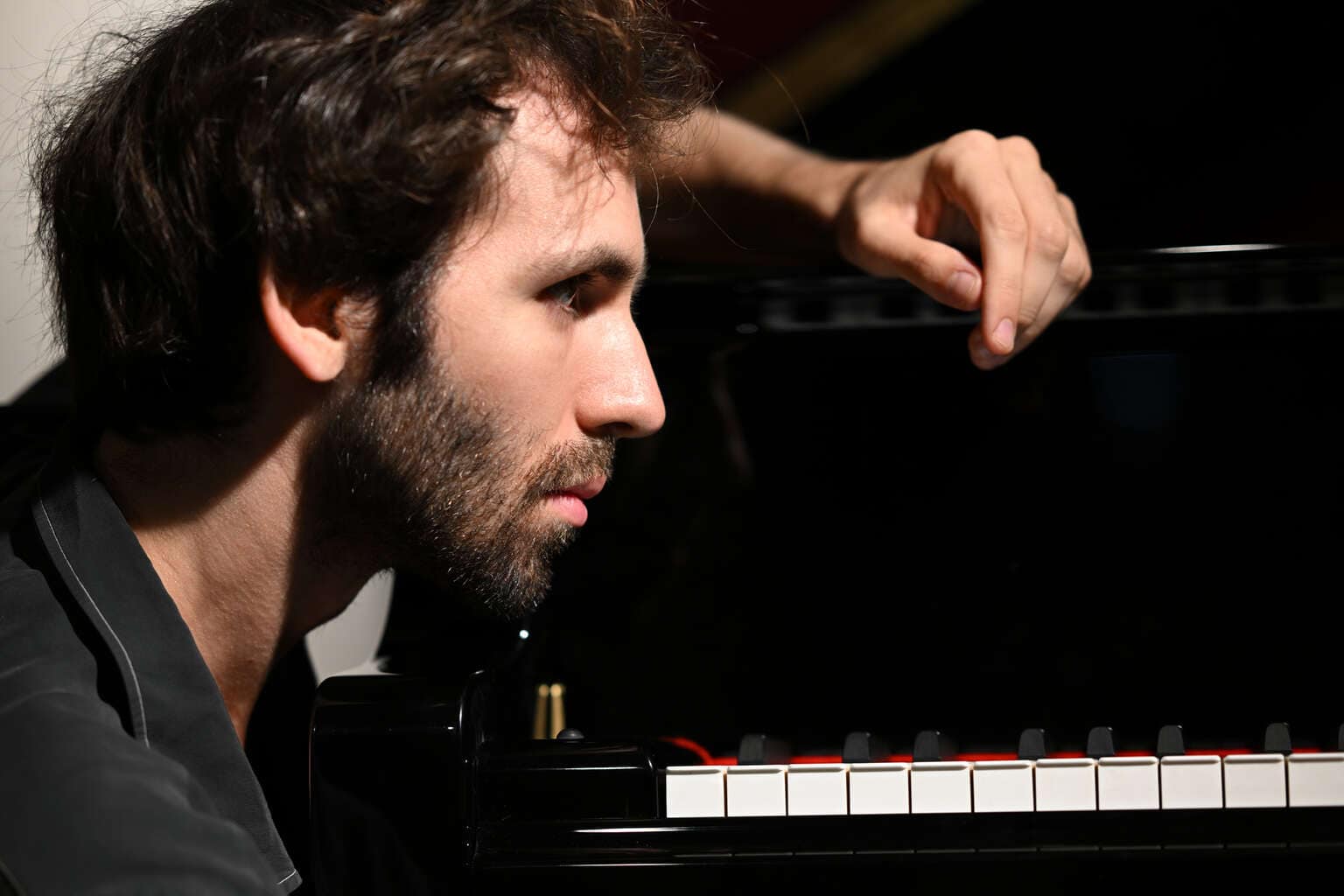
There are pianists who play notes, and there are pianists who open an inner world. Alexandre Kantorow unmistakably belongs to the latter category. In Keys to the Soul, he transformed Studio 4 at Flagey on Monday, March 23 into a space where sound, silence, and emotion met, where every touch gained meaning and every silence breathed. While Brussels was shaken that evening by a bomb threat, this recital as part of the Klarafestival drew the listener from the very first moment into an almost physical proximity to the music and grew into an inner expedition through the deepest layers of sound and feeling, one of the most moving recitals I have ever experienced.
From melancholy to introspection
The recital began with Variations on the theme of 'Weinen, Klagen, Sorgen, Zagen', S. 180, by Franz Liszt (1811-1886). Here, a universe of emotions immediately unfolded. Kantorow let the variations breathe as a continuous dialogue between light and darkness, with a strikingly transparent voice leading in the polyphonic passages. The bass notes rumbled softly through the hall, deep but never heavily struck, the highest notes sparkled like sunlight breaking through clouds. Each variation was a separate breath of the soul: the melancholy, the fiery surges, the hushed moments of contemplation formed together an organic whole. Liszt's complex technical challenges never became an end in themselves; they served the dramatic and spiritual contours of the work, whereby Kantorow in an inimitable way made the listener feel how the composer's emotions came to life directly through the keys.
With the Piano Sonata in f, op. 5, by Nikolai Medtner (1880-1951), the introspection shifted to a deeper psychological level. It is indeed a sonata that lays bare the human soul in all its tension and longing. The first movement raged with an inner energy that immediately compelled the listener's attention: every phrasing, every dynamic curve was saturated with human seeking, with a strong sense of tension building over longer lines. In the third movement, Largo divoto, an almost liturgical serenity unfolded: Kantorow let time slow down and the space between the notes speak, without the arc of tension slackening, allowing Medtner's often forgotten sonata not only to be heard but to be deeply experienced. Kantorow's playing during half an hour felt as if he himself were living through the composer's existential questions, causing every note to gain deeper meaning. This piece was a revelation.
Miniatures as psychological theater
After the intermission, the Prélude in cis, op. 45, by Frédéric Chopin (1810-1849) introduced a subtle shift toward intimate reflection. The short work, almost a whisper, was drawn out by Kantorow into a moving moment of respite in which the listener could savor every touch. It thus became a moment in which vulnerability became palpable. Chopin, so often performed as a virtuosic exercise, became here a contemplation, a meditative introspection of the human heart. In this moment, the listener was, as it were, invited to become silent themselves, and to let the resonance of the piano penetrate their own thoughts and feelings.
A surprising and fascinating turn came with La chanson de la folle au bord de la mer, from 25 Préludes, op. 31, by Charles-Valentin Alkan (1813-1888). Alkan, often an outsider in the concert repertoire, was brought to life by Kantorow as a psychological storyteller. The bizarre leaps, the capricious rhythms, and the melodic turns formed a portrait of inner madness and melancholy, sharply articulated and with an almost theatrical timing. Kantorow found in it the ideal balance between grotesque humor and deep emotional seriousness; the piece became a story about human vulnerability, absurdity, and beauty. Here he also showed his remarkable sense of characterization, whereby each phrase gained an almost theatrical charge. This piece too was a fascinating discovery.
With Vers la flamme, op. 72, by Alexander Scriabin (1872-1915), the concert became a ritual of light and energy. Kantorow let Scriabin's flames literally dance: the trills and harmonies flickered through the hall and awakened a sense of transcendental fire. This work, which so often sounds abstract or distant, became a physical, spiritual experience. The audience became not merely spectator, but participant in an ignition wherein every nuance, every harmonic tension, seemed to fill the space with light and energy that extended beyond the tangible sound range of the piano.
Beethoven as culmination
It was striking how these three shorter works flowed into one another without interruption, creating a coherent arc of tension that naturally led to the monumental finale of the evening, the Piano Sonata No. 32 in c, op. 111, by Ludwig van Beethoven (1770-1827). The first movement pulsed with universal drama: powerful, urgent, charged with tension, but never merely demonstrative. The Arietta: Adagio molto semplice e cantabile unfolded as a serene, ethereal meditation, in which every sound and every silence mirrors itself in the listener's inner life. Here time became fluid, sound a mirror of human striving, and music itself a contemplation of struggle and reconciliation. Kantorow brought a balance between concentration and emotional abundance, causing Beethoven's final sonata to feel like a completion of the journey that the recital from Liszt to Scriabin had initiated.
As a subtle and perfect finale, a moving Liebestod from Tristan und Isolde by Richard Wagner (1813-1883) followed as an encore, in the transcription by Franz Liszt (1811-1886). This magistral recital could not have ended better: a soothing sustained note of a perfectly calibrated programme that moved many to tears.
A revelation of the soul
What made Keys to the Soul unforgettable was the coherence and depth of Kantorow's approach. Liszt, Medtner, Chopin, Alkan, Scriabin, Beethoven and Wagner/Liszt were not merely successive names, but formed a carefully constructed dramaturgy in which melancholy, passion, introspection, absurdity, mysticism and transcendence reinforced each other. Kantorow showed how music can breathe and resonate, how silence and sound meet to touch the listener deeply.
Thus Keys to the Soul became more than just a recital, but a pilgrimage through sound and time – a rare moment of inner beauty in which Kantorow not only let the music sound, but also revealed something essential.