
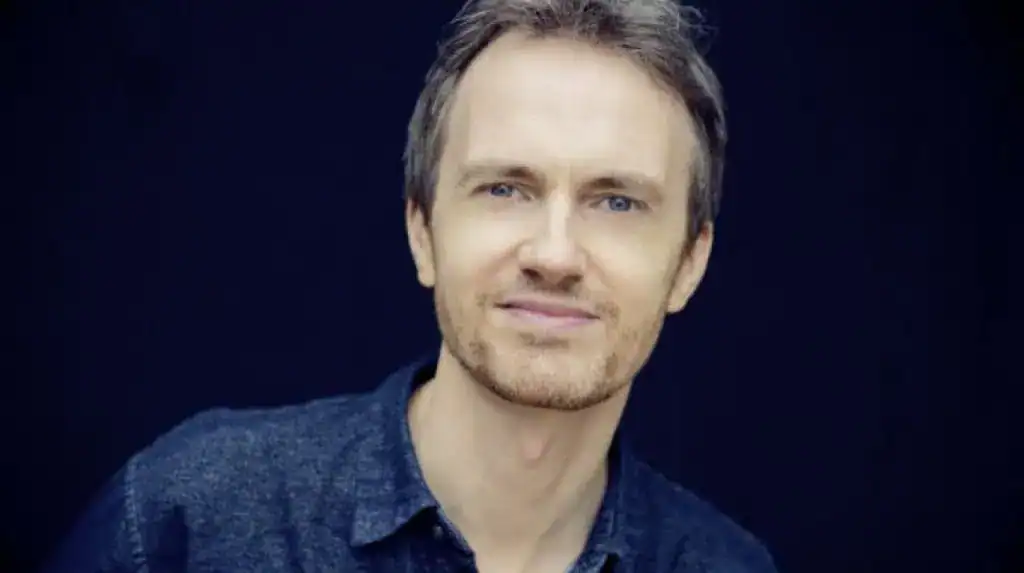
Alexandre Tharaud was long a name among many aspiring young pianists. Until I saw the film by Michael Haneke. There his name took on the concrete meaning of a 'rising star' playing Schubert, with his former teacher and her husband in the audience. And who wanted to bring them his brand new CD shortly after, but to his horror had to find that he had forgotten it!
Saturday Tharaud was in the Concertgebouw Brugge. Also for a recital: Rameau, Mozart and arrangements of French chansons. Also with a new CD. His ex-piano teacher and her husband, Emmanuelle Riva and Jean-Louis Trintignant, have since passed away. But his CDs, he had brought them: Pianosong or a selection of 29 select chansons, transformed and elevated to full-fledged concert repertoire. Before him, in the 'années folles', Jean Wiéner did that already for the 'die-hards' in the striking Parisian cabaret 'Le Boeuf sur le toit'. In 1953 the Bulgarian-French Alexis Weissenberg (1929-2012), one of the best pianists of the 20th century, elevated the everyday to poetry and art, when he, in the wake of Charles Trenet, entrusted the charm of "En avril, à Paris" to the keys.
The keyboard sings, speaks and moves
In his search between classical and popular Tharaud coupled a crystal-clear Mozart Sonata and a dancing Rameau to French song and chanson art. From Mozart we had heard the 'Turkish March' so often that we no longer stop to consider the link between his elegant time-bound compositions and the music of the Janissaries of that era, which made a great impression on Western ears. In the introduction Jan Christiaens drew attention with image and sound to the dominant drums, the blaring trumpets, the noisy shawms and the tinkling bells of these elite troops of the Ottoman Empire, whose evocation alternates so ingeniously with more pianistic passages in Mozart's 'Alla Turca'. With Rameau too, the keyboard was a source of varied musical and emotional atmospheres.
Tharaud chose one of his 'Nouvelles Suites' and that gave him the opportunity to obtain special sound effects, such as the illusion of three hands in 'Les Trois Mains' or the sound of a wind ensemble in 'Fanfarinette'. Melody and ornamentation went hand in hand. Yet my attention wandered unintentionally, precisely with Rameau! Was it an impression? The nature of the music? The memory of the sound of the harpsichord? Too romantic an approach? Perhaps it was the latter, because the staccatos at the end of the Suite proved that it could also be more piquant...
Hommages
Alexander Tharaud is a poet at the piano. The velvet opening notes of Poulenc's 'Hommage á Piaf' proved it with verve. He conjures with rubatos and ralentandos. His interpretations are more than arrangements or adaptations. Sometimes they are total transformations, unrecognizable from the beginning. But that is precisely what makes it so fascinating. His version of 'Ne me quitte pas', a cry for love in Brel, was in the arrangement by Abdel Rahman El Bacha, honored here as winner of the Queen Elisabeth Competition 1978, a whisper of crystalline sounds, as fragile as the pianist himself.
Equally moving was 'La Bohème' by Aznavour. Very slow, hesitant, dreamy, as if Tharaud were improvising, it came, 'simple comme bonjour', only to eventually burst forth. Jazzy touches, well-placed dissonances, merciless rhythms gave standards like 'J'attendrai' or 'Padam' the verve they demanded. A standing ovation and a pleasant signing session rounded off the evening nicely.