
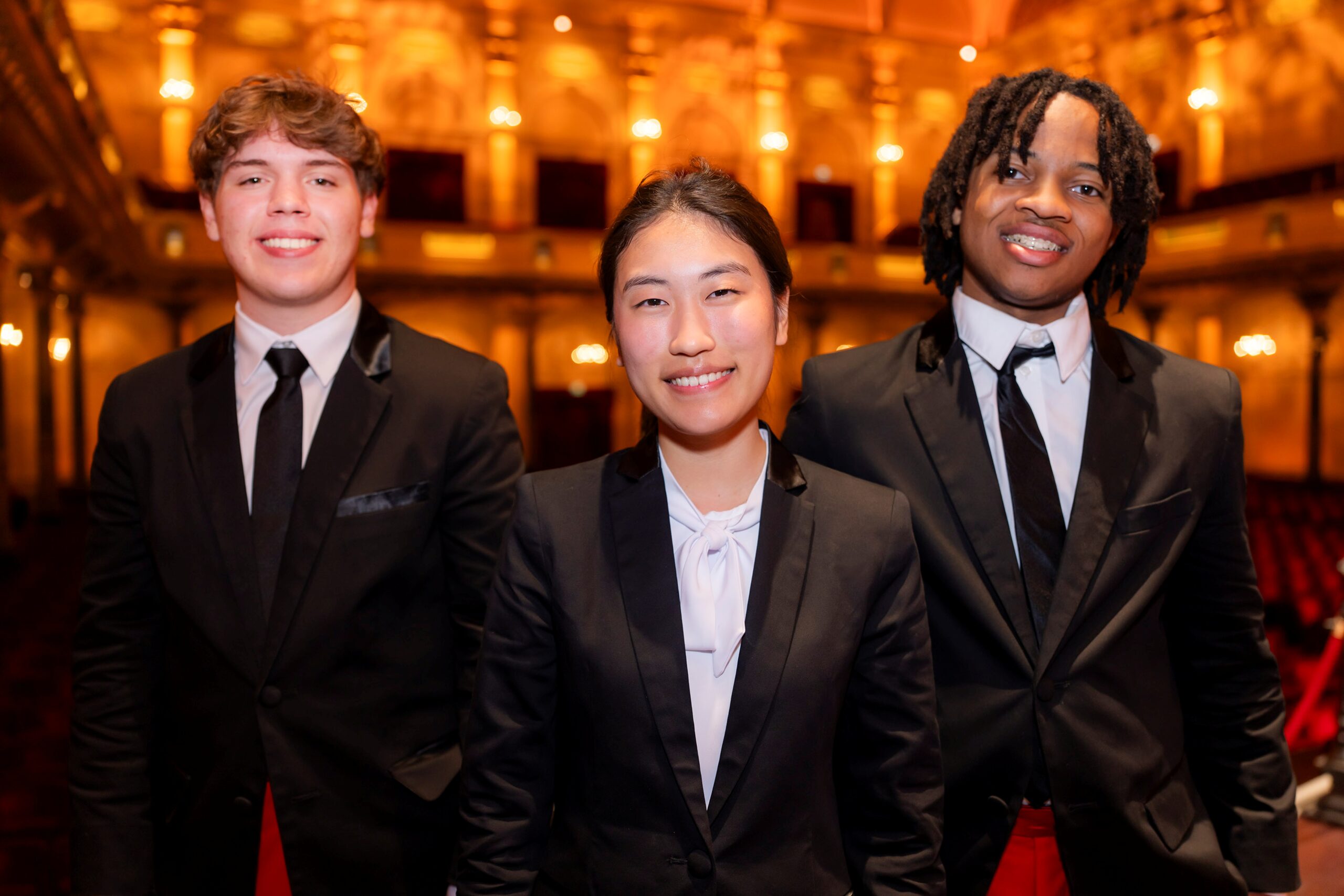
Still energized from the concert, three young musicians from the National Youth Orchestra of the United States of America (NYO-USA) speak with me after the performance. The atmosphere is relaxed and cordial, as if the adrenaline from the performance still flows through the halls of the Konzerthaus. The orchestra has just completed an impressive musical journey: from the lyricism of Samuel Barber and the vibrant rhythms of George Gershwin to the much darker and more complex sound world of Béla Bartók. For these young Americans, moreover, it is more than just a concert: they represent a country that, like Europe, consists of many different regions and cultural backgrounds.
How do you bring young musicians from different corners of a vast country together and turn them into one orchestra in a short time? For percussionist Dylan Goldbach (17) from South Carolina, the adventure began with a video audition. After submitting his audition, he received word about two months later that he had been selected. "We come, if I'm right, from about 35 states," he tells me – plus Puerto Rico. Then they all came together at Purchase College in New York, about an hour north of New York City: "I actually found it quite easy to make connections. We all have a similar background as Americans, and besides, we shared rooms. We stayed in suites of four, which immediately creates very close connections with at least three other people."
That geographic aspect keeps coming up throughout the conversation. Ellie Choi (17), from New Jersey, is used to playing mainly with musicians from her own area. The NYO-USA has significantly broadened her perspective: "I've discovered here how many connections I can make with people spread across the entire United States. It's an incredible experience to work together with players I'd never met before, and then share music on such fantastic stages. That's truly a special part of this entire journey."
For viola player Obinna Uchime (18) from Georgia, it went beyond just music – the orchestra became a personal challenge. He describes himself as rather introverted and not someone who easily talks to everyone in his own orchestra: "When I came to NYO-USA, I actually wanted to talk more with people and meet new people. I think I've become much better this year at meeting people from all parts of the country." Moreover, that sense of connection doesn't arise only through conversation: "Even when we play, I can make contact with other people through movement." Music thus becomes not only the purpose of their being together, but also the means by which they get to know each other.
That feeling is audible and visible during the concert. The program indeed demands enormous stylistic flexibility. Barber and Gershwin speak a language that the young Americans seem to handle relatively naturally, while Bartók requires a completely different concentration and emotional depth. For Goldbach, Bartók's Concerto for Orchestra was precisely the greatest challenge: "I still find it difficult to grasp the full emotion he put into this piece. I haven't had that much life experience yet." He smiles when he talks about conductor Karina Canellakis, who according to him played a crucial role in the musical process: "She's wonderful. If we can grasp the emotion she gives us, there's a good chance we'll get close to what Bartók intended. She's constantly on top of it." During rehearsals, there was extensive discussion about the character of the different passages and the emotions that each instrumental section should convey: "We've gone over countless times how different sections should sound and how we can draw those different emotions from Bartók's music."
For Ellie Choi, that is precisely one of the fascinating aspects of the work. She even calls the Bartók concerto her favorite piece of the program: "It's truly a work in which every instrument gets its own moment. We all have our solos and get the opportunity to listen to every instrument in the orchestra." According to her, that makes a big difference from much of the well-known orchestral repertoire, in which individual voices sometimes easily blend into the whole: "By working on this piece, I've learned to listen much more consciously to the other instruments."
As a flutist, she is moreover confronted with a very specific emotional world. In her solos, she tries to evoke feelings of longing and unfulfillment: "Sometimes I try to imagine a flutist who wants something very much but can't get it. It's that feeling of pushing and withdrawing, of longing and at the same time not being able to reach. Those emotions I try to capture in my playing." It's a remarkable image, especially coming from such a young musician, and it says a lot about the way this generation approaches music: not only technically, but also through imagery and personal associations.
Obinna, for his part, emphasizes the enormous contrast within the program. For him, Gershwin is immediately recognizable as a typically American sound world, connected to the jazz that became increasingly important in the 1920s: "I grew up with that kind of music myself, so it's quite natural for me to convey that atmosphere." With Bartók, everything changes. A much darker and more complex emotional universe takes its place. He points out that Bartók wrote the work during a period when his health and life situation were under severe strain, and that it is one of his last compositions. That makes the transition within the program all the greater: "It's an enormous leap between the two halves of the program," he says. "You go from the almost opera-like Barber and the jazzy Gershwin to the much darker world of Bartók."
At the same time, Bartók is not simply somber. It is precisely the constant alternation of dark, sometimes almost oppressive sounds and moments of lightness that makes the work so difficult to play: "It's a kind of cacophony of all those different sounds. It's very difficult to grasp all of that correctly: not to play too much, not to obscure the melody, but to convey all the emotions in the right way."
Herein perhaps lies the greatest challenge for a young orchestra: not only to overcome the technical difficulties, but to learn to listen to the whole and at the same time take responsibility for one's own contribution. The words of the three musicians make it clear that this is precisely where the strength of NYO-USA lies. They are young, but they are not put on stage as students. They are challenged to listen to each other as accomplished musicians, support each other, and together create a musical identity.
And what do they hope the audience will take home with them after the concert? For Dylan Goldbach, the answer is simple: "I hope they enjoyed the American music, and especially Gershwin. How could it be otherwise when Kirill Gerstein plays the piano concerto?" But he hopes for more than just a successful evening: "I hope they get a true picture of how we Americans make music and how we feel music. And I hope that stays with them."
Ellie Choi hopes that the audience especially felt the energy of young people: "We may be young, but we have enormous energy. We want to perform and share music with the world." Obinna formulates it somewhat differently, but ultimately arrives at the same essence: "I hope that people realize that young musicians can do almost as much as professionals. That we too can convey joy and attention, and everything that is present in the professional music world."
They are modest words, certainly after a concert in which these young Americans presented themselves anything but as musicians-in-training. From dozens of states, with different backgrounds and personalities, they found each other in one orchestra. And when the last notes of Bartók have faded away, one realization especially lingers: the future of American classical music was not somewhere far off, but simply on the stage.