
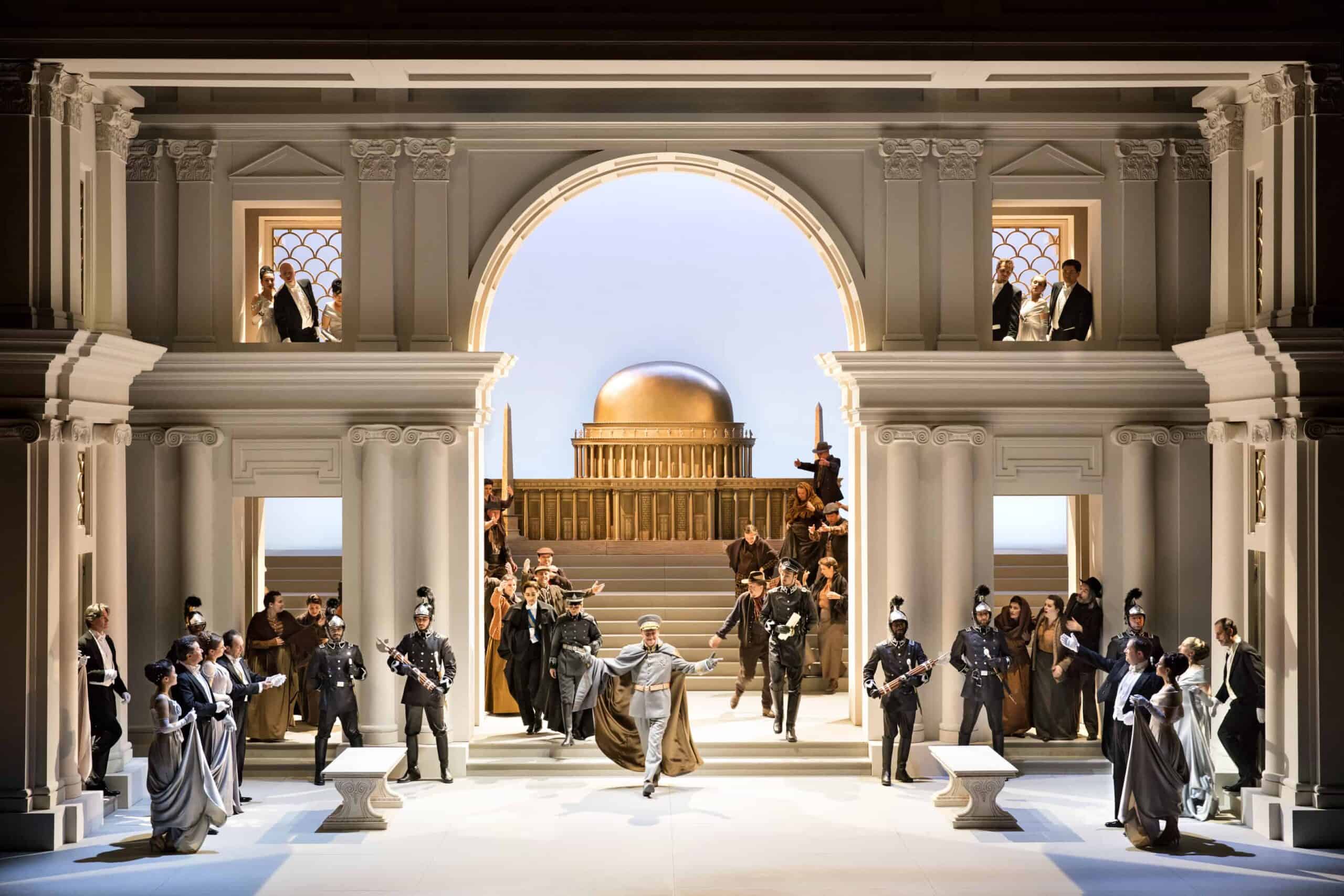
The Opera Vlaanderen production shows us Mozart's last opera seria in an aesthetic Roman setting. Director Michael Hampe may have been guided by the official occasion for which Mozart wrote the opera. This doesn't prevent him from expressing with sharp clarity the diversity of emotions with which the characters struggle.
Mozart's opera La Clemenza di Tito is a commissioned work for the coronation of Leopold II as King of Bohemia. The opera premieres in Prague in September 1791. Two months later Mozart is dead. In the story, the individual is entangled with the interests of state. Human feelings are tested to the extreme by fate. Mozart brilliantly succeeds in making the conventional opera seria burst with sincerity and credibility. His opera is therefore a true crowning achievement of the opera seria genre.
The story of thwarted ambition, a failed assassination attempt on a prince and especially ultimate clemency, mingled with passionate and honest love, sets sharply drawn characters against each other, and despite some gaps in the narrative is moving and gripping. That we look in this production at a room from a Roman design book from the year 100 AD, with Ionic columns and a view of the dome of the Capitol, which indeed collapsed after the arson, doesn't disturb the psychological impact of the story at all. Some attributes indeed come across as dated (the scepter, the plume on the helmets of the guards, and so on) and risk forcing the characters into clichéd poses, but the inner drive works. The direction is universal enough to provide space for anyone wanting to give a contemporary interpretation to love troubles in power relationships.
Passionate Vitellia
The opera opens with the duet between Vitellia and Sesto, in which she urges Sesto to murder Tito, because she wants to become empress herself. From this opening scene, Agneta Eichenholz reveals herself as the unappreciated woman who claims the right to imperial status. Throughout the opera she manifests herself as passionate and highly self-assured, dominated by jealousy that only at the very end of the opera – in her final recitative with the beautiful aria Non più di fiori – gives way to let love prevail. Eichenholz plays a clever, ambitious woman. Her voice conveys what stirs and churns within her. When you hear her sing, you understand what she says in the interview in the Opera Vlaanderen magazine (Insight no. 15) about "coloraturas and high notes that come naturally". You could say she sings from the belly. The flip side is that her technique does dare to falter in hitting the highest notes flawlessly and in giving resonance to the lower notes…
Although Tito is central to the action, along with Sesto, Vitellia is the most important role in the opera. Sesto gets a vocally wonderful interpretation with Anna Goryachova. Goryachova does not really embody physically the role she plays as a character in the opera – she looks boyishly young – and the same goes for the other "Hosenrolle" Annio (Cecilia Molinari), but their vocal performance makes up for this shortcoming. Goryachova plays smoothly with the demanding coloraturas of her part and in her top arias of the piece, Parto, parto in the first act, engages in a beautiful duet with the obligate clarinet. For all singers it holds that they vocally master virtually all the emotions in the fateful turns of events in the story – fear, unrest, anger, jealousy, passion, there are quite a few – Your vocal convincing performance makes you as a spectator empathize with the heartbreak of their inescapable fate. Tito also rises to this. Lothar Odinius suffers from all the roles the most under sometimes clichéd poses and somewhat also under the stiffness of the character. Yet he grips you through the sincerity of his vocal engagement in the final scene, in which he is tossed back and forth by the choice to condemn or spare Sesto. Servilia is sung with much tenderness and lyricism by Anat Edri, and Markus Suihkonen, a second member of the Young Ensemble Opera Vlaanderen, gives a personal interpretation to the often stereotypical role of Publio with his beautiful full bass voice.
Orchestral subtleties
Conductor Stefano Montanari has his baroque background to convey the orchestral subtleties of the score with enthusiasm to his musicians. They play with great pace and without ever becoming pompous. The recitatives typical of opera seria are performed by Pedro Beriso on pianoforte with verve and, where appropriate, with a touch of irony. The arias with obligate instruments come into their own beautifully. Bravo for the oboe and the basset horn (Non più di fiori). The chorus also gives a splendid performance and is beautifully integrated into the stage picture.
Not a production that can erase the memory of the sublime Clemenza from long ago at the Munt (1982 in a production by Karl-Ernst Herrmann and with Sylvain Cambreling as conductor!), but a fine production with good singers who can meet the high vocal requirements and at the same time convey authentic emotion. A necessity for a successful performance.
- WHAT: Wolfgang Amadeus Mozart (1756-1791) | La Clemenza di Tito
- DIRECTION: Michael Hampe
- VOICES: Lothar Odinius, Agneta Eichenholz, Anna Goryachova, Cecilia Molinari, Anat Edri, Markus Suihkonen
- ORCHESTRA: Symfonisch Orkest en Koor Opera Vlaanderen conducted by Stefano Montanari
- WHERE: Opera Vlaanderen, Antwerpen
- WHEN: Wednesday 23 May 2018
- PHOTOS: © Annemie Augustijns