
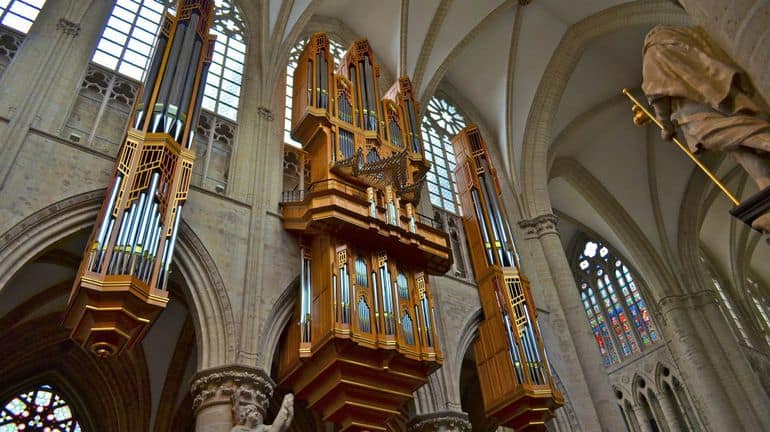
THE ORGANS OF THE CATHEDRAL
Did you know? The Sint-Michiels- and Goedelekathedraal has 3 organs.The most impressive one naturally hangs in the nave. Built in 2000 by Gerhard Grenzing, the instrument consists of three organ cases: in the middle a central corpus with the keyboard arrangement and the four manuals, flanked on both sides by pedal towers. The organ is suspended like a swallow's nest and weighs almost 30 tons. This setup is ideal for acoustics, as the organ sounds are reflected downward by the vault and are also reflected by the wall opposite the organ cases.
All concerts of the Ars in Cathedrali festival are performed on this majestic organ.
The second organ is a "Collon" from 1977. It is positioned in the Choir where more intimate concerts are held. It has two manual keyboards and a pedalboard. The third organ is a small positive organ, also by Patrick Collon (1973), with a single manual keyboard. This organ will be used during the first concert, in parallel with the Grenzing organ.
THE ORGANIST, MORE THAN A MUSICIAN
Playing an organ is a true feat according to dramaturg Ludovic Halévy: "The artist who sets out to work with the organ is an athlete. In the heat of playing, the slightest mistake is striking and comes back like a boomerang to the one who played it. A wrong note is a torment… One must coax hidden treasures from the instrument, but once the instrument is tamed, all efforts are rewarded: the instrument is ready, invites the one who masters it, and seems, like a diligent errand boy, to give new strength to the intelligent hand that directs it."
Saint-Saëns, composer of the Organ Symphony, would say: "the organ stimulates the imagination, the unpredictable rises from the depths of the unconscious; it is continually a new world emerging from the shadow, like a fairy island rising from the sea, never to sink back into it again." For Stravinsky, the organ was "a monster that never breathes". For Berlioz, "the organ is made for absolute sovereignty. It is a jealous and intolerant instrument. The organ and the orchestra are both kings. Or rather, the one is emperor and the other is pope. Their mission is not the same, their interests are too enormous and too different to be confused with each other."
THE ORGAN, AN INSTRUMENT TO DISCOVER
Balzac already said: "The organ is the greatest, the boldest and finest instrument sprung from human genius."
Yet the organ, this majestic wind instrument with impressive power, remains unknown to the general public. Robert Schumann already invited us to discover it. He said: "If you pass a church and hear an organ there, go inside and listen. Run your fingers over the keyboard and marvel at the power of the music. There is no instrument that knows so well how to avenge all impurities and uncleanness in the composition or in the playing."
The origin of the organ goes back to 300 years before our era. It was Ctesibios, a Greek engineer who lived in Alexandria, who first came up with the idea of designing a compression machine to replace the human breath and make wind instruments sound: the compressed air generated by pistons is stored in a bellows submerged in water, to the Aulos, ancestors of the "Organ Reed": the hydraulis or hydraulic organ is just born. In the beginning it is a very small instrument, but as it enjoys lightning success, it develops considerably to become an imposing instrument. We must wait until the 13th century to see the appearance of the abbreviation and the keyboard with keys, which evolves through a series of successive musical inventions to the current modern keyboard, gradually transitioning from 2 to 5 octaves. The current pipe organ keyboard currently has 61 keys extending to 5 octaves. The most advanced organs can have five manuals.
The liturgical organ is a fascinating instrument that invites contemplation and reconciliation within the protective enclosure of the church. The sound capacity is generated by a set of sound pipes fed by a wind tunnel. It includes a facade, various manuals, a pedalboard, a windchest and stops. 'King of Instruments', the church or pipe organ, is an unforgettable wind instrument whose sustained sound is produced by a set of sound pipes driven by a blower. Each pipe will emit only one note at a time.
The organist of the Sint-Michiels and Sint-Goedelekathedraal and co-organizer of this 10th festival, Xavier Deprez, notes: "If Johann-Sebastian Bach is the reference musician of the organ, this instrument was played before and after his time. That is why we welcome this year, during our eight summer concerts, old and contemporary works performed by excellent artists and ensembles from Europe and Asia".
Dean of the Cathedral, Abbot Benoit Lobet, explains: "Our festival reminds music lovers of the power and beauty of the church organ. We are pleased to be able to organize this tenth edition of the festival in the cathedral of the European capital and hope that the public will be even more numerous than in previous years.
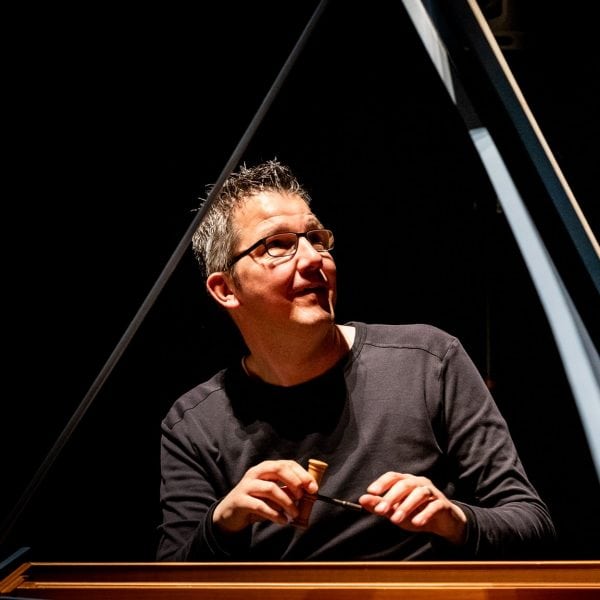
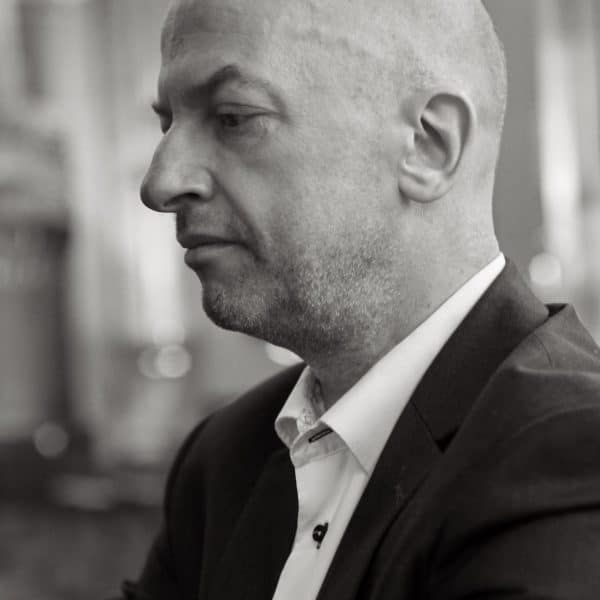
The cultural association, Ars in Cathedrali, presents the 10th edition of its summer festival with a program of eight weekly organ concerts, every Tuesday at 8 p.m., from July 12 to August 30, 2022, in the Sint-Michiels- and Sint-Goedelekathedraal in Brussels. The 2022 festival aims to combine new and old repertoire.
- New, with music by Xavier Deprez in the opening concert, for organ, voice and choir
- New, with music by Pierre Slinckx, organ and electronics.
- New, with composers Michaël Kamen (USA) and Craig Philips (UK) in the concert Organ Pipes and Brassery Bells, and with Jan Welmers, minimalist composer.
- Old, with Heinrich Schütz, to whom we pay tribute during the closing concert on the occasion of the 350th anniversary of his death.
- Old, with Johann-Sebastian Bach, with two recitals as a tribute. And closer to home, the German Romanticism of Mendelssohn, Liszt and Reger.
- Also new: an organ and brass ensemble concert.
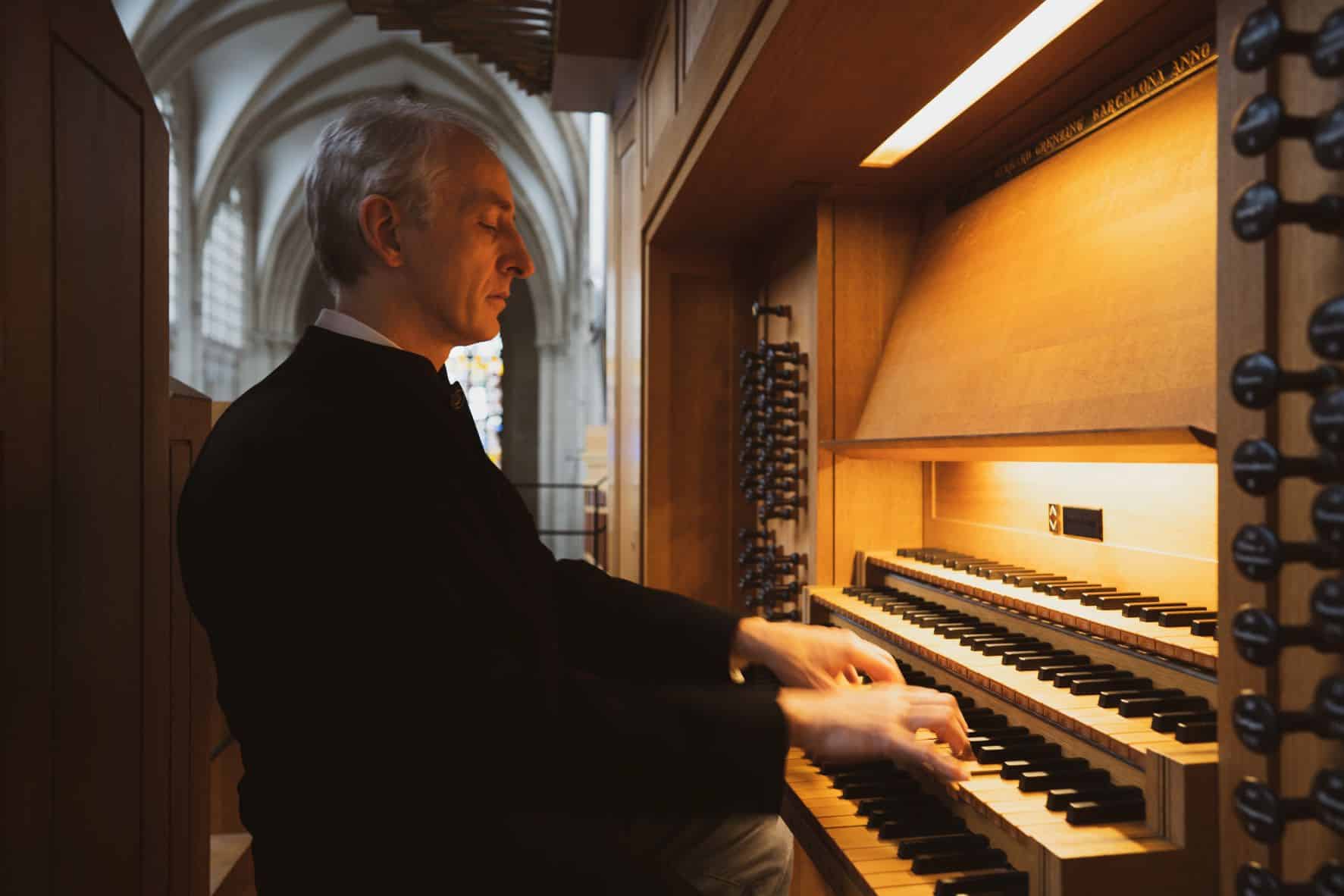
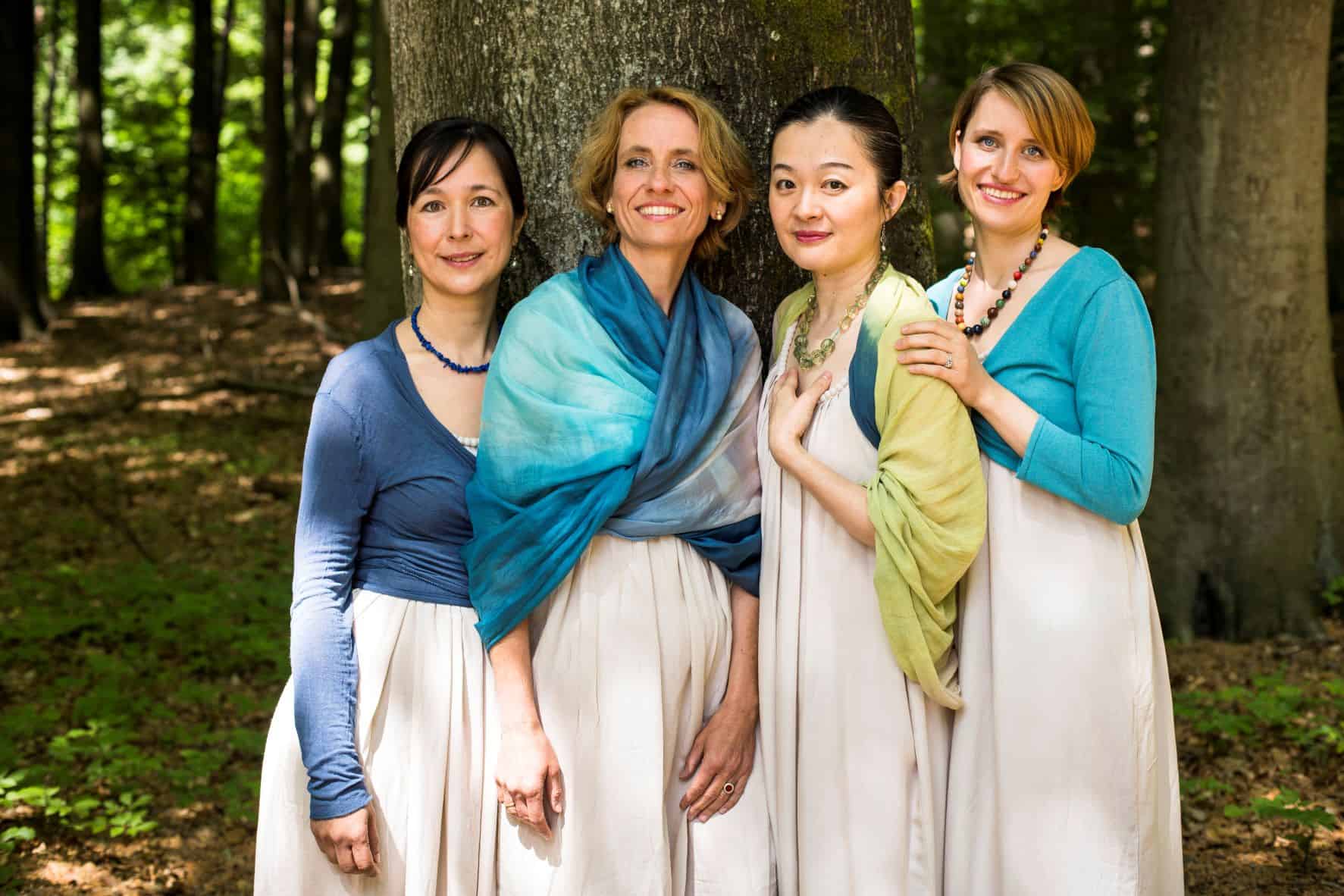
The 2022 program, featuring internationally renowned artists of Belgian, Dutch, French and Japanese nationality, includes the following concerts (detailed program on page 4):
- Tuesday July 12 : « The wind blows where it will » | Xavier Deprez, organ, with soprano Elise Gäbele, the Ensemble Filiæ and the choir Voces Desuper. A unique concert and a world premiere.
- Tuesday July 19: « Belgian solutions » | Cindy Castillo and Pierre Slinckx - Works by Johann-Sebastian Bach, Joseph Jongen and Pierre Slinckx.
- Tuesday July 26: « Organ Pipes and Brassery Bells » | Nicolas de Troyer and the Brassery Brass Players - Works by Hans-André Stamm, Jehan Alain, César Franck, Alexandre Guilmant, Michaël Kamen, Craig Philips.
- Tuesday August 02 : « Fantastic Organ » | Rie Hiroe, Japanese organist - Works by Johann-Sebastian Bach, Max Reger and Franz Liszt.
- Tuesday August 09 : « ClavierÜbung III - Lutheran Mass and the chorales of the Great Catechism » | Benjamin Alard, French organist - Concert dedicated to Johann-Sebastian Bach.
- Tuesday August 16 : « United tastes, Bach and the Italian style » | Jean-Luc Thellin, organist from Liège - Works by Johann-Sebastian Bach and Antonio Vivaldi.
- Tuesday August 23 : « Monumental organ works » | Jan Hage, Dutch organist - Works by Johann-Sebastian Bach, Jan Welmer and Franz Liszt.
- Tuesday August 30 : « Schütz and his Legacy » | Bart Jacobs, titular organist of the Cathedral, with the Belgian Ensemble In Alto and soprano Alice Foccroulle - Works by Heinrich Schütz, Matthias Weckmann, Dietrich Buxtehude.
tickets & info