
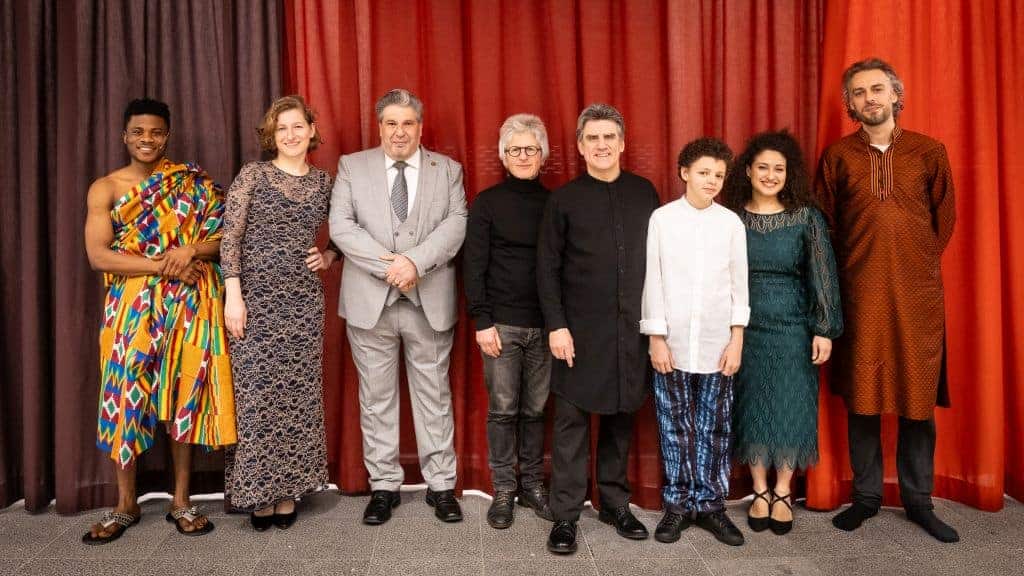
Dirk Brossé has been collaborating with Symfonie orkest Vlaanderen for quite some time. Thirty years ago, he composed an idealistic manifesto: an innovative, universal symphony for orchestra, ethnic instruments and soloists. We are all swept along by the maelstrom of history.
What remains thirty years later of this cross-cultural vision of brotherhood and human rights? That dream returned in shards. Brossé is not paralyzed. His composition remains carried by positive emotion. With music, the complexity of the world we live in can be done justice. This work remains impressive with the gleam of purification.
Layering
The programme booklet contained a note: Dirk Brossé's mother had suddenly died a few days earlier. Despite the great grief, he wished to complete this cycle of four concerts. He did not give up. You can only have great admiration and respect for this man's professional integrity. As a conductor, you must inspire and create a safe context. Purely on character and an inner fire, he conducted his work and dedicated it to his mother. Immediately there was a respectful vibe from the instrumentalists and the audience.
World Citizen
Brossé is a well-travelled man who has collaborated with many people from different cultures. He lives nomadically between different metropolises. The world is his home. There is a societal role for an artist. Thanks to his great entrepreneurial spirit and work ethic, Brossé still generates much energy that nourishes musical life and society. We live in turbulent times. Is humanity not beyond saving due to primordialism?! The world is on fire. We watch and feel powerless. Dirk Brossé is not discouraged and brings with 'Artesia Revisited' a plea for a world with more compassion and peace. As an accomplished composer of musicals, film music, classical and contemporary work in our Western sound idiom, he also has an eye and ear for other cultures culminated in this work. The main soloist is an 11-year-old boy. Youth and strength are needed to make the world better. Music infused with a web of hope.
The composition opens very cautiously, almost conjuringly, with a sound scale that is touched. Then the orchestra falls in like a flower bud bursting open. The strings offer a sound tapestry from which the sound of a flute with high-frequency vibrations rises like a babbling brook. In this musical story in seven parts: Birth, Life, Joy, Strife, Hope, Artesia, Harmony Brossé pulls open multiple stylistic drawers, richly coloured from diverse styles with tribal percussion. With the finest colour gradation, subtle tempo accents and soaring melodic lines. By constantly keeping the antennae open to the world around us. With a hairline sense of nuance, he purifies the massive architecture of his composition into gossamer filigree. With the involvement of around 65 ethnic instruments including much percussion: tam-tam, djembé, darabukka, Syrian tambourine cochas and seashells, Arabic flute and also pre-Columbian flutes hundreds of years old, further sitar, didgeridoo, Ghanaian harp lute, saxophone... a new perspective opens up.
The boy soprano Theo Jadoul with tousled blonde curly hair surprises in a smart blue suit. A large symphonic orchestra at his back. He stands in the middle of the stage, looks defiantly into the hall while he sings in his crystal-clear voice in an invented language 'jabbertalk' to show that music is a universal language. Even if you don't understand each other, you can still understand each other. Theo looks calm, while he is consumed by stress, I suspect. His hands clench into little fists several times. It makes his performance all the more impressive. A voice, like a thread weaving the acoustic fabric of the melody.
[embed]https://www.youtube.com/watch?v=DADg93AmP4U[/embed]
In between, Amel Sdiri brings Arabic songs. It is a noble singing style, melismatic, which requires a highly developed register and extensive technique. It is a musical genre with a characteristic rhythmic movement in a specific meter. Improvisation takes a large place in these repertoires and attempts to express the inexpressible. The music stems from the attitude of placing oneself at the service of the text. Quite distinctive to hear is the connection of the monotone and sonorous sound of the didgeridoo with her agile voice. Also inventive is the sound of the violins which provide a soft sound bed where the sitar rises above in sound and rhythm.
'Artesia Revisited', a tender and purifying moment amidst all the rhetoric and violence of war. An ode to human resilience. Music carried by positive emotion. The proof of a unique bond and strength and shows that respect and love know no colour.
After the performance of 'Artesia' there was another musical epilogue consisting of three parts. Nana Osei Twum Barima brought his vision of the future in his own composition: NIPA. ICHA is a song that Brossé composed for Amel Sdiri. The Arabic text is by Tunisian author Taher Hadad (1899-1935), and finally there was his latest composition 'The Pulse of Joy'.
This universal alliance of both Eastern and Western music offers the listener a return to the sources and is a bridging of musical and geographical boundaries. Music, in whatever sound idiom, is universal.
An ode also to Brossé's mother. He wrote about her with great love. She had the strength of a primordial woman, the smile and gentleness of an angel and faced the world with an unparalleled perseverance. I am grateful to her for shaping me into who I have become. The loss is from now on… forever. Klassiek-Centraal wishes the family strength in this difficult period.
- WHAT: Artesia Revisited
- WHO: Composition & conductor Dirk Brossé, Symfonieorkest Vlaanderen & ethnic musicians
- WHERE & WHEN: 23 March CC De Factorij Zaventem
- PHOTOS: © Bjorn Comhaire