
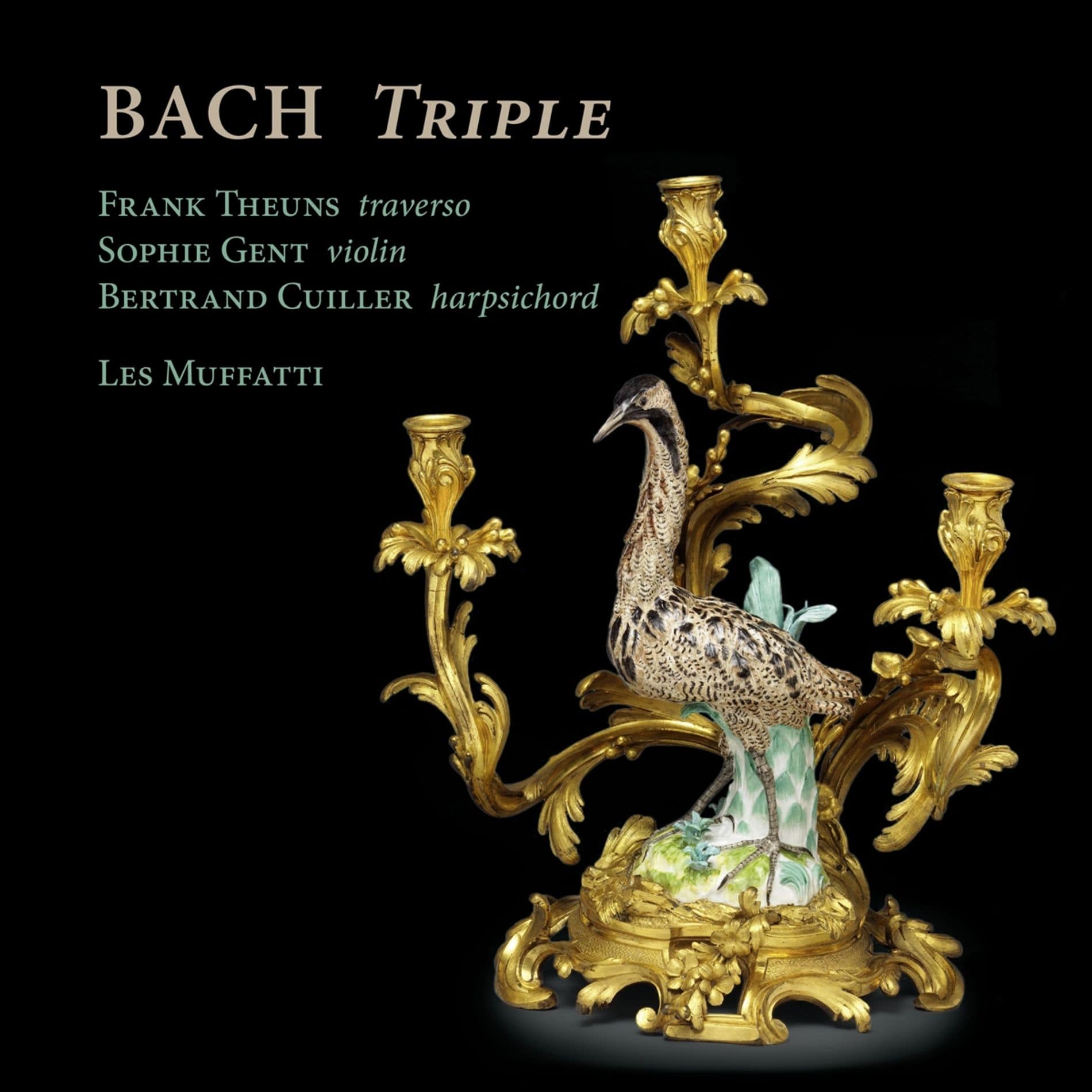
Bach Triple - Les Muffatti
Bach: Overture in b, BWV 1067 - Brandenburg Concerto No. 5 in D, BWV 1050 - Triple Concerto in a, BWV 1044
Bach/Theuns: Siciliana BWV 1063
Frank Theuns (traverso), Sophie Gent (violin), Bertrand Cuiller (harpsichord), Les Muffatti
Ramée 2301 • 66' •
Recording: March 2023, Begijnhofkerk, Sint-Truiden (B)
With a program like the one on Bach Triple, one can certainly make a fine impression at any Bach festival. Provided, of course, that the ensemble in question is talented in all respects, which is certainly the case with Les Muffatti.
There is plenty of variety, with not only the well-known Suite (I prefer to keep the old-fashioned term 'Overture') in b, BWV 1067 (to which the virtuosic, immediately appealing flute part in the final section, the Badinerie, has certainly contributed considerably) the fifth Brandenburg Concerto BWV 1050 and the Triple Concerto BWV 1044.
To bring BWV 1050 and 1044 together on this album is in itself a perfect choice from a programmatic point of view, because in both works the same instruments are featured, although for BWV 1044 there is an additional second violin part (intended as ripieno, alongside first violin, viola and continuo, with the exception of the middle section, a beautifully arched concertino, an Adagio in C major, whose origins lie in the second movement of the Trio Sonata BWV 527). In BWV 1044, the harpsichord plays a dominant role almost throughout, which only further underscores the significance of the chosen instrument. You will hear a particularly beautiful-sounding copy by Bruce Kennedy (Castelmuzio, 2002) based on an instrument by Christian Zell (Hamburg, 1728).
A novelty is the Siciliana in flutist Frank Theuns's successful arrangement for traverso, violin and harpsichord from the Concerto for three harpsichords in d, BWV 1063. It serves as an interlude and takes just under four minutes, but that makes the choice no less striking.
Les Muffatti takes its name from composer Georg Muffat (1653-1704), who left behind a fascinating oeuvre that has played an important role in the repertoire of this Belgian ensemble since its founding. Les Muffatti excels in Baroque rhetoric with, as a matter of course, historically informed performance practice as its foundation, and derived from this knowledge of and experience with the various stylistic characteristics of this repertoire and the associated playing techniques. Equally important: these are not dull interpretations governed solely by theory, but extremely spontaneous performances, filled with instrumental brilliance, also serving as an example of musical joy.