
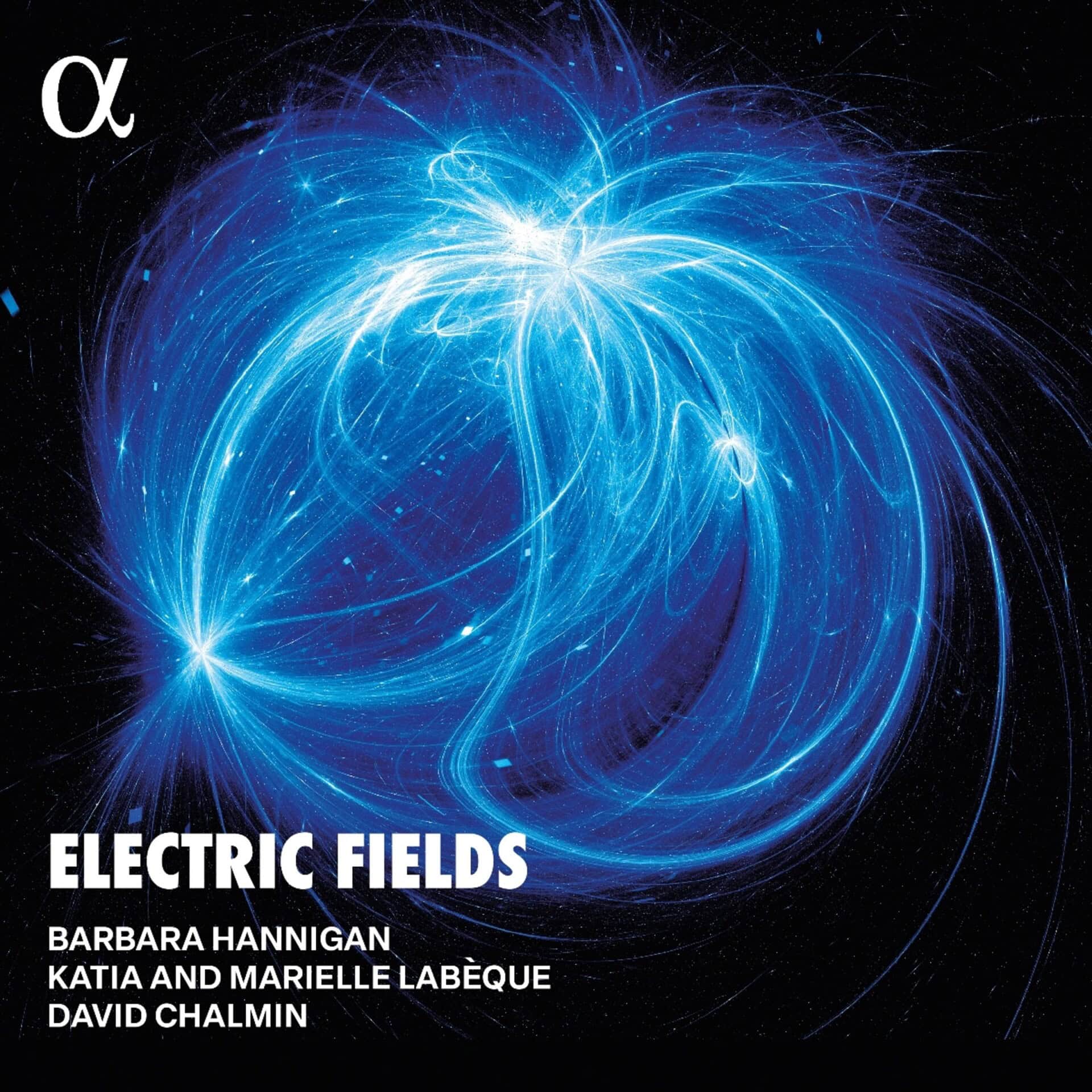
Electric Fields — ancient mysticism in contemporary trance
Soprano Barbara Hannigan is no stranger to musical adventure. With more than a hundred world premieres to her name, often of ostensibly 'unsingable' contemporary compositions, she has earned her place as an unstoppable pioneer. Yet her newest project Electric Fields surprises — not through the unfamiliar, but precisely through its grounding in the very ancient. Together with French piano duo Katia and Marielle Labèque and composer-electronics virtuoso David Chalmin, she dives into the visionary world of 12th-century German abbess and composer Hildegard von Bingen (1098–1179). The journey that emerges is both ethereal and hallucinatory — as if you were falling asleep in a time machine.
The music on Electric Fields is a kaleidoscope of centuries and styles, where medieval mysticism, baroque expression and experimental sound exploration collide and merge. Central is the oeuvre and spirit of Hildegard von Bingen. Her hymns, more than 900 years old, are not simply reconstructed here, but reinvented through a 21st-century lens: Hannigan's voice — drenched in reverb, echoes and distortion — floats above electronic drones, minimalist piano passages and processed field recordings. Immediately in the opening number O virga mediatrix (12th century) it becomes clear that this is no historical interpretation, but a poetic sound laboratory.
The project, which was in development for a full decade, is steeped in textual and musical references to female composers from bygone ages. Alongside Hildegard von Bingen (1098–1179) we find works (and reworkings) of Barbara Strozzi (1619–1677) and Francesca Caccini (1587–ca.1645), two key figures from the early baroque. Their music is not merely cited but transformed — like echoes through an electronic dream. In Che t'ho fatt'io?, after Caccini, melodic fragments are mixed with breathing, multi-vocal samples and pulsing club beats. The result is a sultry blend of baroque and glitch-pop that in less than five minutes traverses an almost cinematic arc from chaos to hushed lyricism.
Bryce Dessner, known from The National but also active as a contemporary composer, contributes two new works: O orzchis Ecclesia and O nobilissima viriditas. He bases himself on Hildegard's own 'secret' language that she developed for her fellow sisters in the convent — a unique detail that underscores the connection between religious devotion and artistic imagination. Musically, the Labèque sisters create in these pieces an enchanting texture of minimalist arpeggios, where Hannigan's voice floats through like a whispering priestess.
Noteworthy is the variety in vocal technique: Hannigan switches effortlessly between plainchant without vibrato, intimate whispers, processed echoes and overdubs. In the two versions of Che si può fare (Strozzi), we get both a relatively traditional reading — which gradually descends into a storm of synths and driving pianos — and a radical improvisation in which the original work almost completely disappears into a haze of electronic effects. This latter version in particular, with its overdubbed voices and piercing piano tolls, is both unsettling and fascinating.
The closing track of the album, O vis aeternitatis (Hildegard von Bingen (1098–1179), at almost 14 minutes is the most contemplative moment. Chalmin's arrangement is remarkably restrained, with spare piano accompaniment, scarce electronic tints and an almost archaic melodic line. Yet the simplicity is deceptive — the piece radiates a sacred intensity that creeps deep under the skin. The finale, a 19-second crystalline high C from Hannigan, is both literally and figuratively a pinnacle that allows the album to end on the border between earthly and heavenly realms.
The technical realization also deserves mention. Electric Fields was recorded in 2022–2023 at La Fabrique des Ondes (Saint-Pée-sur-Nivelle), and although only available in stereo, the sonic palette is remarkably rich — especially when listened to via headphones. Sound layers slide over each other like thin glazes, subtle noise transforms into rhythmic texture, and breath becomes music.
What makes this record so special is not only the musical imagination, but the coherent aesthetic that Hannigan and her partners manage to evoke. Despite the vast stylistic and temporal spread — from 12th-century mysticism to 21st-century electronics — Electric Fields feels like one long trance, a sonorous vision in which history and present merge.
For those already familiar with Hannigan as a tireless explorer of new music, this project is a logical, though surprisingly spiritual next step. For listeners with an open ear for the unusual, the sensual and the sublime, Electric Fields is nothing less than a revelation.
Recommended for those who crave music that erases boundaries, suspends time and elevates the voice.