
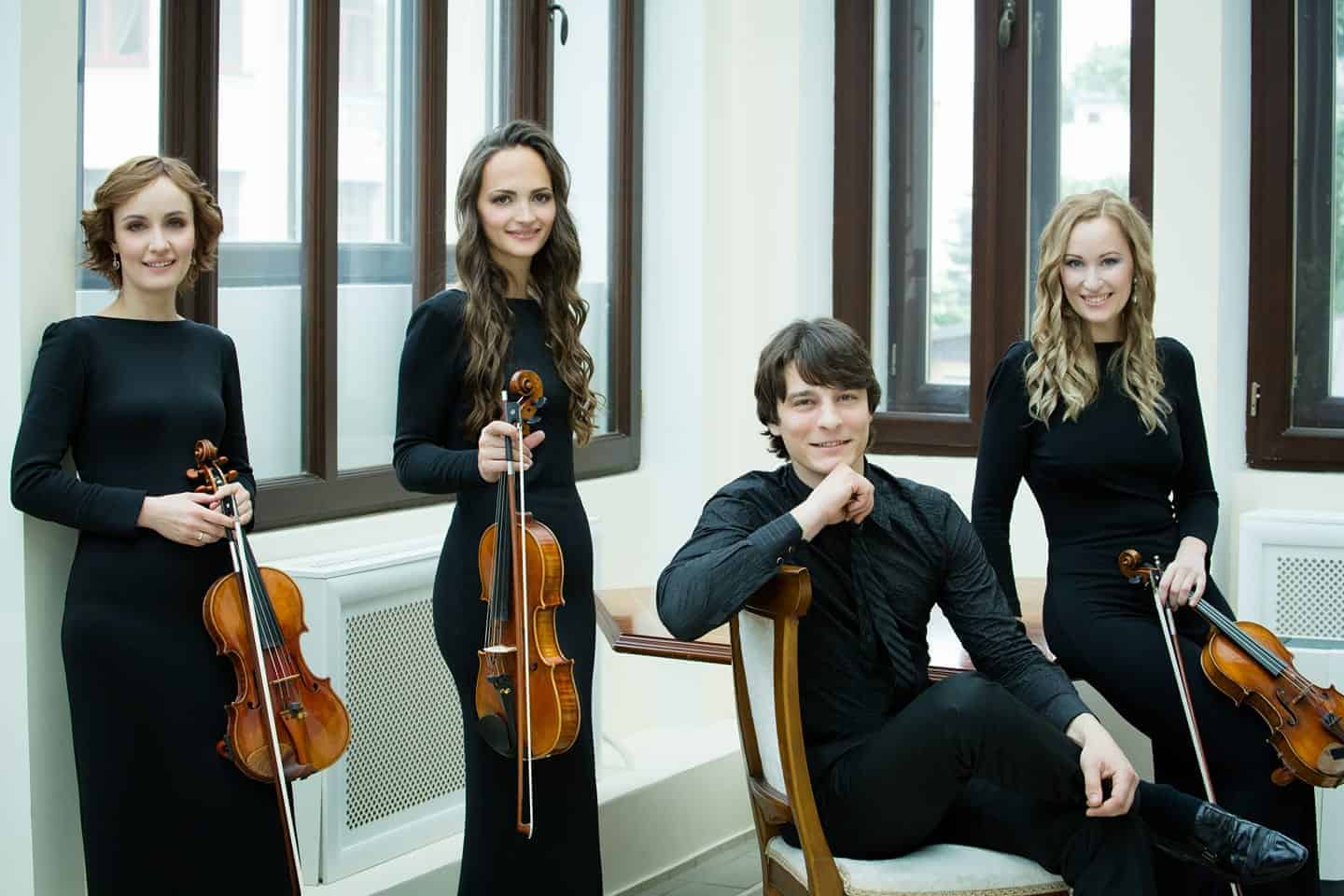
Russian music is well served this year during the Midis-Minimes string quartet week. After Prokofiev and Borodin yesterday, it was Tchaikovsky's turn on this sweltering Thursday. The Rusquartet demonstrated that his contribution to the genre extends far beyond the by now 'worn-out' Andante cantabile, but unfortunately could not convince across the board.
The Rusquartet has an intimate bond with the Low Countries. The Russian quartet, formed at the Moscow conservatory, has been a regular guest at the Orlando Festival in Kerkrade for several years – which by the way starts next week (9-19 August). In addition, their most recent CD with string quartets by Tchaikovsky was recorded in the Sint-Pieterskerk of Leut – for the Belgian label Etcetera Records. This recording received considerable acclaim. In a review on the website Opus Klassiek it reads as follows: "The Rusquartet plays purely. Impeccably purely. […] Everything falls into place, old bad habits have been replaced by fresh ideas. […] This is a CD that wakes up lazy ears." In 2008 the quartet won the eighth edition of the International Shostakovich String Quartets Competition in their home country. Despite their interest in diverse repertoire, Russian music nonetheless takes first place for them, as prima Xenia Gamaris indicates in the video below. And so it was today. With the third string quartet by Tchaikovsky, the choice fell on a work that curiously enough is not performed so often.
Surrounded by empathy
Could that perhaps be related to the melancholic character of this composition? The fact is that the 35-year-old Tchaikovsky dedicated the piece at the beginning of 1876 as a tribute to the deceased Bohemian violinist Ferdinand Laub, incidentally the man who had led the premieres of his first two string quartets. The Andante funebre e doloroso ma con moto thus forms the sad, but at the same time incredibly serene heart of the music. Together with the opening section, a lamenting introduction (Andante sostenuto) followed by an ambiguous Allegro moderato, this third movement forms the focal point of the quartet. Partly due to that depressed mood, opus 30 was called Tchaikovsky's 'quartetto serioso' by French musicologist André Lischke, "[…] and this Beethovenian designation is fully justified by the depth and density of the score. In every respect, it is the most accomplished and most homogeneous of the three […]." The Rusquartet succeeded in capturing the restrained atmosphere of the extended opening perfectly, though barely concealed passion was already audible. In what followed, an intensive – or rather – drawn-out playing alternated with velvety pianissimo passages. It only benefited the resilience, though there were also moments when the tuning within the ensemble was somewhat uncertain. Better timed was the Allegretto vivo e scherzando, whose sprightly character came beautifully to the fore through the precise interventions of each of the string players. During the poignant Andante, one could hear a pin drop in the hall. And that is always a good sign of course. Stately declamatory, solemn homophonic or wistfully singing: almost every note was surrounded by empathy. Moreover, the quartet produced beautiful timbres. The finale on the other hand (Allegro non troppo e risoluto) proved to be partially a misfire. Certainly the somewhat grotesque opening theme lacked coherence, causing the musical narrative to falter more than once. The density of the score, which for Lischke was a trump card, was unfortunately not sufficiently conveyed here.
As a bonus, the Rusquartet ventured into the nimble-fingered finale from Haydn's opus 33 first quartet. The Presto rushed past at breakneck speed, but proved not to be an unqualified success. Sloppiness marred the – admittedly – devilishly difficult part of the first violin. In addition to poor intonation, there were actually even a few wrong notes in her playing. After the performance, the piercing look of the altoist spoke volumes. During the bow, a nervous laugh could be seen from the prima. But self-critical as musicians are, it must surely have dawned on them at that point that this could certainly have been better.
- WHAT: Pyotr Tchaikovsky (1840-1893), String Quartet No. 3 in E-flat (opus 30)
- WHO: Rusquartet [Xenia Gamaris (violin), Anna Yanchishina (violin), Ksenia Zhuleva (viola), Peter Karetnikov (cello)]
- WHERE: Royal Conservatory, Brussels (as part of the Midis-Minimes festival)
- WHEN: Thursday 2 August 2018
- PHOTO: © Evgeny Evtyukhov