
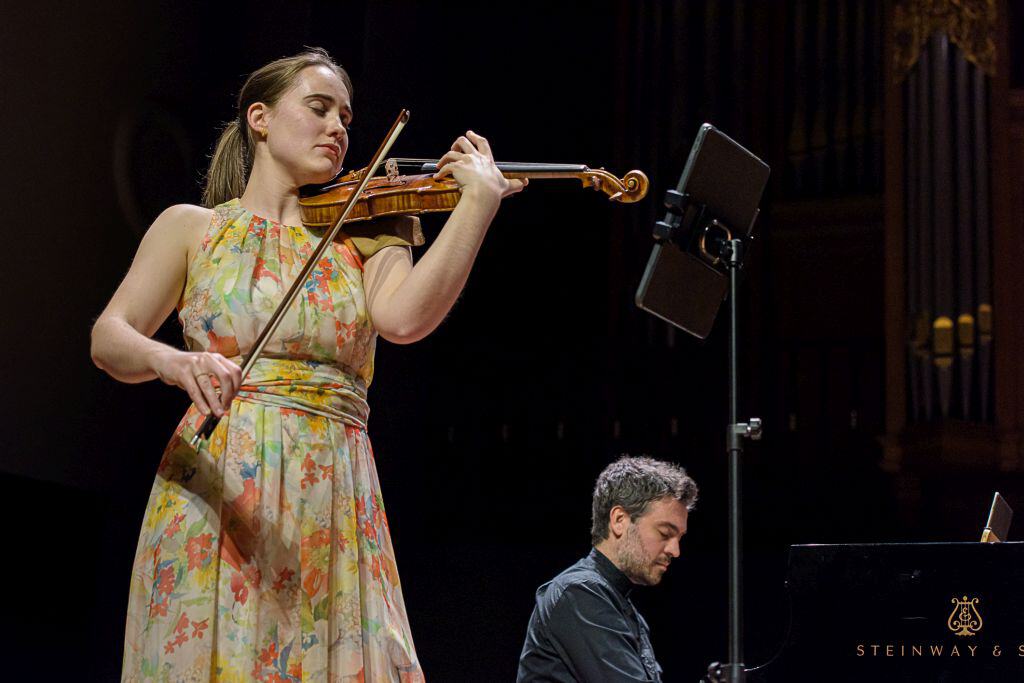
A retrospective of recitals featuring some exceptional violinists: Jiska Lambrecht, Veronique De Raedemaeker, Kristina Georgieva and Bade Dastan.
Abendrot
In anticipation of a new violin session of the Queen Elisabeth Competition this month, I attended several recitals by exceptional violinists in recent weeks. Jiska Lambrecht has already received attention at KC after being selected as SWUK laureate 2024. On 21 April her new cd Abendrot was presented in the Miryzaal, during a recital with pianist Marco Sanna in which the works from the cd were performed live.
It rarely happens that you can attend a concert and afterwards hear the same performers playing the same music on cd. With the only difference that Jiska played a different violin in the Miryzaal than the Gagliano on the cd. On the programme and the cd are the second violin sonata by Robert Schumann, the romance by Clara Schumann, the third violin sonata by Brahms and a romanza by Lodewijk Mortelmans, the Flemish Brahms, as Jiska announces him. The four works summarized under the title "Abendrot" because they composed these works in the evening of their lives.
I remember the first time I heard Jiska Lambrecht, on 8 March 2020, the last Sunday before the covid crisis broke out, with the same pianist Marco Sanna. In a burst of admiration I compared her to the intense playing of Ginette Neveu. Coincidence or not, she was also playing the second sonata by Schumann then. Lambrecht's violin playing sometimes sounds rather modest, always honest, dreamy, elevated, sometimes also somewhat ethereal, alongside the solid piano playing of Marco Sanna. Modesty and expression need not get in each other's way, I heard this before on 17 February as well from violinist Veronique De Raedemaeker, who was selected by Radio Klara as one of the twenty-somethings. They have a similar profile. They are not extravagant little devils out of a box. Here and there it may be somewhat refined and polished, it could be a bit more raw, with a rough note in between. Perhaps because they are both Flemish and wild unpolished expression is not in our nature.
For that expression I attended another recital a few days before. On 19 April the young Bulgarian violinist Kristina Georgieva performed with the young Israeli pianist Itamar Carmeli at the international chamber music festival of Arte Amanti, as always preceded by young talent.
Vardar, the blood and the river
Georgieva is now a 23-year-old violinist, studying at the Barenboim-Saïd academy in Berlin. At seven years old she already won her first competition. After that came successes in no fewer than fifteen competitions in Italy, Germany, France, Russia etc. At a very young age she came to Leonid Kerbel of the Musica Mundi school in Waterloo. As a teenager she was able to collaborate there with famous musicians such as Misha Maisky and Maxim Vengerov. With this list it need come as no surprise that we are dealing with a rare supertalent. She plays with remarkable refinement and maturity for her young age.
She alternates the second violin sonata by Grieg with lesser known works. Who has ever heard the second sonata by Enescu. Violinists invariably play the well-known third sonata by Enescu "in Romanian style". If you could already hear pristine nature in Grieg in her pristine playing, in the Vardar Rhapsody by Bulgarian composer Pancho Vladiguerov her unpolished Bulgarian soul comes out. She sings, calls, weeps, muses, laughs, dances with her violin. Kristina's blood flows and surges like the sparkling waters of the Vardar river, after which the rhapsody is named. What a feast, what an ode to that pristine land Bulgaria.
And I have not yet written about pianist Itamar Carmeli. Also a young twenty-something. He plays jazz as well as classical music with the bravura of a master. You can see this in his footwork, as pianists do not only play with their hands. As a solo piano piece he also makes a surprising choice: the suite op.14 by Béla Bartók. Rarely heard on a stage.
Words fail
Critics, like authors of thrillers, like to save the climax for the end. As with all Arte Amanti recitals, the programme is introduced by young talent, sometimes from our country, sometimes also internationally emerging talent. Prior to Kristina Georgieva, young Turkish violinist Bade Dastan performed. Even younger than Georgieva, just seventeen. She played two pieces, first a slow movement from a Bach solo sonata (the Grave from the second sonata) and then the Grand Caprice (on the theme of Schubert's Erlkönig) by Heinrich Wilhelm Ernst. The latter is considered a technical tour de force, more difficult than Paganini's caprices. Pure virtuosity.
However, I want to conclude with how it began, this recital with Bade Dastan as a young supertalent. With such a slow movement from Bach you cannot excel in fingering speed or virtuoso brilliance and bravura. From the very first slow sustained notes and chords I hear an exceptional, fully-fledged and mature talent. She plays with such profundity, serenity and balance, a heavenly tone. Technical perfection that in a slow movement with many double stops is sometimes even more difficult to achieve than in a fast movement. Here words fall short. In the programme booklet of Arte Amanti I read that she was already admitted to the elite school Musica Mundi at age twelve. I later heard that she was selected worldwide from four hundred young supertalents to study at the famous Curtis Institute of Music in Philadelphia, with the renowned pedagogue Shmuel Ashkenazi. Curtis alumni are often world famous, such as Hillary Hahn. Perhaps I heard the new Hillary Hahn this evening, I think afterwards.