
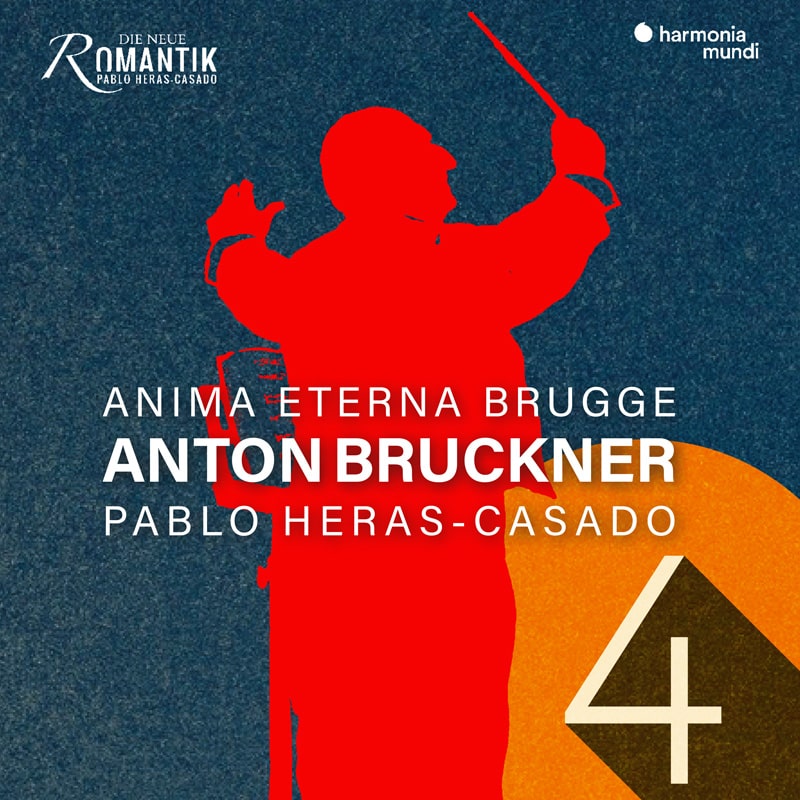
Bruckner: Symphony No. 4 in E-flat, WAB 104 (version 1878-81, Nowak edition) Anima
Eterna Brugge cond. Pablo Heras-Casado
Harmonia Mundi HMM 902721 • 66' •
Recording: Jan. 2024, Concertgebouw, Brugge

Performances on period instruments is not new although relatively rare, with Roger Norrington and Philippe Herreweghe in the forefront. This time it is the Spanish conductor Pablo Heras-Casado who, together with the 'authentic', Brugge-based Anima Eterna, has tackled the Fourth Symphony, a project that will ultimately encompass all symphonies (although it is not yet certain, as far as I know, whether the so-called Nullte (or Annulierte) and the Study Symphony will be included). And then there is the Finale of the Ninth completed by others, which many conductors still regard as 'forbidden territory'.
Period instruments
Heras-Casado's initially not very positive view of Bruckner's 'giant snakes' (in an interview the conductor spoke of 'the very conservative composer who wrote the same symphony nine times') has gradually changed. Now he sees him, despite his (ambivalent?) personality, as a modernistic, revolutionary tone poet. The realization only came with the years and with it the insight that those musical characteristics could be best expressed with the help of period instruments. For Heras-Casado, an orchestra accustomed to playing Rachmaninoff, Shostakovich and Mahler, and applying this equally to Bruckner, will not make his music sound so surprising or modern. For Heras-Casado, the more radical side of Bruckner's music lies precisely in not knowing what comes next.
We know from the many (predominantly positive) reviews that Heras-Casado has gained considerable experience with 'authentic' ensembles over the past two decades, including the Freiburger Barockorchester, the Balthasar Neumann Ensemble and Concentus Musicus Wien. More than merely good precursors to his involvement with Anima Eterna Brugge, but this did not detract from the fact that the 'authentic' step towards Bruckner (he had performed his symphonies many times with 'traditional' orchestras) seemed very large, although he was certainly not deterred by it.
The use of period instruments has considerable consequences on the altered sound perspective and how to respond adequately to it, including the handling of voice leading and texture. There suddenly appears to be more room for the counterpoint from within, without the 'pumped up' brass. It is an image that fits perfectly with this conductor, as evidenced by this formidable performance: the unadorned sculpting of an otherwise more rounded voice weave (the sharp edges are taken off) and Bruckner's complex counterpoint balanced evenly against well-balanced strings, strictly clear woodwinds and brass that sounds not only mighty but also lyrical. Together, this creates a fascinating relief that does not miss its effect on the listener.
Period instruments: it is nothing more than a collective term, and for that reason rather meaningless. Heras-Casado was fortunate that Anima Eterna looked beyond the tip of its own nose and invested considerable time and effort in searching for and acquiring instruments that suited the period of a symphony's creation (here you will find the complete overview of the instruments used for this recording). On this point, one is very close to history indeed. That had good reason, because wooden and brass instruments developed at breakneck speed in that time: quite suddenly, a completely new model could emerge from one year to the next, or an instrument adapted to new possibilities (bore, valves).
Heras-Casado gives a striking example of this: the F trumpet that Anima Eterna used in the Seventh Symphony (its premiere took place in Leipzig in 1884), but which did not fit the sound of the earlier composed Fourth Symphony. So it could depend on the city where the performance took place, or on tradition. And Leipzig was not the same as Vienna or Munich. So the choice fell on valve trombones with their slender timbre and the small tuba. Only to discover on the first rehearsal day that simply by pushing a bit harder, such instruments could easily break. Creating volume at will proved not to be a good idea, but rather paying much attention – in the magnificent chorales, where the brass plays colla parte – to a sublime lyrical sound that blends ideally with the woodwinds (which can be heard well on this successful recording).
And then there is the certainly not merely incidental aspect of playing on gut strings. It is Heras-Casado's experience that this makes it possible to achieve both a differentiated texture and dynamics (including the clearly perceptible difference between p, pp and ppp). I readily defer to his judgment and – again! – the recording proves it.
From Scratch
The now immortalized recording of the Fourth Symphony is the first discographic product of the collaboration between the Spaniard and Anima Eterna. In concert practice, the Seventh preceded it. From the very beginning, Heras-Casado's approach was that of a tabula rasa, simply starting from scratch and then discovering and rediscovering, further critically listening to the 'authentic' instruments and what possibilities they could hold, both in terms of playing technique and sound. Where were the real boundaries? Richard Strauss wrote orchestral works knowing they would challenge the musicians to the utmost. With Bruckner, it was no different, according to Heras-Casado.
The conductor has brought with him for this Bruckner project: his great experience with the symphonic oeuvre of Haydn, Mozart, Beethoven, Schubert, Schumann and Mendelssohn, as he has also immersed himself in music from the Renaissance. A broad repertoire then, which only offers advantages.
This also includes the orchestral seating arrangement, already tested many times by Heras-Casado, with the first violins on the left and second violins on the right of the conductor, then the violas and cellos with the (seven) double basses at the back, comparable to the standard seating of the Wiener Philharmoniker in the Musikverein, which maintains this typically German arrangement and – fortunately! – is also being applied more frequently elsewhere again.
Version and Edition
The version used by Heras-Casado is that of 1878-1881 (in the cd booklet it states, as is customary, 1878-1880, but 1881 is somewhat more precise, about which more later), in the well-known edition of Leopold Nowak, published in 1953 by the Viennese Musikwissenschaftlicher Verlag.
To establish the basic pattern: the first version of the Fourth Symphony was created in 1874, the second version between 1878 and 1881, and the third, also final version in 1888.
First Revision
The genesis of the Fourth Symphony can be reduced to three fundamental phases. The first phase was (of course) characterized by the conception of the original version as it was created between 2 January 1874 (the Third Symphony had been completed just a few days earlier, on New Year's Eve 1873) and 22 November 1874 ('Wien, 1/2 9 Uhr Abends'). The compositional process seemed definitively concluded, until Bruckner picked up the threads of the work again on 18 January 1878 and began an extensive reworking. This image evokes the memory of the seemingly endless genesis of its predecessor, the Third Symphony.
In the intervening years, he had moved heaven and earth from his writing desk to get the Fourth Symphony performed, directing his arrows especially toward Berlin. He had persuaded the German music critic Wilhelm Tappert (whom he knew from his visit to the Wagner temple Bayreuth and whom he considered a friend) to 'work on' the conductor Benjamin Bilse for this purpose. Apparently, after many negative experiences in Vienna with the performance of his Third Symphony, Bruckner had little confidence in a performance in the Austrian capital. But all attempts ultimately came to nothing, after which Bruckner decided in 1877 to subject the Fourth to a drastic revision nonetheless. And this even though the work had never been performed. The beginning proceeded laboriously, because the fair copy of the score was still 'somewhere' in Berlin and despite repeated requests was not returned (he never saw it again).
'Thorough Reworking'
On 18 January 1878, Bruckner began what he described as a 'gründliche Umarbeitung' (letter to Tappert, dated 12 October 1877). The following passage is illuminating: 'I have become thoroughly convinced that my fourth Romantic Symphony urgently needs to be reworked. For example, in the adagio there are violin figurations that are too difficult and unplayable, and the instrumentation here and there is too overloaded and restless. Even Herbeck, who likes the work very much, makes the same remarks and confirmed me in my decision to rework the symphony in part.' Bruckner is referring here to the second movement, the eventual Andante quasi allegretto, the violin figurations referring to the indeed very difficult passages for the first violins in the third section of this movement. The passage also shows that Bruckner gave serious consideration to the technical aspects of playing.
Only the Scherzo remained outside the revision work. Around November, he put the finishing touches on even a completely new 'Jagdscherzo' to replace the old one. But despite all the work on the extensive finale, Bruckner was far from satisfied with the final result. After drawing the double bar on 30 September, he decided in November to design an entirely new version of that finale, a task that, interrupted for some time by the String Quintet he was working on, could only be completed on 5 June 1880.
It must have been particularly pleasing to Bruckner that quite soon afterwards the Viennese Wagner Society took up the plan to perform the second version (with the newly composed finale of 1879/80). This took place on 20 February 1881, by the Wiener Philharmoniker under Hans Richter, with Beethoven's Fourth Piano Concerto (soloist: Hans von Bülow) in the 'opening program'. Yet still not entirely satisfied after the successful performance under Richter, Bruckner made further changes to the score, which were later incorporated as such by Leopold Nowak in the (new) 'Gesamtausgabe'.
'Volksfest'
What happened to the original finale of the second version? It never disappeared from the historical record (the composer himself never heard it, incidentally), but gained independent significance as 'Volksfest' (Bruckner gave it this title himself) and was thus included in the (old) 'Gesamtausgabe' edited by Robert Haas. In 1980, under the editorship of Leopold Nowak, a reprint followed that was included in the (new) 'Gesamtausgabe'. It is, however, unclear why there is still insufficient interest in the music business for a performance of the Fourth in the 'Fassung' of 1878, but with 'Volksfest' as the finale (the piece has been recorded separately several times). Gerd Schaller recently took this step, with the Philharmonie Festiva on the Hänssler Profil label. Who will follow?
Once again 'Umarbeit'
The success of the Fourth, though not unqualified (a performance of the second version in Karlsruhe under Felix Mottl even turned out to be a downright disappointment and in Sondershausen conductor Karl Schröder shamelessly confined himself to performing only the first and third movements, to the great displeasure of the composer), nevertheless did not spur Bruckner to hasty publication. Only in 1886, shortly after the seriously mutilated performance in Sondershausen, did he send the score to two German publishers: Bote & Bock and Schott. However, they showed no interest whatsoever. This rejection certainly contributed to Bruckner's ever-present insecurity, for he decided to take the Fourth in hand again, which would result in 1888 in the third and thus final version. The first performance of this third 'Fassung' took place on 22 January 1888 in the 'Golden Hall' of the Vienna 'Musikverein', by the Wiener Philharmoniker under Hans Richter.
This final version underwent a number of drastic changes compared to the version from 1878/81 in terms of structure, instrumentation, dynamic proportionality, tempi and phrasing. The differences are especially noticeable in the Scherzo, with its substantially shortened reprise and the newly designed transition from Scherzo to Trio. But the finale also received a completely new shape at the end of the development episode and the beginning of the recapitulation. It is also interesting that a third flute and piccolo were added to the Scherzo, the brass section was further expanded and cymbal clashes were inserted at measures 76, 473 and 477.
Deposito
Where the two German publishers had declined, the 'Musikalienhändler und Konzertagent' Albert Gutmann, from the Bavarian Fürth and residing in Vienna, did seize the opportunity: he was willing to publish the 1888 version, but not without demanding a deposit of no less than 1000 Mark. It was Hermann Levi who scraped the amount together.
The manuscript ('Reinschrift') intended for the first edition is not in Bruckner's hand, but in that of Ferdinand Löwe (movements 1 and 4) and the two brothers Josef and Franz Schalk (movements 2 and 3). This may seem an affront to authenticity, but closer inspection shows that it is not. It is full, now in Bruckner's handwriting, of corrections and 'improvements' made, which justifies the conclusion that the final result corresponds to Bruckner's wishes and intentions. This is further confirmed by Bruckner himself in a letter to Hermann Levi, dated 27 February 1888, which shows that the revisions were carried out 'aus eigenem Antriebe'. A remarkable detail: thanks to extensive musicological research, the 1888 version is now considered 'des Bruckners', after it was initially kept out of the (old) 'Gesamtausgabe' as the 'Löwe Fassung'. An example, then, of 'advancing insight'.
New edition
Gutmann's luck did not hold, despite the 1000 Mark as a 'security deposit'. After he had prepared the first edition in September 1889, as a result of countless typographical errors (everything had to be done by hand), a new edition had to be prepared fairly soon afterwards. This appeared in January 1890. In passing, the opportunity was taken to also indicate the tempi with metronome markings, while the tempo markings themselves were also changed. In the Bruckner biography by Cornelis van Zwol, the author goes into this further. Movement 1: 'Bewegt, nicht zu schnell' became 'Ruhig bewegt' ('nur nicht schnell'), Movement 2: 'Andante quasi Allegretto' became 'Andante', Movement 3: 'Trio. Nicht zu schnell. Keinesfalls schleppend' became 'Trio. Gemächlich', Movement 4: 'Finale. 'Bewegt doch nicht zu schnell' became 'Finale. Mässig bewegt'. Among others, Hans Knappertsbusch made use of the Gutmann edition.
Korstvedt
Despite the intensive fieldwork of musicologist and Bruckner expert Benjamin Korstvedt (in 2003 he prepared an edited, but unfortunately far from flawless edition of the 'Fassung 1888' within the framework of the 'Gesamtausgabe'), the third version is performed less often than the one from 1878/81. Osmo Vänskä, among others, believes strongly in that latter version, as evidenced by his recording with the Minnesota Orchestra on the second BIS label. Vänskä has - fortunately! - based himself on the corrections subsequently made by Musikwissenschaftlicher Verlag.
Finally ample room for the first version
Originally, the first version of the Fourth Symphony (1874) was to be included in the (old) 'Gesamtausgabe', but Robert Haas decided otherwise by including the version of 1878 and coupling it with the finale from 1879/81. The original Scherzo (1874) was not performed until the end of 1909, by August Gröllerich in Linz, then still from Bruckner's manuscript (a printed edition was missing, after all).
It took until the mid-1970s before the 1874 version edited by Leopold Nowak appeared in the (new) 'Gesamtausgabe'. After which the Fourth Symphony in this (thus original) version was performed by a number of conductors, including Roger Norrington, Michael Gielen, Simone Young and Franz Welser-Möst. Eliahu Inbal has the distinction of the first recording of the first versions of Symphonies nos. 3, 4 and 8, on the Teldec label (later also released on cd). Conductor Kurt Wöss was responsible for the world premiere, with the Münchner Philharmoniker, on 20 September 1975 as part of the second Brucknerfest in Linz. Van Zwol also recalls that Wöss came to Hilversum a few years later to conduct this first version with the Radio Filharmonisch Orkest.
Bruckner in London
On 5 October 2021, Bruckner's Fourth Symphony was heard in St Luke's, the home base of the London Symphony Orchestra (reviewed by me here). Conductor Simon Rattle had, like Heras-Casado, chosen the version of 1878-1881, but with the difference that he had made use of the latest musicological research of the German musicologist and conductor Benjamin-Gunnar Cohrs, thus designated as Cohrs A04B. Cohrs worked until his unexpected death on 21 November 2023 (click here) on the Anton Bruckner Urtext Gesamtausgabe (or Anton Bruckner Urtext Complete Edition), a project that was to encompass the entire oeuvre and at the same time put an end to what had gone wrong in all those published editions so far, but also beyond, due to carelessness and misinterpretation of historical data.
In St Luke's, under Rattle in that same concert, the Scherzo from 1874-76, Cohrs A04B-1, the 'Volksfest' finale from 1878, Cohrs A04B-2, the Andante quasi Allegretto from 1878 in the extended version and the complete version of the Finale from 1881 were heard.
Bruckner in Bruges
Heras-Casado, however, turned to the most commonly used version, that of 1878-1881, in the edition of Leopold Nowak, with the conductor motivated as follows:
'In this most iconic of Bruckner symphonies, I always wanted to record the usual version. The next chapter in our Bruckner journey will be the Third Symphony in September and there we will be playing the first version (1873). I do think the revised version of the Third is better – in general, when composers got the chance to improve something, they usually did – but that doesn't mean that it's not interesting to explore those first thoughts.'
I readily grant him his opinion, but in my view it is rather shaky, following the history of the genesis of the Fourth Symphony. But the real relevance lies of course in both interpretation and the instrumentation used, and in both cases it applies: chapeau!
For Heras-Casado has, with his exceptionally well-functioning ensemble, sought and found the way to the mysterious (especially in the opening section), to the grand, monumental, warm, broad and idiomatic. Unlike with Celibidache, the cosmos is not 'touched', the performance under Heras-Casado is more tightly controlled, the phrasings more framed, but it sounds no less gripping (which also says something about the way the conductor works out the many tension arcs). The architecture (the periodic construction with its many transitions is explicitly included) creates not only distant vistas, but also compelling strictness in conjunction with an infallible sense of direction, also as an antidote to prolixity or fragmentation. It is an interpretation that, alongside all other qualifications, excels in impressive structural awareness, a quality we also find in conductors such as Klemperer, Wand and Haitink. The objection of some reviewers, also in our country, that Bruckner's symphonies are partly directionless finds its origin more in the conductor than in the composer...
The striking woodwind and brass players sound beautifully differentiated on this recording, but where required also with the necessary cohesion, the strings equally expressive without vibrato as a superfluous aid. The soundscape develops in all calm in such a way that the deeper layers are brought to excellent light and even shows visionary features. Rustic poetry does not lead to expressive idiosyncrasy in this process that unfolds in a balanced nature, revealing the master hand of the genuine Bruckner conductor.
At the same time, the picture is one of an electrifying stature, permeated with fervent inner life, the excellently chosen tempi and the resulting tempo changes smoothly, flexibly embedded in the discourse.
Thanks also to the particularly successful recording, we hear radiant orchestral playing that combines great brilliant qualities with true grandeur. This too contributes to a magnificent interpretation that with repeated listening also consistently yields new impressions.
In the booklet an interview with the conductor is printed, from which it can be gathered, among other things, how the conductor experiences Bruckner's music and what it entails.
This Bruckner project is only just beginning, but judging by this 'debut' it does promise quite a lot in the future!