
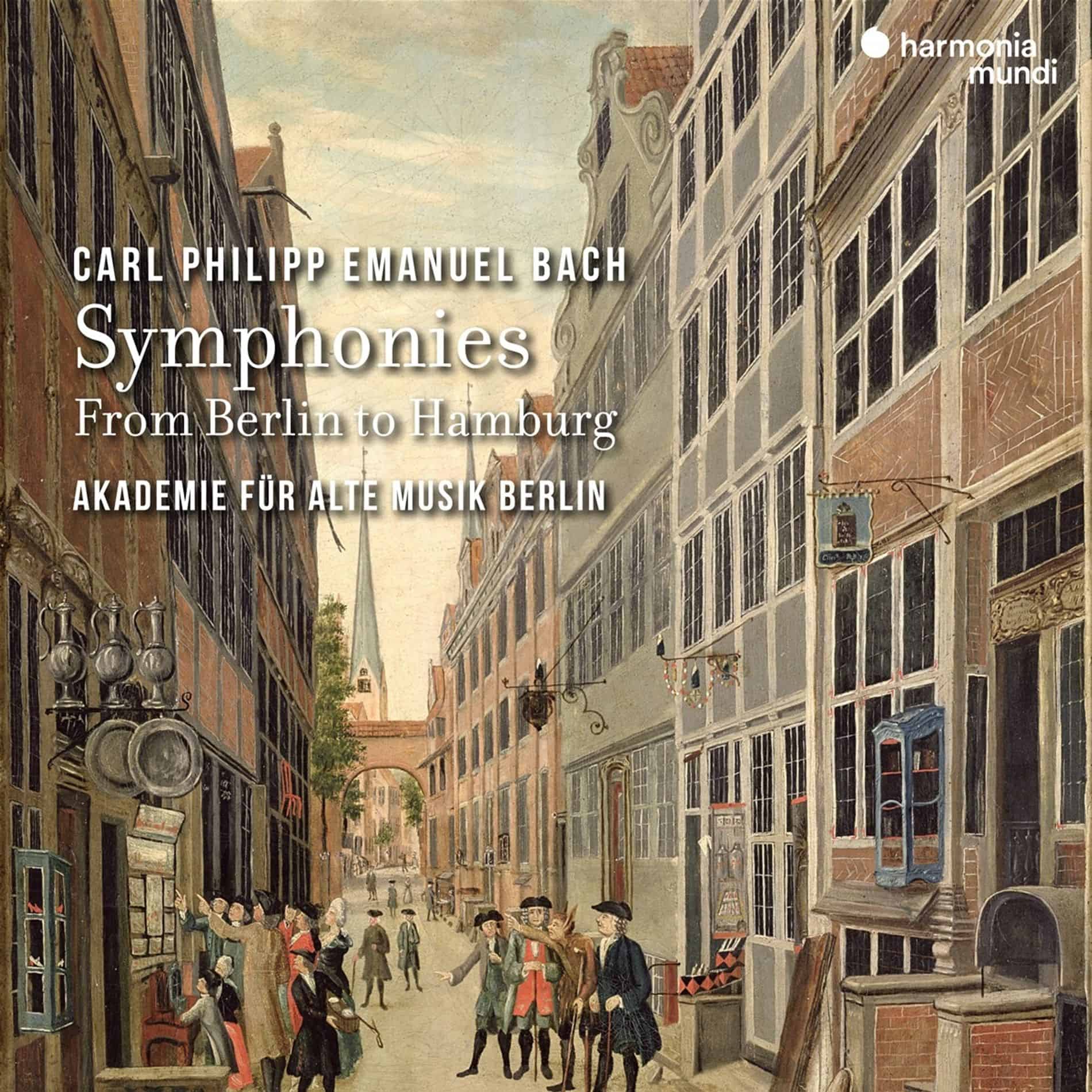
Carl Philipp Emanuel Bach - From Berlin to Hamburg
(C.Ph.E.) Bach: Symphony in C, Wq. 174 - in D, Wq 176 - in e, Wq 177 - in G, Wq 182 no. 1 - in C, Wq 182 no. 3 - in A, Wq 182 no. 4 - in b, Wq 182 no. 5
Akademie für Alte Musik Berlin conducted by Mayumi Hirasaki & Georg Kallweit (concertmasters)
Harmonia Mundi HMM 902317 • 72' •
Recording: Jan. 2023, b-sharp, Berlin
Those sufficiently familiar with Baroque music will immediately understand the subtitle: From Berlin to Hamburg. For those less well versed, this explanation may serve as guidance.
How did matters stand musically around the middle of the eighteenth century? Johann Sebastian Bach had died in 1750. His second son, born in 1714, Carl Philipp Emanuel Bach, had not followed in his footsteps but had devoted himself to an entirely new style. In his autobiography, published in 1773, he looks back on the years around 1740, when the Berlin and Dresden 'Hofkapellen' had risen to great heights and the composers working in their sphere knew how to respond inventively to this: 'Wer kennt den Zeitpunkt nicht, in welchem mit der Musik sowohl überhaupt als besonders mit der accuratesten und feinsten Aufführung derselben, eine neue Periode sich gleichsam anfieng, wodurch die Tonkunst zu einer solchen Höhe stieg.'
A new name had been coined for that 'Tonkunst': 'empfindsamer Stil', 'sensitive', in the words of Bach scholar Peter Wollny:
'Die Formulierung von individuellen und unverwechselbaren Themen, die treffende Deklamation eines vorgegebenen Textes, das Umsetzen eines bestimmten Affekts, die Erweiterung der Palette musikalischer Ausdrucksmöglichkeiten – dies sind nur einige der Bereiche, mit denen ein Komponist des empfindsamen Zeitalters sich auseinandersetzen musste.'
The Berlin Kapellmeister and music publicist Johann Friedrich Reichardt put it this way in 1776:
'Man erkennt [C.Ph.E.] Bachs Original-Geist an allen seinen Werken, auch an den kleinsten Stücken; alle tragen den Stempel der Originalität; und alle sind unter hundert anderen Stücken kenntlich, wiewohl in jedem Erfindung und Neuheit ist.'
It was the new and 'empfindsame', that found particularly convincing expression in C.Ph.E.'s instrumental works. There it was: the colourful splendour, the esprit, the extraordinary, distinctive character that this music radiated, qualities that even Haydn and Mozart were impressed by. It was a musical language that broke away from oppressive traditions and conventions, and instead produced a completely distinctive identity.
C.Ph.E. never made a secret of the fact that he owed his venerable father a great debt (the Thomascantor was his first and only teacher), but that the all too familiar music, steeped in a long chain of traditions, in his conviction now called for something quite different, more expressive, with more feeling and drama, filled with surprising melodic and harmonic turns. The 'empfindsamer Stil' was born.
It is C.Ph.E.'s symphonies (five are gathered together on this album) that perhaps best express this style. Certainly at that time, their compactness and intensity must have been experienced as surprising at least, even though despite the agitated character of this music, the classical formal model was retained: the tried and tested fast-slow-fast remained largely intact.
The six so-called Hamburg symphonies from 1773, commissioned by the well-known baron Van Swieten, then Austrian envoy at the Prussian court, are considered the most progressive in the genre at the time (on this album you will hear four of them: the symphonies Wq 182 nos. 1, 3-5). Van Swieten gave the composer conceptual freedom, resulting in a truly 'deafening' musical panorama for strings alone. There are the phenomenal ideas, the unprecedented inventiveness, the many overwhelming key changes, the great dynamic contrasts and the caesuras applied with great refinement and a well-developed sense of tension and release. Exciting and fresh, that's how they still sound; provided of course they are in good hands. And in doing so, you would almost forget that C.Ph.E. was one of the most important keyboard composers of his time. In short, he is regarded as the principal figure in the transition from the Baroque to Viennese Classicism.
The Berlin symphonies Wq 174-177 performed here were created around 1755, thus only about five years after the death of father Bach. The then forty-year-old C.Ph.E. was at the height of his fame. Also in these works, although composed eighteen years earlier than the Hamburg symphonies, the listener is repeatedly caught off guard, they are full of changes of mood, harmonic innovations, there is the strong rhythmic pulse and the equally surprising caesuras. What the symphonies as a whole share with each other is, despite their classical design, their unpredictability. It is this Bach who also excelled in strategically constructed contrasts, not only in terms of dynamics, but also through the many skilfully executed modulations within a single movement. Only at the end of it is the tension released by the return to the 'home port', the tonic.
In his commentary, Wollny points out the distinctive character of the symphony Wq 177 within this framework:
'The virtuoso work with its unique dark, ominous atmosphere made a great impression on his contemporaries; as late as 1772, Johann Adolph Hasse, who was already living in Vienna at that time, recommended to the English music traveler Charles Burney to obtain this symphony if possible, as he considered it "the best he had heard in his life".'
In the printed interview, one of the two concertmasters, Georg Kallweit, notes that the characteristics and development of the Akademie für Alte Musik Berlin (Akamus) are very closely connected with the symphonies of C.Ph.E. The nucleus for this was laid at the beginning of the eighties by musicians from Berlin and Leipzig, based on historical performance practice and equally historical instruments. Johann Sebastian Bach stood at the cradle of the ensemble, soon followed by the music of C.Ph.E.
It was the then concertmaster Stephan Mai who took the first important steps toward the current form of the ensemble. The 'drastic' and 'provocative' character of C.Ph.E.'s compositions played an important role in this. It felt as if they were written for him and thus for the ensemble in a way. Even then, the bar was set very high, it was Mai's concept of sound that demanded the highest standards. As time progressed and other concertmasters came into view, sound and articulation changed. For this reason alone, it is interesting to listen to older recordings of the Akamus. Thirty years of development and advancing insight are contained in them. It may not be in large steps, but those who listen critically will recognize that they were important steps nonetheless.