
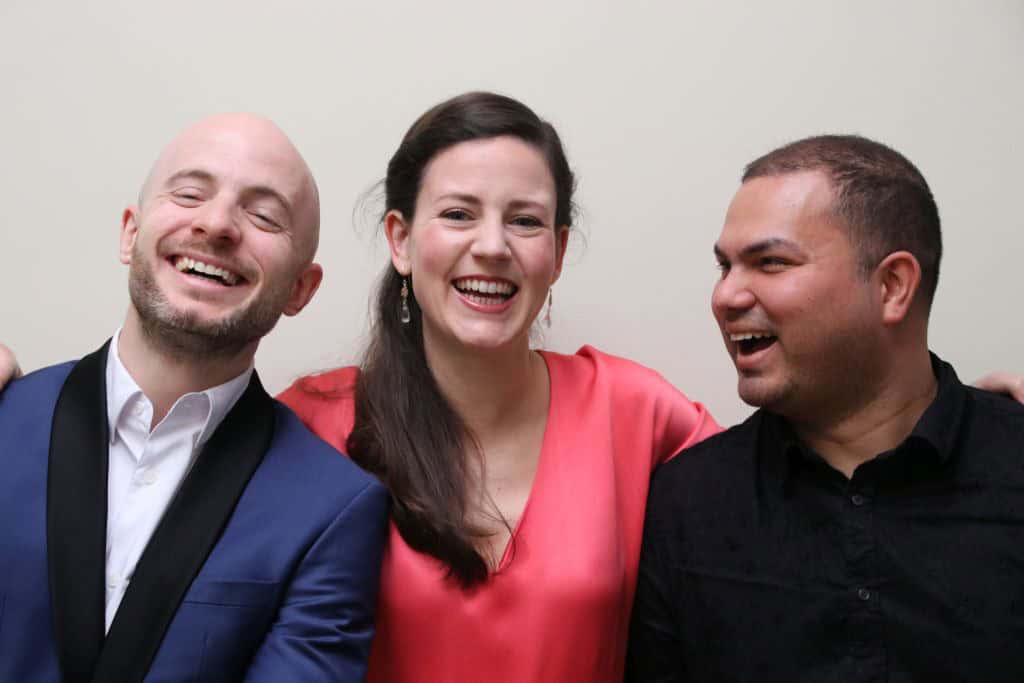
In theater and concert circles, establishing a program and its performers is long-term planning, a year or more even. For just over ninety percent, all the pieces fall into place. But sometimes unexpected things happen and quick adjustments must be made. For 'Ciao, bella Italia' alongside hostess Lissa Meyvis, the Italian soprano and flutist Elisa Soster was announced and at the piano Lester Van Loock. Neither one nor the other could make an appearance.
Lissa Meyvis sang last year at Opera Ballet Vlaanderen the role of Jano in the opera Jenůfa by Leoš Janáček in a production by Robert Carson. There she most likely ran into the phenomenal baritone Alberto Martines and pianist Mario Maiguel. It became a pleasant and overwhelming acquaintance. Both gentlemen were embraced by the audience. It became an international gathering Alberto Martines with Spanish roots and Mario Maiguel with Colombian. The lovely spring weather cheered people up but also in the theater café of the Fakkeltheater these unexpected guests brought warmth and positive vibes with their southern temperament. The choice was not exclusively for Italian music. The setlist was opened up somewhat more broadly. A demanding repertoire but they navigated through it with suppleness and craftsmanship. Singing and singing are two different things. It can be purely technical but leave everyone rather unmoved. It can also be with technique and empathy and that is how these three musicians reached the audience and provided emotion and euphoria.
With 'Cinque, dieci, venti' from le Nozze di Figaro this song recital was opened.
Right at the beginning of the first act of the opera, Figaro is measuring the room where he and his beloved, the maid Suzanna, will live after their wedding. Together with her he sings the beautiful duet about the result of his measurements: 'Cinque, dieci, venti'. The performers add some playful elements and the playful tone is set immediately.
'Come paride vezzoso' from L'elisir d'amore by Geatano Donizetti
Baritone Alberto Martinez takes his turn. What a beautiful, flexible voice and stage performance this man has. In an attentive way he courts Adina. Moving with a gracefulness and the pride of a don.
'In uomini in soldati' In this aria from the opera buffa by Wolfgang Amadeus Mozart, Lissa Meyvis displays her broad palette of vocal colors and performs with her sparkling eyes the cunning wisdom in Despina's aria.
Then follows an instrumental work 'Passione' by Ernesto Tagliaferri played by Mario Maiguel. He is co-répétiteur at Opera Ballet Vlaanderen. He plays a Neapolitan song. A pianist with a strong and forceful touch. The melody was composed by Ernesto Tagliaferri.
From the Italian Songbook comes the duet 'Caro mio ben' by Tommaso Giordani. It is one of the best known of the 'Arie antiche' (old arias) from the eighteenth century. The performers exploit all possibilities.
Because Saturday, March 8 was International Women's Day, several strong female roles from opera literature were highlighted: heroic and passionate women. Female solidarity and strength in these difficult times. Lissa Meyvis performs 'Quando me'n vo'' from the opera La Bohème by Giacomo Puccini. The piano accompaniment provides with refinement an atmospheric framing that sharpens the emotions.
After the intermission, Alberto Martinez steals the show with the world-famous cavatina 'Largo al Factotum'' from the Barbier van Sevilla by Gioachino Rossini. He climbs on tables. Creates salt and pepper with his playful interpretation. A fireball that shoots through the room. He commands the space and the audience with playful joy and swing.
Lissa Meyvis then plays the ingenue in 'Je suis encore tout étourdie'' from the opera Manon by Jules Massenet, one of the great soprano parts assigned to Manon. The sixteen-year-old girl Manon is sent to a convent because the family is concerned about the girl's pleasures. On the way to the convent, however, she manages to escape and flees with her lover.
The pair then perform three songs from Don Giovanni by Mozart: 'Deh vieni alla finestra, 'La ci darem la mano' and 'Vedrai Carino',' including the beautiful seduction duet. Baritone Alberto Martinez can bring all his strengths to bear in the last song with a nice addition on his transverse flute.
With this he also begins the beautiful classic from his native country Spain 'Malageunia Salerosa'' by Pedro Galindo Galarza. With this beautiful song in which a man tells a woman how beautiful she is and how much he would like to be her husband, but understands that she rejects him because he is poor, he completely captivates the audience. The long sustained tones with falsetto are impressive and moving.
Pianist Mario Maiguel then takes his turn with the spicy 'Mazurka de las sombrillas'' by Federico Moreno Torroba.
Lissa Meyvis brings the restrained 'Alfonsina y el mar'' by the late Mercedes Sosa. The song written by Félix Luna and Ariel Ramirez is based on the suicide of feminist poet Alfonsina Storni and became world famous through the version that Mercedes Sosa performed in 1969 on the album Mujeres Argentinas.
Alberto Martinez creates another highlight with the performance of the Spanish classic 'Granada' composed by Mexican composer Agustin Lara, who later moved to Spain. Spanish temperament and attitude and his fantastic voice create goosebump moments.
As a point finale, Lissa Meyvis and Alberto Martinez encore perform the beautiful 'What a Wonderful World' which became world famous through trumpeter and singer Louis Armstrong, with his textured voice.
The audience was pleasantly surprised and enthusiastically delighted with the newly introduced charming and talented artists. This certainly leaves one wanting more…