
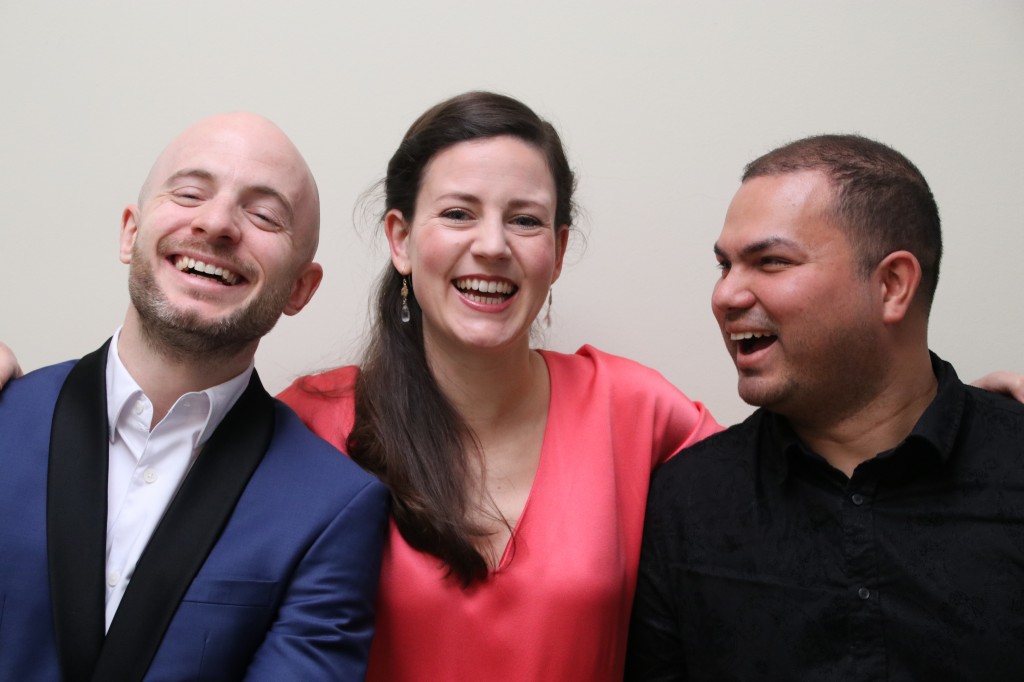
'Ciao & Buenos Dios' the season closer of BeLLISSAma '25'-26 was a smashing success. After the overwhelming success of his first appearance, baritone Alberto Martinez's return was written in the stars. Never change a winning team, at the piano Mario Maiguel. Martinez is a gentleman who is proud of his roots. He has found a second home in Antwerp but with pride and flair he showcases the richness of Spanish musical history.
These three top performers joined forces and provided an immersion in a vibrant, passionate and humorous Spanish and Italian musical bath. Alberto Martinez was given a free hand in the first part to put composers he admires or has a crush on in the spotlight. Songs in an impressive relief of sound and sonority.
Interlace
The whole thing is again interwoven like an artful interlace. Pianist Mario Maiguel opens with work by Isaac Albinez, the beautiful 'Prelude, Suite España', an atmospheric musical reverie full of color variations. Then Lissa Meyvis appears on stage like a full-blooded Spanish beauty in a tight flowery dress, a picture! She fills the space with her beautiful, flexible voice and tessitura, and shortly after Alberto Martinez joins her. Everything interlocks seamlessly. Together they bring an expressive interpretation of 'Jota from Suite canciones' by Manuel de Falla. They skillfully manage to capture all the elements of this work.
Alberto Martinez declares his love for 'zarzuela', a traditional Spanish musical genre in which spoken word, music and dance alternate with each other. In the second half of the seventeenth century, the term was used for comic musical theater pieces, performed for the entertainment of the king in his Palacio de la Zarzuela. He performs 'Ya mis horas felices from La del Soto del Parral' by Reveriano Soutullo & Juan Vert and lets the charm and strength of old songs revive. He is rather a frail man but the decibels he produces are impressive. This composition also contains a beautiful part for the pianist woven in. He then introduces one of his favorites: the influential Spanish composer and conductor from the 19th century Francisco Asenjo Barbieri, especially famous as the founder of modern zarzuela. Lissa opens with 'Cancion de la Paloma' from El barberillo de Lavapiés followed by 'Duet Paloma Lamparilla', a famous Spanish zarzuela. The piece premiered in 1874 and combines cheerful romanticism and political intrigue. A dish after the taste of two expressive performers, challenging, matched against each other. Who can hold a note the longest?! In terms of empathy, they both have a frame of reference from which they can draw experiences.
To give both soloists some rest, pianist Mario Maiguel performs the well-known 'Tango, Suite España' by Isaac Albéniz. Lissa brings a lullaby by Manuel de Falla 'Nana' from Siete canciones. The zarzuela genre is further explored with two songs by Federico Moreno Torroba: a solo part by Alberto. 'Luche la fe' from Louisa Fernanda. He brings the love song with the necessary pathos and in the duet with Lissa 'Mazurca de las Sombrillas', two lovers merge completely into each other: sun or rain, nothing can matter to them. Then it's Lissa's turn again with 'Del cabello mas sutil' by Fernando J. Obradors. A tender, playful and romantic love song in which she fantasizes about braiding a chain from her beloved's hair to bind him to her. Alberto Martinez brings the beautiful 'Granada' by Agustin Lara. His singing and narrative power is immense, causing goosebumps.
The program meanders from classical to popular. The first part is concluded sultrily with the melancholic love ballad 'Bésame mucho', a world-famous Spanish song by Mexican composer Consuela Velasquez. The atmosphere refers to W.W.II. The composer is said to have written the song when her beloved had to leave, which made it a symbol of farewell between two lovers in uncertain times. Lissa shapes the song with words, tones and physical expression.
After the intermission, the Italian repertoire comes into play, beginning with a duet from Le nozze di Figaro by W.A. Mozart 'Crudel perché finora'. A musical thrust between the mighty Count Almaviva and the clever chambermaid Susanna. Comic tension and dynamics assured. The ultimate recipe for a successful comedy. Lissa dives from one emotion to another with the song 'Quando m'en vo' from Puccini's La Bohème. Musetta sings of her beauty to make her ex-boyfriend Marcello jealous. Lissa exposes her flirtatious character without shame. Baritone Alberto then sings 'Ah per sempre, i Puritani' by Vincenzo Bellini. The aria is one of the highlights of the romantic bel canto repertoire. The portrait of a rejected lover. This aria demands enormous vocal control from the performer. In 'O mio babbino caro' by Giacomo Puccini, she breathes lightness and humor. The performer plays her father to be able to marry the prince of her dreams and throws all her charms into the fray. An innocent soul from the audience gets the plea projected on him. Lissa even goes on her knees. She makes the audience smile with the kind of restrained humor she employs and also excels at.
Subsequently two songs from Don Giovanni by W.A. Mozart. Alberto in turn displays all his charms in the intimately seductive song 'Deh vieni alla finestra'. The duet 'La ci darem la mano' is a masterful piece of music in which the charming womanizer Don Giovanni tries to seduce the innocent peasant girl Zerlina. The chemistry sparks between both performers in dynamic musicality. She wants to go with him, then again not, but ultimately she lets herself be swept away. Result: an empty stage! Pianist Mario sits without singers, waits and waits…. and then decides to play something himself. Spielerei of the highest order. It becomes the 'Sonate K27' by Domenico Scarlatti. Lissa Meyvis also has a program in which she explores the repertoire of Charles Aznavour together with Hans Peter Janssens. As a teaser, she brings an Italian translation of one of his hit numbers 'Com'è triste Venezia'.
As the penultimate number and finale, Alberto Martinez brings the house down with the most famous aria from Il barbiere di Siviglia by Gioachino Rossini 'Largo al Factotum'. In terms of articulation it goes incredibly fast. Alberto is completely in his element and lets the audience enjoy his impressive performance and vocal abilities. As a finale the trio performs 'Con te partiro' from The Count of Monte Christo. The song became world-famous in the version by Andrea Bocelli and Sarah Brightman. In this number too, perfect vocal projection and blending of both voices. Both Lissa and Alberto manage to evoke a broad emotional spectrum that offers room for rhetoric, playfulness and emotion. A rich banquet from which you keep eating. 'Con te partiro', couldn't be more symbolic. Farewell to a brilliant season and the hope and expectation of what the new will bring.
The trio received a long standing ovation. The conclusion that imposes itself: this was undeniably a fantastic concert. Artists who have such enthusiasm and pleasure in their craft is blissful to witness.