
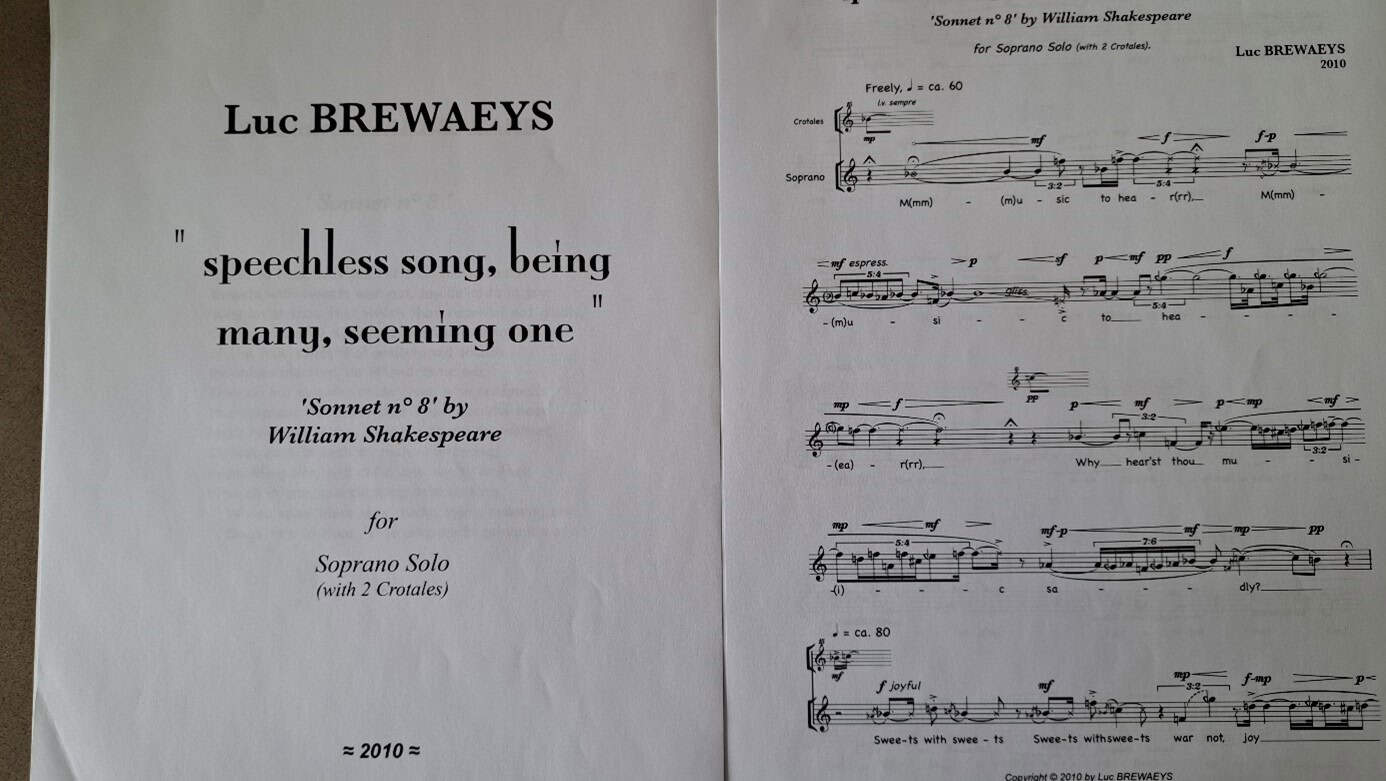
This book about Brewaeys includes a few scores printed in it. A copy of one is still lying in the "music" compartment on my desk. I received it from Katelijne Boon when I was preparing a Journaal item about that sensational 'compulsory piece' he wrote for the semi-final of the Elisabeth vocal competition 2011. It was a commission from the Belgian competition organizers but the international competition jury found it unperformable and scrapped the compulsory work. Wrongly so, because soprano Laure Delcampe gave a memorable performance in BOZAR on March 31, 2011 of "speechless song, being many, seeming one" to the text of Shakespeare's sonnet no. 8.
[video width="1920" height="1080" mp4="https://klassiek-centraal.be/wp-content/uploads/2024/05/2300_20240521141214_hires.mp4"][/video]
It is a story that author Johan Huys also tells at length in this book. And it is a friend who tells it. You notice that on every page of this work. That resonates throughout the numerous testimonies, conversations, citations from interviews and emails about and around the life and work of Brewaeys. It is not really a true biography but a monumental tribute, that it certainly is. A "kaleidoscopic" portrait in 56 very fluently written short chapters.
Joker, whisky lover, who also enjoyed cigars and convivial dining. That is how Johan Huys describes this composer, pianist, conductor and music director. But those were far from his only qualities. Brilliant, he adds, and illustrates that brimming with testimonies from others and himself: from parents and spouse, contemporary composers such as Jonathan Harvey and Annelies Van Parys, from conductors and performers such as Arturo Tamayo and Arne Deforce and mentor André Laporte. Who said of him: "a flamboyant student with phenomenal musical hearing" and who also wanted to teach him "notions of counterpoint," but "all those rules, commandments and prohibitions do not interest him. He had something else to tell." And that was indeed the case.
Once he found spectral music, he destroyed almost everything he had written before. It is the music genre he is characterized by. You get a real insight into, in and behind the scenes of Brewaeys' compositional mind and how it unfolded during his lifetime. That becomes very clear from the interview fragment of Brewaeys with musicologist Maarten Beirens about the different phases of his complicated compositional process. You stand in admiration for the research work the author has done to find all those names and surnames, dates and locations of premieres, performances, residencies, festivals. And analyses of his major works such as his orchestrations of Debussy preludes, his cello piece Black rock unfolding and his "Whisky pieces" (treated in a separate chapter), his symphonies, his only opera L'uomo con fiore in bocca, created at De Munt in 2007. That was also the year of his first cancer treatment and not the last. An exhausting but also stubborn struggle it certainly was, until his death in 2015. Throughout the description of all those works, you come to know, tragically enough, everything about that long road of suffering that Brewaeys traveled. Huys calls his oeuvre "a biography transformed into sound", his true biography. That is why he was always busy with future plans, interrupted by periods of illness, operations, recovery, relapse. Much remained unfinished. He was rational and sober about that, but continued to love and greedily live. As has often been written: he had a special sense of "h(t)umor". He could seek out the ultimate limits in almost everything he did, it says. There are moving passages enough in this book, with fragments from conversations with his wife and family doctor, sometimes shamelessly intimate. Huys quotes Brewaeys about his composition "E pur si muove": "And yet I write music, even though I am sick and will remain sick".
It is remarkable how throughout the entire book names appear of people who motivated Brewaeys. The leitmotif at the front of the book is therefore very aptly chosen. A statement by artist Gerhard Richter: "I have no motive, only motivation".
After reading this extremely fascinating book you realize - perhaps too late - truly, Luc Brewaeys may have been difficult and complex, but he was a brilliant person.
editor's note: Luc Brewaeys added an extra dimension to Klassiek Centraal. Halfway through December 2008, the magazine, run by Koen and Ludwig, received an email. With praise for the initiative and content and with the question of whether he could collaborate, voluntarily. For our young magazine, this was a recognition that surpassed all others. He immediately became the first contributor outside the initiators. Unfortunately, the collaboration did not proceed as Luc and we wished. The ugly cancer, which would also strike Koen, threw a wrench in the collaboration. After 1.5 years of collaboration, we named Luc Honorary Editor during the Five Years Klassiek Centraal celebration at Brussels Town Hall. Luc could not be there. Lucrèce Maeckelberg and the meanwhile also lamented Wim Henderickx brought the certificate to Luc's home. Between the cigars and the whisky, yes indeed. Wim, Koen and Luc are no longer with us, but they do not let us go. Each in their own way they are an inspiration to continue. Yes Luc, do not worry, we will keep going, partly thanks to you!