
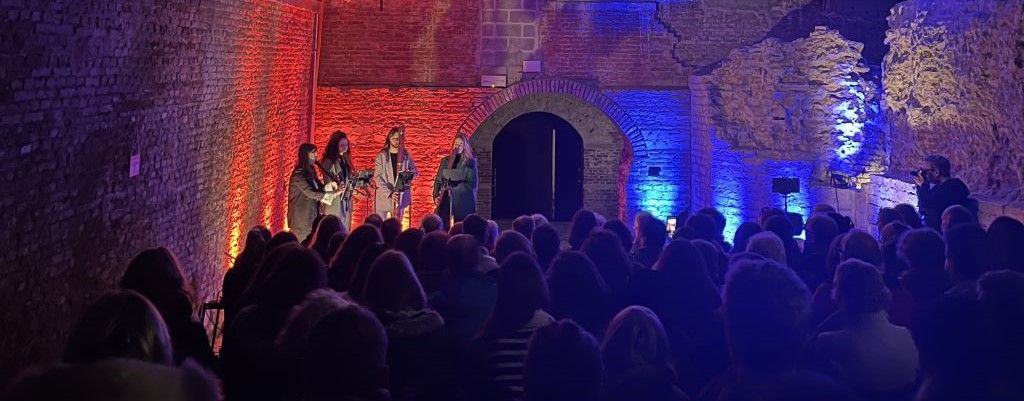
Beneath Koningsplein, in the remains of the former Coudenbergpaleis in Brussels, the final concert of the 'Coudenberg Sound Box Fest' series took place last Sunday. Throughout last month, audiences could enjoy weekly duo concerts underground themed around consort music.
After descending the stairs, visitors immediately felt the ominous atmosphere of the dark underground passages. A small stage had been set up and chairs were arranged in the old 'Isabellastraat'. Together with appropriate lighting, the audience found itself in a cozy setting among the ruins of the former palace.
Artistic director Matteo Gemolo welcomed the audience and enthusiastically explained the festival's theme of consort music. A term first used in 16th and 17th century England to denote an instrumental ensemble. Either composed of the same instrument family (whole consort) or from different families (broken consort).
For this evening, Gemolo had selected the Ictus duo and Delle Donne Consort. The Ictus duo combined viola da gamba and cello, a contradiction of old and new, through which they blended Baroque and contemporary influences. The recorder ensemble Delle Donne Consort also sought innovative approaches to old musical traditions, through contemporary interpretations of themes from early music.
The Ictus duo opened with Eva Reiter on viola da gamba and Geert de Bièvre on cello. Their program was structured around works by Monsieur de Sainte Colombe. He was one of the most gifted viola da gamba players and is credited, among other things, with adding a seventh string to the instrument, thereby expanding its range. Around his compositions, the Ictus duo performed contemporary works and original compositions, whose modern sounds flowed appropriately around the 16th century works.
The underground conditions presented a challenge; because of the cold and damp environment, the musicians were forced to tune regularly. Eva Reiter's own work was at times very fragile, with sweeping, tapping and squeaking sounds. This flowed organically into the works of Monsieur de Sainte Colombe. I myself lost track of the program's sequence and was quite confused whether we were listening to 16th century music or contemporary compositions. That may have been the intention. Background sounds from the city of Brussels, such as the rumbling metro or a passing ambulance, blended into the music. As a listener, you only realized later, 'oh wait, these are sounds from outside'.
The Delle Donne Consort presented a program with music from the 16th century Neapolitan villanella genre. A popular genre at the time, with simple, easily understood texts about pastoral themes. The originally vocal music was adapted by the Delle Donne Consort for recorder ensemble. With works by Adriaan Willaert, Cipriano de Rore and Orlando di Lasso, the recorder players told the story of a 'toxic polyphonic love tragedy' between two people. All themes passed by, from attraction to severe rejection, and the various emotions that come with it.
The ensemble had a wonderful stage presence; enthusiasm radiated from them. It was also beautiful to see how the recorder players were attuned to each other. In their playing together, they frequently made eye contact or sought contact through body movements or head gestures. They also reinforced the musical themes by adding small theatrical elements to their performance. With this, they drew the audience into the story and truly stole the show.
Both ensembles gave a brief introduction before their performance. Some additional background information about the instruments and selected works in between would have been interesting. As a nice added bonus, there was the opportunity during the interval, with a warm drink in hand, to explore the underground palace. All in all, an impressive evening in which the audience was drawn into 16th century atmospheres with a modern twist!